
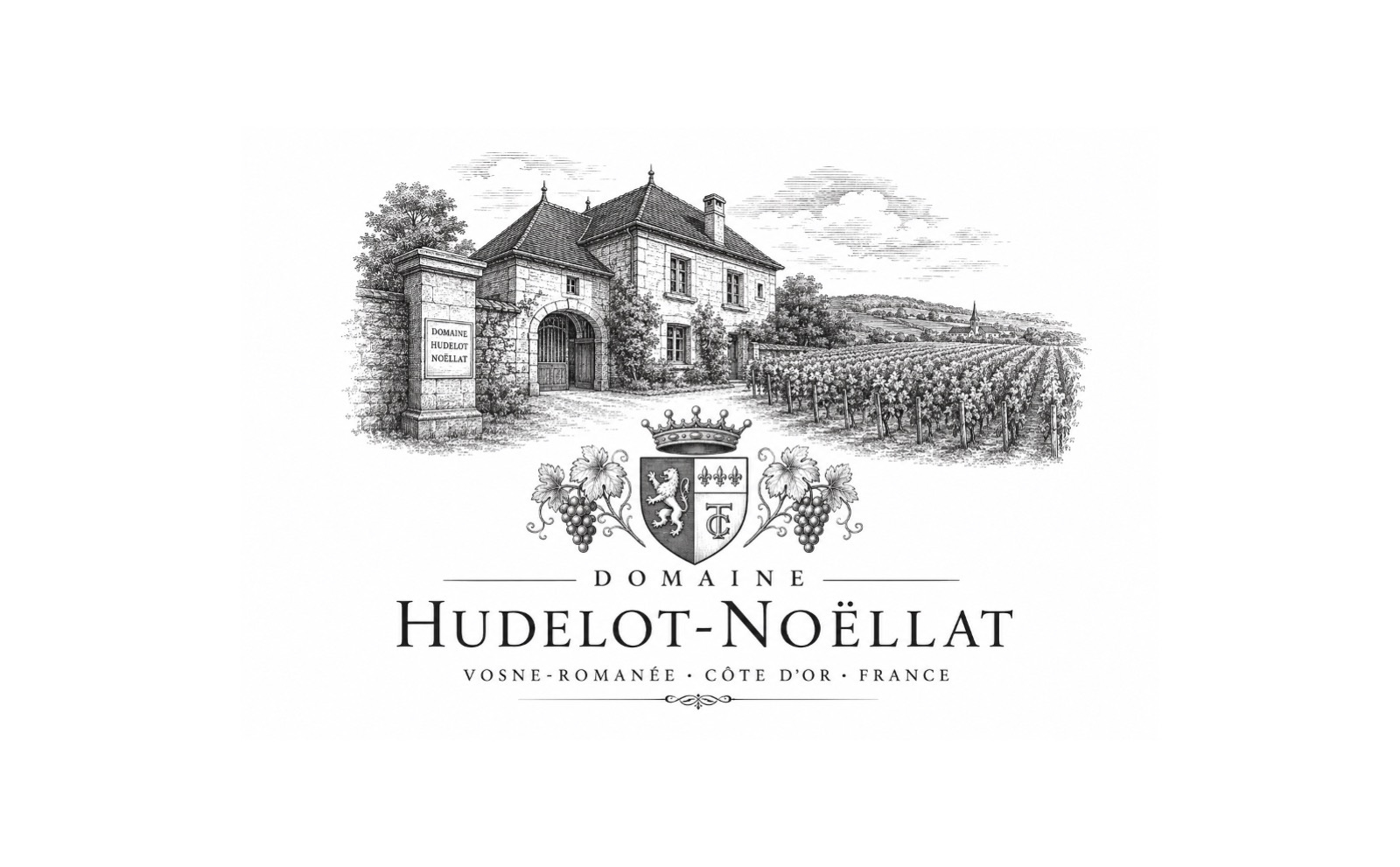
Domaine Hudelot-Noëllat
A leading Côte de Nuits domaine with exceptional holdings in Richebourg, Romanée-Saint-Vivant, and Vosne-Romanée's finest premier crus.
Collector Thesis and Historical Foundation
Collector and investment thesis
Domaine Hudelot-Noëllat is best regarded as an elite connoisseur’s collectible with credible investment-grade characteristics at grand-cru level, rather than a universally liquid blue-chip comparable to the most heavily traded Bordeaux first growths or the most expensive Burgundy trophy estates. Its strongest assets are a small holding of exceptionally old vines in Romanée-Saint-Vivant, a scarce parcel in Richebourg, highly regarded upper-sector Clos de Vougeot holdings, and a deep premier-cru portfolio centered on Vosne-Romanée. The domaine combines physical scarcity, prestigious appellations, consistently strong modern criticism, and growing international recognition under Charles van Canneyt. Its constraints are equally important: allocations are extremely tight, public production data are incomplete, transaction depth is limited, and no current public estate-specific Liv-ex performance series permits a rigorous calculation of long-term return, volatility, or turnover.
The domaine therefore cannot be classified simply as a “blue chip.” Romanée-Saint-Vivant and Richebourg merit consideration as serious, long-duration cellar assets, particularly in highly rated vintages and pristine original packaging. Les Malconsorts, Les Suchots, and Les Beaumonts or Beaux Monts are high-order Burgundy collectibles with meaningful scarcity but thinner resale markets. Clos de Vougeot is often the most commercially accessible grand cru and can offer particularly strong drinking value, while the village wines are principally prestige drinking wines rather than financial instruments. This hierarchy is visible in current merchant offers: one August 2026 snapshot listed 2023 Romanée-Saint-Vivant at £4,200 per six bottles in bond, 2023 Clos de Vougeot at £1,140 per six, 2023 Beaux Monts at £1,260 per six, and 2022 Suchots at £1,140 per six; 2024 Richebourg was offered at £2,250 per three bottles. These are asking prices, not verified transaction values.
Documented history
The estate states that Alain Hudelot founded Domaine Hudelot-Noëllat in 1962. It now reports 10 hectares distributed across four villages and 15 appellations. The official account does not publish a detailed year-by-year history of every inheritance, purchase, lease, or family transfer, so more specific narratives about the exact dates on which Odile Noëllat’s holdings entered the domaine should not be regarded as fully settled. Reliable importer profiles agree that the Noëllat family connection helped form the estate’s exceptional Vosne-Romanée holdings, but the domaine’s own public record confirms only the 1962 foundation and present scale.
The decisive modern transition came in 2008, when Alain’s grandson Charles van Canneyt assumed responsibility after completing formal wine studies at Dijon University. Alain had led the estate through the 2007 vintage; Vincent Meunier, who had worked alongside him from 2005, remained at the domaine, preserving technical continuity through the generational transition. This succession is central to the domaine’s present-day collectibility because it created a relatively clear stylistic and reputational inflection point: bottles from the Charles van Canneyt era increasingly attract collectors seeking precision, purity, controlled extraction, and transparent vineyard differentiation.
Domaine Hudelot-Noëllat has no Bordeaux-style official estate classification. Burgundy’s hierarchy attaches principally to legally delimited appellations and climats rather than to a permanent producer ranking. Its formal prestige therefore derives from its ownership of vines in grand-cru, premier-cru, village, and regional appellations—especially Richebourg, Romanée-Saint-Vivant, and Clos de Vougeot—not from an institutional classification of the producer itself. The Vosne-Romanée sector contains six grands crus, and the official regional documentation places its vineyards primarily between approximately 250 and 310 meters, generally facing east or slightly southeast.
Evolution of reputation
Hudelot-Noëllat was already a respected Côte de Nuits name under Alain, but the critical and commercial evidence indicates that its reputation accelerated under Charles. The domaine appeared at number 49 in the 2019 Liv-ex Power 100, with a reported average trade price of £1,616, 30 distinct wines traded, and 8.6% price performance during the report’s measurement period. That position is a historical snapshot, not a current ranking, but it demonstrates that the estate had progressed beyond specialist recognition into the internationally traded fine-wine universe by the end of the 2010s.
Analytical interpretation
For buyers, the most meaningful historical distinction is not “old versus new label,” but pre- versus post-2008 stewardship, assessed alongside the individual vintage. Mature Alain-era bottles can be superb and can provide rare insight into the domaine’s long-term aging capacity, but they demand more rigorous provenance analysis. Charles-era wines offer greater consistency of critical coverage, clearer stylistic identity, and more standardized packaging for the modern market. Neither era should be purchased solely on the basis of the domaine name; parcel, vintage, condition, and acquisition history remain decisive.
Ownership, Leadership, Terroir, and Vineyard Assets
Ownership and leadership
Domaine Hudelot-Noëllat remains a family estate managed by Charles van Canneyt, Alain Hudelot’s grandson. Public sources continue to identify Vincent Meunier as a longstanding technical presence. Charles and his wife, Anne-Sophie, have also acquired Domaine des Chézeaux in Gevrey-Chambertin as a separate project. Collectors should not conflate wines or vineyard assets from that venture with Domaine Hudelot-Noëllat: the acquisition does not mean that Chézeaux parcels have automatically entered the Hudelot-Noëllat portfolio.
The domaine’s strategic direction has been evolutionary rather than disruptive. The domaine’s official language emphasizes revealing the identity of each climat, working close to nature, and pursuing depth, purity, and finesse through restrained intervention. Merchant and importer reports describe investments such as a destemmer capable of feeding uncrushed berries into fermentation vessels, alongside less aggressive extraction and controlled oak. The resulting market view is that Charles has sharpened the wines’ definition without severing continuity with the fine, fragrant style associated with Alain.
Vineyard scale and concentration
The estate’s stated 10 hectares are spread over four villages and 15 appellations. According to a detailed importer inventory, the principal holdings include 0.28 hectare in Richebourg, planted mainly in 1950; 0.48 hectare in Romanée-Saint-Vivant, with vines dating principally from 1920; and 0.69 hectare in Clos de Vougeot, planted mainly in 1950. The domaine also holds 0.45 hectare in Vosne-Romanée Premier Cru Les Suchots and 0.32 hectare in Les Beaumonts, both reportedly planted in 1920, together with 0.14 hectare in Les Malconsorts, planted principally in 1950. Beyond Vosne-Romanée, the reported holdings include 0.68 hectare in Nuits-Saint-Georges Premier Cru Les Murgers, planted mainly in 1985, and 0.53 hectare in Vougeot Premier Cru Les Petits Vougeots, planted principally in 1970. These figures offer a useful indication of the estate’s vineyard concentration and vine age, although they are not a substitute for a current cadastral statement issued directly by the domaine.
The same inventory reports additional Chambolle-Musigny, Vosne-Romanée, and Nuits-Saint-Georges village holdings. These figures should be treated as a reliable importer’s published record, not as a guarantee that every surface measurement remains unchanged in 2026.
Romanée-Saint-Vivant is the domaine’s most distinctive viticultural asset. Its reported 1920 planting provides a genuinely old-vine foundation, while the parcel’s approximately half-hectare scale is large enough to establish a recognizable house expression, yet still exceptionally scarce in global terms. For context, the entire Romanée-Saint-Vivant appellation covers roughly 9.24 hectares and produces an official long-term average of about 38,700 bottles across all proprietors; Richebourg covers about 8.03 hectares and averages approximately 33,600 bottles. Hudelot-Noëllat therefore controls only a fraction of each climat, but a fraction of exceptionally prestigious land.
Richebourg is the domaine’s most powerful and structurally imposing grand cru. The holding is smaller than Romanée-Saint-Vivant at a reported 0.28 hectare, helping to explain the wine’s acute allocation pressure. A 2024 merchant listing reported that only three barrels were made in that vintage. Barrel counts vary with yield and vintage, but the example provides a practical measure of scarcity: at normal barrel volume, availability is counted in hundreds rather than thousands of bottles before losses, formats, and allocations are considered.
Clos de Vougeot occupies a distinct position for collectors. An importer reports that Alain sold a lower-slope parcel near the former RN74, reducing production by roughly 40%, while retaining two parcels close to the château and neighboring a Domaine Leroy holding. The significance extends beyond reduced quantity: Clos de Vougeot is a large and heterogeneous grand cru, so parcel position can materially affect style and reputation. Hudelot-Noëllat’s retained upper-sector material underpins the wine’s standing above many generic assumptions about the appellation.
The premier-cru holdings are central to the domaine’s collector identity. Suchots lies among the most sought-after Vosne-Romanée premiers crus and is supported here by old vines reportedly planted in 1920. Malconsorts is physically tiny at a reported 0.14 hectare and appears regularly in magnum in the secondary market, making it a format-driven collectible. Beaumonts or Beaux Monts offers another prestigious Vosne expression, while Nuits-Saint-Georges Les Murgers broadens the range toward a more structured, mineral profile. Their value lies not in imitating grand cru, but in providing highly differentiated climat expression at lower—though still substantial—entry prices.
Terroir and aging relevance
Official regional descriptions of Vosne-Romanée emphasize varied combinations of limestone, marl, and clay across east- and southeast-facing slopes. These differences help explain why Hudelot-Noëllat’s Richebourg tends toward breadth, mineral power, and deep structure, while Romanée-Saint-Vivant is repeatedly described by critics and importers as more perfumed, satin-textured, and refined. This contrast is more than stylistic branding; it is reinforced by the domaine’s separate vinification of individual climats and by repeated critical observations across vintages.
Viticulture, Winemaking, and Portfolio
Viticulture
The domaine states that it works as closely as possible to nature, maintains soils, observes the vineyard environment closely, and follows individual vines meticulously through the growing season. It does not, however, publicly claim certified organic or biodynamic status on the material reviewed for this profile. Berry Bros. & Rudd describes the vineyards as managed under lutte raisonnée, or reasoned intervention. Claims elsewhere that the estate is unequivocally “fully organic” therefore warrant caution unless supported by a current certification or explicit estate statement.
Importer accounts describe sorting both in the vineyard and again at the winery. This is particularly relevant in Burgundy, where small parcels and variable flowering, hail, frost, or disease pressure can make fruit selection central to quality. For collectors, the implication is positive: rigorous sorting can protect the upper wines in difficult years, although it cannot eliminate vintage variation or compensate for severely reduced yields.
Public information on yields, pruning systems, canopy parameters, cover-crop regimes, and climate-adaptation trials remains limited. No reliable estate-issued annual technical sheets providing parcel-level yields were located. Consequently, claims that the domaine follows a specific regenerative program, uses exclusively massal selection, or applies fixed yield ceilings should not be made without further primary documentation. For investment analysis, this limited disclosure is not necessarily a quality concern—many family domaines publish little technical data—but it limits quantitative comparison with more transparent estates.
Vinification
The domaine characterizes its winemaking as classical and minimally interventionist. Fermentation relies on indigenous yeasts; the wines undergo approximately three weeks of cuvaison and are then raised in the cellar for around 18 months. The stated objectives are depth, purity, and finesse rather than obvious extraction or cellar signature.
Third-party technical accounts add that fruit is sorted before entering enamel-lined concrete tanks and that a modern destemmer can transfer berries without crushing them. This approach can preserve whole berries, moderate extraction, and encourage a gradual release of aroma and tannin. Reports also indicate predominantly Allier oak, supplemented by Vosges and local Cîteaux sources. Berry Bros. & Rudd has cited approximately 20% new oak for village wines and as much as 50–60% for grands crus, but the estate itself does not publish a fixed contemporary oak schedule; these percentages should therefore be treated as reported practice, potentially variable by vintage and cuvée.
The stem policy is another area where public accounts differ. Flint Wines describes the modern range as fully destemmed, whereas Pearl of Burgundy reports that Charles may retain up to 20% stems when the vintage and appellation can support the additional tannin. The official site does not specify a fixed whole-cluster percentage. The most responsible conclusion is that stem use has either evolved or is applied selectively; collectors should not assume one unchanging recipe across every Charles van Canneyt vintage.
Portfolio and collectibility hierarchy
The domaine reports 15 appellations, not a single flagship “grand vin.” Its structure is Burgundian: each climat is a distinct wine, with collectibility rising according to vineyard rank, vine age, parcel quality, scarcity, and critical performance.
Richebourg and Romanée-Saint-Vivant sit at the apex. Richebourg is typically the more muscular, backward, and mineral wine, while Romanée-Saint-Vivant offers finer perfume and a more satin-like texture without sacrificing depth. Both are credible long-term cellar assets. Richebourg’s smaller holding and very low barrel count can make it more difficult to secure; Romanée-Saint-Vivant often has equally intense collector demand because of its old vines and the appellation’s global prestige.
Clos de Vougeot is the third grand cru and usually sits substantially below the two Vosne grands crus in market price. That discount reflects both the broader market’s view of the appellation’s variability and the greater prestige of Richebourg and Romanée-Saint-Vivant. For collectors focused on drinking rather than label hierarchy, Hudelot-Noëllat’s upper-sector parcel history makes Clos de Vougeot one of the most rational entry points into the domaine’s grand-cru range.
Among premiers crus, Les Malconsorts is the trophy specialist’s choice because of its tiny reported holding, proximity in prestige to grand-cru territory, and unusual format scarcity. Les Suchots may offer the strongest combination of old-vine credentials, Vosne perfume, market recognition, and relative accessibility. Les Beaumonts or Beaux Monts tends toward elegance and mineral lift, while Les Murgers supplies a firmer Nuits-Saint-Georges counterpoint. Chambolle-Musigny Les Charmes and Petits Vougeots appeal more strongly to Burgundy specialists than to broad financial buyers.
The village and regional wines—including Vosne-Romanée, Chambolle-Musigny, Nuits-Saint-Georges, and Bourgogne-level bottlings—benefit from the domaine’s reputation and often sell under allocation. They are valuable for understanding the house style and for building a drinking cellar, but their lower absolute scarcity-adjusted value and higher transaction costs make them less suitable as stand-alone investments. A small white-wine component, including Meursault Clos des Écoles in recent merchant and critic records, sits outside the estate’s central collector thesis, which remains Côte de Nuits Pinot Noir.
No authoritative current annual production total was found that reconciles all public estimates. Published figures vary materially, likely because of vintage yields, exclusions of certain bottlings, and differences between theoretical and bottled production. Exact estate-wide bottle counts should therefore not be used in an investment model without confirmation from the domaine.
House Style, Vintage Performance, and Cellar Strategy
House style
Hudelot-Noëllat’s modern signature is fine-boned without being slight: pure red and dark fruit, floral and exotic-spice detail, clear mineral definition, fresh acidity, finely textured tannins, and oak that usually recedes behind the climat. The wines do not pursue maximum density for its own sake. Their authority derives from persistence, aromatic layering, and the ability to combine concentration with a relatively weightless palate impression. The official emphasis on depth, purity, and finesse is consistent with repeated descriptions from Vinous, Wine Advocate, Burghound, Inside Burgundy, and the domaine’s importers.
Richebourg generally carries the greatest dry extract, breadth, and tannic reserve. Romanée-Saint-Vivant is more overtly perfumed and silky, but the best vintages possess enough structural depth to age for several decades. Suchots tends to be generous and aromatic; Malconsorts is darker, more intense, and more forceful; Beaumonts offers lift and finesse; Les Murgers leans toward Nuits-Saint-Georges firmness. Clos de Vougeot occupies the middle ground, combining volume and earthier structure with a more approachable market price.
Vintage strategy
Vintage declarations in Burgundy are less uniform than in Bordeaux, and estate performance must be assessed wine by wine. For Hudelot-Noëllat, the most persuasive long-term targets of the recent era are 2016, 2018, 2019, 2020, and 2022, with 2015 also attractive where provenance and price are favorable. The 2023s have received encouraging early commentary, while 2024 is exceptionally scarce and must be judged from preliminary barrel assessments rather than mature bottle performance.
The 2015 vintage combines strong market recognition with sufficient structure for long aging. Its commercial standing is illustrated by Sotheby’s 2026 estimate of $4,000–$6,000 for six bottles of Hudelot-Noëllat Richebourg 2015, compared with $900–$1,200 for six Clos de Vougeot 2015. The realized prices were not publicly visible, so these figures demonstrate auction-house valuation and hierarchy, not actual sale performance. For collectors already holding pristine 2015 grand cru, the appropriate stance is generally to hold, with periodic condition review rather than early consumption.
Romanée-Saint-Vivant is particularly convincing in 2016. William Kelley awarded it 96 points in Wine Advocate in December 2019, emphasizing its layered depth, refined tannin, and lively acidity; Stephen Tanzer rated it 93–96 in Vinous in January 2018, noting exceptional concentration and a firm mineral finish. Sotheby’s estimated six bottles at $3,500–$4,200 in a March 2026 auction, again without a publicly displayed result. This combination of critical strength, classical structure, and established auction recognition makes 2016 Romanée-Saint-Vivant one of the domaine’s most balanced buy-and-hold candidates.
The 2018 vintage produced a more opulent style, but the best wines retain aging structure. Neal Martin’s 2022 blind reassessment of the 2018 Romanée-Saint-Vivant yielded 97 points in Vinous and a drinking window of 2028–2060. William Kelley had rated the same wine 96 in Wine Advocate in December 2019. For investors, the long published drinking window is supportive, but 2018 should be bought selectively: warmer-vintage richness can encourage early drinking, reducing future stock, yet market pricing must still leave room for transaction and storage costs.
The 2019 vintage is a compelling choice for the cellar, particularly for Richebourg. Burghound’s January 2021 barrel review awarded 94–96 points and advised drinking from 2036 onward, emphasizing power, dry extract, minerality, and backward structure. Charles van Canneyt has also cited 2019 as an internal benchmark when discussing later vintages. The collector proposition is long-term aging rather than immediate gratification: well-stored Richebourg should remain in professional storage, while village and selected premier-cru wines can be approached earlier.
Within the available evidence, 2020 represents the clearest modern critical high point. William Kelley rated Richebourg 96–98 in Wine Advocate in January 2022 and suggested it might become the finest of the domaine’s 2018–2020 sequence. Neal Martin scored Romanée-Saint-Vivant 96–98 in Vinous in December 2021, highlighting harmony, complexity, satin-like tannin, mineral definition, and exceptional purity. These wines combine a highly regarded vintage, top-end scores, and severe scarcity: for buyers with long horizons, 2020 Richebourg and Romanée-Saint-Vivant are core targets, although acquisition price discipline is essential.
The 2021 vintage demands greater selectivity. Regional conditions produced vivid aromatics, freshness, and lower alcohol in many wines, but the vintage was affected by frost, disease pressure, reduced yields, and less consistent structural depth than stronger surrounding years. Hudelot-Noëllat’s careful sorting and restrained style may suit the year, yet its strongest use case is generally connoisseur drinking and medium-term cellaring rather than aggressive financial accumulation. Grand cru should be bought only at a meaningful discount to 2019, 2020, or 2022 after checking critic-specific assessments and provenance.
The 2022 vintage is also a priority. Jasper Morris MW awarded the Richebourg 96–98+ in Inside Burgundy in November 2023, with a recommended 2035–2045 window, while William Kelley rated it 95–97 in Wine Advocate in January 2024. Their assessments converge on perfume, breadth, layered fruit, substantial but integrated tannin, and exceptional completeness. The vintage offers the concentration collectors expect from a great year without sacrificing the domaine’s precision. Richebourg is the prime investment candidate; Romanée-Saint-Vivant and the top Vosne premiers crus are logical cellar-building alternatives.
The 2023 vintage remains an early-stage opportunity. Specialist commentary published in February 2025 described the range as a significant step forward, with well-judged phenolic ripeness and extraction. Because fewer final, bottle-aged critical assessments and transaction histories are publicly available, 2023 should be treated as a selective new-release buy, not as an established outperformer. The current asking-price hierarchy—approximately £700 per bottle in bond for Romanée-Saint-Vivant versus £190 for Clos de Vougeot and £210 for Beaux Monts in six-bottle cases—shows how sharply the market distinguishes the top grand cru.
The 2024 vintage is exceptionally scarce. Neal Martin awarded the Richebourg 94–96 in January 2026 and proposed a 2030–2050 window; the same listing reported only three barrels produced. The score is excellent, though not record-setting, and it is based on a young wine, but scarcity may sustain a high release price. Collectors should avoid paying a scarcity premium unsupported by the critical and vintage evidence: 2024 is a trophy allocation opportunity, not automatically a better investment than 2020 or 2022.
Cellar strategy
For grands crus from 2015, 2016, 2018, 2019, 2020, and 2022, a 15–30-year horizon from the vintage is reasonable, with the strongest Richebourg and Romanée-Saint-Vivant bottles potentially exceeding it. Top premiers crus generally offer their most attractive balance after roughly eight to 20 years, while village wines can provide pleasure from five to 12 years, depending on vintage. These are analytical ranges, not estate-issued guarantees; individual critic windows, bottle condition, format, and storage history should prevail. The published 2028–2060 window for 2018 Romanée-Saint-Vivant and 2036-plus guidance for 2019 Richebourg demonstrate the upper end of the domaine’s expected longevity.
Magnums are especially attractive for Malconsorts, Romanée-Saint-Vivant, and other wines intended for extended aging. They offer slower maturation and exceptional scarcity, but their irregular market depth makes pricing less transparent. Double magnums and larger formats should be purchased only with excellent documentation; no robust public dataset was located showing consistent format premiums for Hudelot-Noëllat. For investment holdings, original six- or three-bottle cases may be easier to value and resell than isolated bottles, while magnums are best treated as long-term collector assets.
Critical Reception and Reputation
Domaine Hudelot-Noëllat has earned a remarkably consistent critical record across leading international reviewers. Rather than relying on the endorsement of a single publication, the estate has earned sustained acclaim from Wine Advocate, Vinous, Burghound, and Inside Burgundy, with scores for its flagship grands crus routinely reaching the mid-to-high 90s. Equally important is the broad consensus on the wines’ stylistic identity: critics repeatedly highlight their purity of fruit, aromatic precision, mineral definition, refined tannin structure, and exceptional persistence, while consistently distinguishing the greater power and depth of Richebourg from the more perfumed, elegant expression of Romanée-Saint-Vivant. This breadth of critical support reinforces the domaine’s reputation among collectors by reducing dependence on any single critic or scoring system.
Published reviews reinforce this pattern across multiple vintages. William Kelley (Wine Advocate, January 2022) awarded Richebourg 2020 96–98 points, while Neal Martin (Vinous, December 2021) rated Romanée-Saint-Vivant 2020 96–98 points. Allen Meadows (Burghound, January 2021) scored Richebourg 2019 94–96 points, recommending cellaring until at least 2036, whereas Neal Martin later awarded Romanée-Saint-Vivant 2018 97 points (Vinous, November 2022) with a projected drinking window of 2028–2060. The celebrated 2016 Romanée-Saint-Vivant received 96 points from William Kelley (Wine Advocate, December 2019), while Stephen Tanzer (Vinous, January 2018) assessed the wine at 93–96 points from barrel. More recent vintages have maintained the same standard: Jasper Morris MW (Inside Burgundy, November 2023) rated Richebourg 2022 96–98+ points, recommending a drinking window of 2035–2045, while William Kelley (Wine Advocate, January 2024) scored the same wine 95–97 points. Most recently, Neal Martin (January 2026) awarded Richebourg 2024 94–96 points, anticipating an optimal drinking window between 2030 and 2050.
Historical versus current perception
The critical record supports a genuine reputational upgrade, not a sudden invention of quality. Alain-era wines had established the domaine’s seriousness; Charles’s tenure has produced greater consistency of acclaim and clearer market attention. The strongest evidence is the recurrence of top scores across different vintages and critics, combined with the 2019 Liv-ex Power 100 appearance. This matters more than an isolated 98-point review because it connects aesthetic reputation to observable market participation.
Critic influence is greatest at release and for the two leading grands crus. A score such as 96–98 or 96–98+ can intensify allocation demand when only a few barrels exist. For mature bottles, the relationship is less direct: provenance, rarity, format, and the general standing of the vintage can outweigh a one- or two-point difference. Liv-ex identifies critic scores, vintage, scarcity, producer popularity, classification, and condition among the principal determinants of fine-wine prices, which is a useful framework for interpreting Hudelot-Noëllat rather than attributing every price movement to reviews alone.
No evidence was found of any formal reclassification, critic-led “upgrade,” or institutional promotion of the estate. The domaine’s rise has been reputational and commercial: stronger winemaking consistency, enthusiastic reviews, allocation pressure, and wider secondary-market visibility. Collectors should therefore focus on individual wines and vintages rather than treating the entire label as uniformly equivalent.
Market Position, Investment Perspective, and Comparative Context
Historical exchange evidence
Hudelot-Noëllat’s 2019 Liv-ex Power 100 ranking of 49 provides the strongest publicly available evidence of meaningful international trading breadth. The report recorded an average trade price of £1,616, an 8.6% price-performance measure, and 30 distinct wines traded. At the same time, Liv-ex warned that Burgundy liquidity was generally lower than for Bordeaux, Champagne, or Italy, with small quantities and occasional single-bottle availability. Its appearance in the ranking demonstrates market relevance; it does not imply Bordeaux-like depth or ease of exit.
The 2019 Liv-ex Classification, which grouped wines according to average trade prices per 12-bottle case and required multiple vintages to have traded, placed Hudelot-Noëllat Vosne-Romanée Les Suchots at £1,617 per 12 and Clos de Vougeot at £1,379. In the same historic table, Georges Roumier Chambolle-Musigny appeared at £1,627, Comte Georges de Vogüé Chambolle-Musigny at £1,666, Sassicaia at £1,527, and Cristal at £1,729. This does not imply equivalence in quality or liquidity, but it demonstrates Hudelot-Noëllat’s market-price position within a global field of recognized fine wines at that time.
A separate Liv-ex Burgundy report observed that release prices for sought-after village Burgundy—including Hudelot-Noëllat and peers—had nearly doubled over the preceding decade, while cautioning that rapid inflation at lower classification levels could undermine value and that Burgundy liquidity remained problematic. This point is especially relevant to the domaine’s village wines: strong allocation demand may create prestige pricing without guaranteeing an efficient resale market.
Current regional context
As of August 2026, the Liv-ex Burgundy 150 stood at 613.4, up 1.1% year to date and 2.2% over one year, but down 8.9% over two years and up only 3.5% over five. The broader Fine Wine 1000 was also down 8.9% over two years. Liv-ex characterized the first quarter of 2026 as broadly stable, with trade value and volume above the 2025 average but below the first quarter of 2025. These data describe a market seeking stability after a correction, not an uninterrupted appreciation cycle. The Burgundy 150 does not contain a public Hudelot-Noëllat sub-index, so it should be used only as regional context.
Current offer-market positioning
Merchant asking prices reveal a steep internal hierarchy. In one contemporaneous UK list, 2024 Richebourg was £750 per bottle in bond in a three-bottle case; 2023 Romanée-Saint-Vivant was £700 per bottle in a six-bottle case; 2023 Beaux Monts was £210; 2022 Suchots and 2023 Clos de Vougeot were each £190. Malconsorts magnums from 2018–2023 were offered between £650 and £750 in bond. These figures are useful observations of replacement cost, but they include mixed vintages and stock conditions and should not be interpreted as completed trades or as a return series.
A separate current merchant listed the 2018 Romanée-Saint-Vivant at £3,539 per six bottles in bond and £3,793 per three magnums, illustrating both the value of mature stock and the substantial capital required to acquire larger formats. Another merchant listed the 2016 Romanée-Saint-Vivant at £1,800 per three bottles in bond. Differences among these offers may reflect vintage, format, merchant margin, provenance, tax status, and stock availability; they cannot be treated as direct evidence of appreciation without original release prices and confirmed transactions.
Auction evidence
Public auction data confirm international saleability, but remain too sparse for a statistically robust performance index. Sotheby’s estimated six bottles of 2015 Richebourg at $4,000–$6,000, six of 2016 Romanée-Saint-Vivant at $3,500–$4,200, and six of 2015 Clos de Vougeot at $900–$1,200. The results were restricted to logged-in users and therefore cannot be cited as realized prices. At iDealwine, a single bottle of 2001 Romanée-Saint-Vivant with a slightly marked label and a one-to-two-centimeter level sold for €550 hammer, or €691.90 including commission. This confirms a functioning market for mature bottles but also shows why bottle condition and buyer’s premium must be integrated into comparisons.
Liquidity assessment
Richebourg and Romanée-Saint-Vivant have the strongest global recognition and should be the easiest wines in the portfolio to sell with specialist merchants or major auction houses. Even so, “easiest” is relative: tiny production means few comparable trades, and high unit prices narrow the buyer pool. Clos de Vougeot and the leading premiers crus have lower entry prices but less universal name recognition. Village wines may trade frequently through merchants but seldom offer sufficient net appreciation to overcome storage, commission, tax, and bid-offer costs.
No current public data were located for Hudelot-Noëllat’s estate-specific annual turnover, bid-to-offer ratio, average days to sale, price volatility, or compound annual return. Any precise claim that the domaine has outperformed named peers over five or ten years would therefore be unsupported. Historical Liv-ex inclusion, auction estimates, and current merchant offers establish market presence; they do not permit a full risk-adjusted performance calculation.
Comparative position
Stylistically, Hudelot-Noëllat sits among the precision-focused modern classicists of Vosne-Romanée: less dependent on overt extraction or oak than some more muscular interpretations, but capable of considerable depth. Commercially, it sits below Domaine de la Romanée-Conti and Leroy’s trophy universe while competing for allocations with highly regarded estates such as Méo-Camuzet, Jean Grivot, Sylvain Cathiard, and Anne Gros. Current merchant listings illustrate the scale of the trophy gap: a 2010 Domaine de la Romanée-Conti Richebourg was offered at more than £3,800 per bottle in bond, versus £750 for Hudelot-Noëllat 2024. Because the vintages differ, the figures cannot support a direct performance comparison; they simply document markedly different nominal market tiers.
Hudelot-Noëllat’s competitive advantage is not absolute brand supremacy. Its advantage lies in the combination of grand-cru access, old vines, low production, consistently high criticism, and pricing that—while expensive—remains below the most extreme Vosne trophy labels. This creates a potentially attractive middle ground: more market recognition than a purely local grower, but less speculative brand premium than the rarest cult domaines.
Investment classification
Overall investment strength ranges from moderate to strong for Richebourg and Romanée-Saint-Vivant; moderate and niche for Malconsorts, Suchots, and selected other premiers crus; primarily collectible for Clos de Vougeot; and primarily consumptive for village and regional wines. The domaine is appropriate for patient capital and diversified Burgundy holdings, not for short-term trading or investors requiring predictable liquidity.
Provenance, Cultural Significance, and Risks
Provenance and authenticity
At current price levels, provenance is not an administrative detail; it is a primary determinant of value. Liv-ex notes that two otherwise identical wines can command different prices because of bottle condition, original packaging, tax status, and storage history. Its Standard-in-Bond contract is designed for wine in perfect condition, in original packaging, and stored in bond; auction prices are less standardized and may vary materially because of damaged labels, uncertain storage, or other condition differences.
For Burgundy bottles, ullage is measured in centimeters from the base of the cork rather than by Bordeaux shoulder terminology. Sotheby’s auction glossary records bottle levels, cork branding, packaging, and other visible condition factors and notes that levels in old bottles may change with cork aging, shipment, or storage temperature. Collectors should inspect fill level, label, capsule, signs of seepage, cork position, glass, vintage markings, and consistency among bottles in a case. A low fill does not automatically indicate poor storage, but it requires a larger risk discount and may impair resale.
Original wooden or cardboard cases help establish chain of custody and facilitate resale, especially when bottle numbers, labels, and packaging are internally consistent. They do not, by themselves, prove authenticity. The strongest acquisition paths are documented original allocations, established Burgundy specialists, professional bonded merchants using standardized condition contracts, and major auction houses that provide high-resolution images and condition reports. Direct estate releases or documented ex-domaine stock deserve a premium only when the documentation is verifiable.
No documented estate-specific counterfeiting scandal was identified in the authoritative sources reviewed. Nevertheless, the combination of prestigious appellations, tiny output, and four-figure grand-cru prices creates an economic incentive for misrepresentation. Older Richebourg and Romanée-Saint-Vivant purchased as loose bottles from an undocumented private cellar require heightened scrutiny. Collectors should retain invoices, storage statements, transfer records, photographs, and case details throughout ownership.
Buying and storage strategy
Primary allocation is preferable when obtainable because it establishes provenance and minimizes prior handling. In-bond purchase and professional storage improve documentary continuity and defer applicable duties until removal, although tax treatment varies by jurisdiction. Secondary-market buyers should make like-for-like comparisons: same vintage, format, case type, tax status, physical condition, and availability. Liv-ex cautions that merchant market prices represent replacement cost and that private sellers may receive offers below that figure after commission and condition adjustments.
For a drinking cellar, individual bottles from reputable merchants can be a sensible choice. For an investment-oriented holding, sealed original cases or complete original packs are preferable. Magnums should be considered long-duration collector pieces rather than automatically more liquid assets. Large-format premiums are not uniform, and the eventual buyer pool may be smaller despite enhanced rarity.
Cultural and historical significance
Hudelot-Noëllat’s cultural significance rests on its custodianship of multiple named climats and its continuity as a family-run Côte de Nuits domaine. Its official philosophy explicitly treats each wine as the expression of a precisely delimited site, reflecting Burgundy’s broader concept of the climat as a parcel shaped by soils, exposure, and generations of human observation. The old Romanée-Saint-Vivant and Suchots vines add historical depth by preserving plant material and vineyard continuity across much of the twentieth century.
No adequately verified literary, aristocratic, architectural, or celebrity association specific to Domaine Hudelot-Noëllat was found. Nor was evidence located that the estate played a formal role in creating appellation regulations or classification boundaries. Such claims are therefore excluded. Its significance is viticultural and collector-based rather than dependent on extraneous mythology.
Risks and limitations
The first risk is the entry price. Top wines already command several hundred to more than one thousand pounds or dollars per bottle in many channels, leaving little margin for error if the broader Burgundy market weakens. The Burgundy 150’s two-year decline of 8.9% as of August 2026 confirms that scarcity does not eliminate cyclical drawdowns.
The second risk is limited liquidity. Small production can support scarcity premiums, but it also produces sparse transaction data and wide potential bid-offer spreads. A theoretical valuation does not guarantee a ready buyer at that level. Auction consignors must account for seller’s commission, insurance, shipping, taxes, and the risk that a lot sells below estimate or not at all.
Third, variation by vintage and climat remains material. The domaine’s restraint may help preserve balance in warm years, but Burgundy is not uniform, and 2021 demonstrated the effects of frost, mildew pressure, and reduced crop size. A famous producer name cannot convert every wine into an equivalent cellar asset.
Fourth, public technical disclosure remains limited. Exact annual production, yields, organic status, stem percentages, and oak regimes are not consistently published, while reputable secondary sources occasionally conflict. This uncertainty does not invalidate the wines’ quality, but it requires discipline when building quantitative investment narratives.
Fifth, dependence on critical scores can distort release pricing. A high barrel score attached to three barrels of wine can generate intense demand before the wine has developed in bottle. Collectors should distinguish a score range from a final score and avoid treating a two-point difference as a guaranteed financial return.
Finally, older bottles carry risks related to cork condition, ullage, and storage. Mature Burgundy can be extraordinarily rewarding, but bottle variation increases with age. A rare wine acquired cheaply without provenance may prove more expensive than a pristine example bought at a premium.
Final Collector Verdict
Verdict: Buy selectively. Domaine Hudelot-Noëllat has secured a durable position in the upper tier of contemporary Burgundy. Its importance rests on documented vineyard assets, old vines, family continuity, a successful 2008 generational transition, restrained winemaking, and repeated high-level criticism across several independent publications. Historical Liv-ex recognition and continuing auction and merchant activity establish real market relevance. Nevertheless, limited transaction depth, elevated entry prices, incomplete public production data, and Burgundy’s recent market correction argue against treating every bottle as a blue-chip financial asset.
For long-term collectors and investors, the priority targets remain 2020 and 2022 Richebourg, followed by 2016, 2018, and 2020 Romanée-Saint-Vivant and 2019 Richebourg. These wines combine strong named-critic evidence, long published drinking windows, prestigious appellations, and severe scarcity. The 2015 grands crus are holds or selective buys where pricing and provenance are favorable. The 2024 Richebourg is attractive as a rare allocation, but should not be pursued indiscriminately simply because only three barrels were reported.
Among premiers crus, Les Malconsorts is the trophy choice for format and scarcity; Les Suchots offers the strongest all-around collector proposition; and Les Beaumonts or Beaux Monts offers a refined alternative. These wines are best bought for a mixed drinking-and-collecting cellar rather than for rapid resale. Clos de Vougeot is the preferred grand-cru value choice, especially for collectors who understand the significance of the retained upper parcels. Village Chambolle-Musigny and Vosne-Romanée are recommended for drinking and domaine study, not as core investment positions.
Owners of pristine 2015–2020 grands crus should generally continue to hold, retaining professional storage and complete documentation. Buyers entering today should favor original cases, in-bond stock, direct allocations, and named merchants over undocumented loose bottles. Mature Alain-era wines can be compelling acquisitions for Burgundy specialists, but condition and provenance should take priority over vintage reputation.
The ideal Hudelot-Noëllat buyer is a serious Burgundy collector, regional specialist, patient drinker-investor, or diversified private-cellar builder. It is less suitable for a short-term speculator, a buyer requiring immediate liquidity, or a trophy collector interested only in the most globally recognizable labels. Its strongest proposition lies between these extremes: a domaine of authentic vineyard pedigree and increasingly established prestige whose best wines can deliver both profound drinking value and credible long-term capital preservation—provided acquisition price, provenance, vintage, and holding period are treated with the same precision that defines the wines themselves.
Editorial Independence: Gallico Vinum receives no affiliate commissions, referral fees, or other compensation in connection with this article. All analysis is independently researched and provided for informational purposes only.
See our Editorial Policy & Disclaimer for details.