
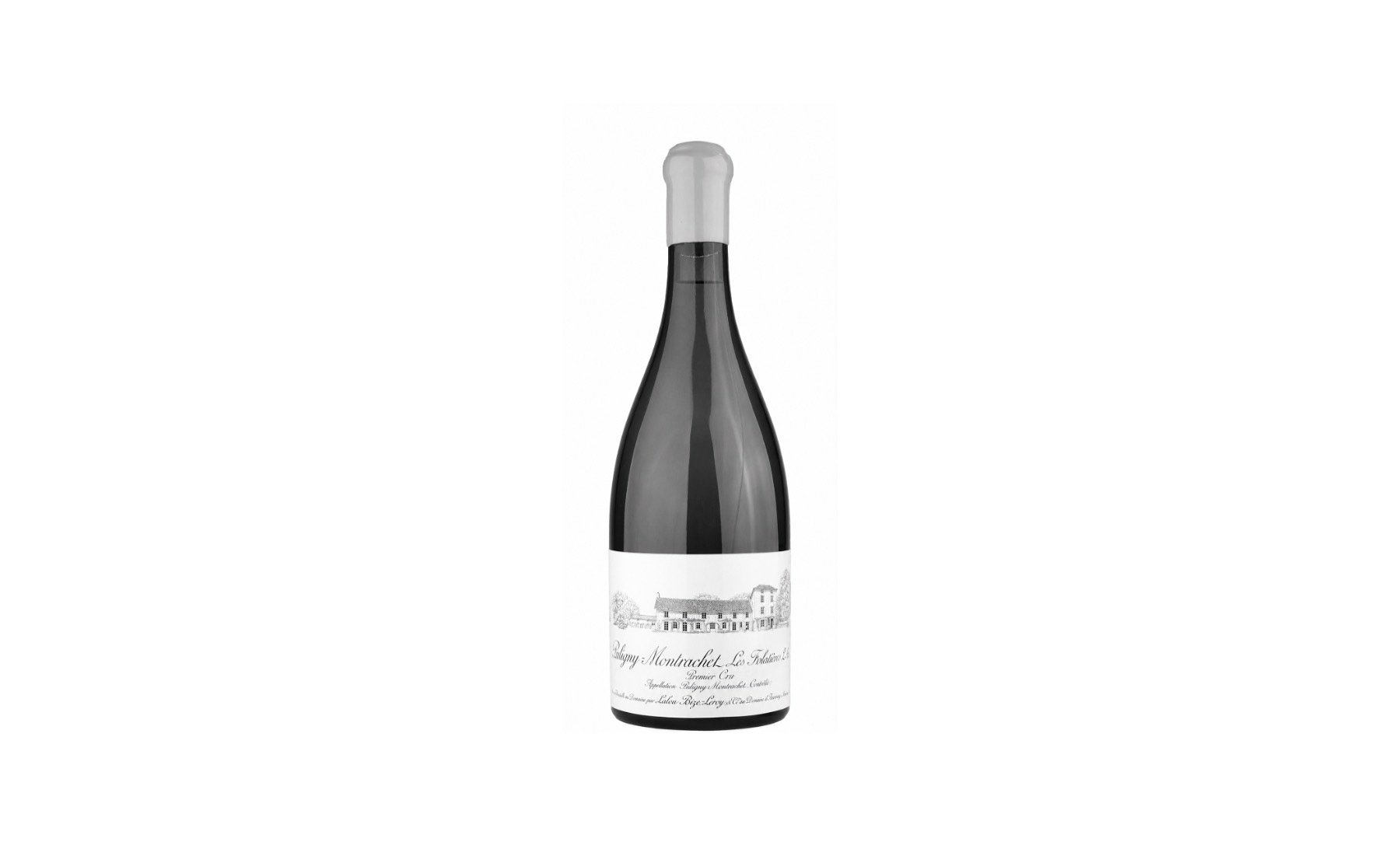
Domaine d’Auvenay: Puligny-Montrachet Premier Cru Les Folatières
A trophy white Burgundy of microscopic supply, grand-cru stature, and unusually selective investment appeal
Collector thesis
Across its publicly documented vintages, Domaine d’Auvenay’s Puligny-Montrachet Premier Cru Les Folatières sits in a very small category of white Burgundy that behaves less like a conventional premier cru and more like a trophy asset with grand-cru prestige. That status rests on four documented pillars: the global renown of Lalou Bize-Leroy; the intrinsic standing of Les Folatières as one of Puligny’s most highly regarded premiers crus; the estate’s tiny production; and auction and price-estimate evidence showing values far above ordinary appellation norms. iDealwine’s 2025 ranking placed Auvenay thirteenth among the platform’s most sought-after producers by auction value, ahead of many famous fine-wine names, while Christie’s and Sotheby’s continue to catalogue Les Folatières in tiny, premium lots.
For collectors, the wine is best understood not as a high-liquidity blue-chip in the Bordeaux sense, but as a collector trophy and connoisseur’s asset with investable upside. It has the prestige and pricing power of elite Burgundy, yet its market is too scarce and episodic to be described as broadly tradeable. iDealwine’s own price-estimate pages show how unevenly the wine trades by vintage: a 2009 quote stood at €1,381 in 2026, while the 2007 and 2011 vintages were quoted at €5,258 and €7,900 respectively, an unusually wide spread for one label and a sign that this market is driven by rarity, vintage reputation, and thin supply rather than deep, continuous liquidity.
This profile addresses the wine across all vintages that are publicly documented in authoritative market and critic sources. Those sources are incomplete by nature: auction houses publish bottle counts only for selected lots, iDealwine indexes only certain back-vintages, and no comprehensive public technical archive from the estate is readily visible. That limitation is itself meaningful to collectors. Auvenay is not a fully transparent, data-rich wine asset; it is an elite Burgundy collectible whose desirability exceeds the amount of information the market can easily extract from it.
Estate and terroir
Estate background
Domaine d’Auvenay belongs to Lalou Bize-Leroy, one of Burgundy’s defining modern figures. Jancis Robinson, Sotheby’s, and iDealwine all identify her as an early and forceful proponent of biodynamics in Burgundy, committed from the outset to old vines, healthy soils, massal selection, and very low yields. iDealwine describes the Auvenay estate as roughly 3.9 hectares, while several specialist merchant and market sources describe it as about four hectares; in practical terms, it is a tiny personal estate adjacent to the larger Leroy universe, and its scale is central to its mystique and market behavior.
For collectors, the producer matters almost as much as the climat. Bize-Leroy’s historical association with Maison Leroy and the Romanée-Conti orbit helped give Auvenay immediate symbolic authority, but the estate’s present prestige is not merely borrowed. iDealwine records that the domaine groups together parcels inherited from her father and acquired between 1989 and 1995; the same source characterizes the estate’s Chardonnays as among the most celebrated in the world and notes a total annual output of around 8,000 bottles across the entire domaine, not all of which are released in normal commercial channels.
Vineyard and climat
Les Folatières is not just another Puligny premier cru. Official Burgundy sources show that Puligny-Montrachet has 17 premiers crus and 5 grands crus, with white vineyards planted overwhelmingly to Chardonnay. The appellation’s soils are predominantly brown limestone and marl-limestone mixes, with east to south-east exposures between roughly 230 and 320 meters of altitude; the official map places Les Folatières squarely among Puligny’s premier-cru belt, above the village and close in spirit to the grand-cru corridor.
That geographical setting explains why Les Folatières is so often treated as a quasi-grand cru. Official Bourgogne sources describe Puligny and its premiers crus as concentrated, balanced, aromatically complex, and “well-bred,” while Jasper Morris MW has publicly stated that Folatières can achieve grand-cru greatness and is considered by many one of Puligny’s very finest premiers crus. iDealwine similarly describes Les Folatières as one of the most prized premiers crus in the village.
The wine’s scarcity is not theoretical. Auction-house lot notes provide concrete production data for selected vintages: Sotheby’s recorded total production of 1,731 bottles for 1989, 2,866 bottles for 1993, and 1,455 bottles for 1999, while Christie’s recorded 1,477 bottles for 2014. Those figures are not a full annual archive, but they are sufficient to establish the order of magnitude: even by elite Burgundy standards, this is a microscopic wine.
Viticulture and winemaking
The viticultural philosophy is clearly biodynamic. Jancis Robinson wrote of Lalou’s early biodynamic conversion and the health and vigor she observed in the vineyards; Sotheby’s describes old vines, massal selection, healthy soils and low yields as foundational; iDealwine notes biodynamic viticulture at the cuvée level and describes extreme debudding and a limit of five bunches per vine. Even where public producer detail is sparse, the consensus across serious market and critic sources is remarkably consistent: Auvenay’s viticulture is obsessive, labor-intensive, and yield-suppressing by design.
For the Puligny-Montrachet AOC itself, the legal framework is clear. INAO’s cahier des charges states that premier-cru white Puligny must reach a minimum natural alcohol of 11.5%, continuous presses are forbidden, irrigation is prohibited, and the standard yield is capped at 55 hl/ha for premier-cru whites, with a maximum threshold of 62 hl/ha. Auvenay’s farming is plainly far below those legal maxima, but the estate does not publicly disclose a complete vintage-by-vintage technical matrix for this cuvée. Publicly accessible data on pH, total acidity, residual sugar, sulfur regime, barrel percentages, or exact élevage length for every vintage are not visible in the sources reviewed.
That gap matters. From a collector standpoint, Auvenay is a wine whose reputation rests on demonstrated bottle performance rather than technical disclosure. iDealwine and specialist merchants repeatedly stress extremely low yields and uncompromising élevage, but exact winemaking parameters remain largely proprietary. The best externally verifiable clues to style therefore come from tasting notes. Those notes repeatedly point to a house signature of reduction, smoke, toast, flint, white flowers, mineral tension, and notable acidity.
On technical composition, the wine is Chardonnay. Public lot descriptions show that alcohol varies by vintage: iDealwine’s 1997 lot lists 13% ABV, while its 2009 page lists 13.5%. No public archive reviewed here provides a continuous sequence of alcohol levels, yields, or bottle-format breakdowns across all vintages. For serious buyers, that means treating every back-vintage acquisition as an individual object, not a standardized SKU.
Vintage arc and tasting identity
What emerges from the best published notes is a remarkably coherent tasting identity across decades. In 2004, Jamie Goode described the wine as dense, mineral, complex, and marked by integrated reductive notes. In 2007, Antonio Galloni rated it 97 points, emphasizing energy, cool mineral tension, and a dazzling, reticent brilliance. Secondary-market descriptions of the 2011 vintage echo that profile but place more emphasis on perfume, dried white flowers, wet pavement, and a tightly wound citrus finish. Retail and merchant descriptions from long-standing importers likewise highlight toast, minerality, and striking acidity.
For collectors, the important point is that Auvenay Les Folatières does not read like a merely richer, riper Puligny. Its typical profile is more architectural than plush: smokiness rather than sweetness, tension rather than fat, and a mineral spine that supports unusually long aging. Official Bourgogne tasting descriptors for Puligny include almond, hazelnut, green apple, butter, citronella, honey and flint; those descriptors match the recurring aromatic field in mature and maturing Auvenay bottles, especially when married to the domaine’s characteristic reductive signature.
Benchmark vintages
Open-source critical evidence is strongest for a handful of benchmark years. The 2004 is especially important because it shows how the wine can transcend a vintage that some Burgundy collectors approach cautiously: FRW shows an average critic score of 95, with 96 from Robert Parker and 94 from Burghound, while Jamie Goode scored it 97. The 2007, meanwhile, stands out as a critical high-water mark in public sources, with Galloni at 97 and a note that emphasizes precision, restraint, and mineral energy. These are the clearest publicly documented “buy if provenance is pristine” vintages in the secondary market.
The 2011 is a fascinating collector vintage because it sits at the intersection of maturity and market strength. Winedecider’s aggregation shows an average rating of 94 with a range from 92 to 95, and Christie’s recorded a dramatic result in Hong Kong in 2021 when three bottles sold for HKD 212,500. That does not prove superior drinkability to 2007 or 2004, but it does establish that the market treats 2011 as a major Auvenay collectible.
Older bottles require more caution. Public score visibility suggests the 1997 vintage received a broad range of views, from 91 to 95 in aggregated sources, and maturity guidance in those same sources was relatively short by elite white Burgundy standards. Jancis Robinson’s recent writing on mature white Burgundy and Burgundy Report’s long-running warnings on premature oxidation both reinforce the same conclusion: top old white Burgundy can be glorious, but bottles from the mid-1990s through mid-2000s must be bought with a tolerance for bottle variation and premox risk.
As a cellar strategy, that means younger documented vintages such as 2011 and 2014 are generally more attractive for long-horizon collectors than the mid-1990s, unless provenance is impeccable. iDealwine explicitly advises waiting at least twelve years for the cuvée, while Galloni’s 2007 note suggested meaningful patience. For mature bottles, provenance now matters more than theoretical peak windows; for younger bottles, patience still appears rewarded.
Critical standing and market position
Auvenay Les Folatières enjoys a level of critical and symbolic esteem unusual even within Puligny. Publicly available scoring evidence is uneven, but where it exists it is emphatic. The 2004 and 2007 vintages reached the high 90s in major critical ecosystems, and public descriptors from reviewers consistently frame the wine as operating above premier-cru expectation. iDealwine goes so far as to describe it as one of the village’s greatest wines, surpassing many grands crus in concentration and complexity, while Jasper Morris’s public characterization of Folatières as capable of grand-cru greatness gives the terroir context behind that judgment.
From a market perspective, Auvenay is both highly desirable and structurally illiquid. iDealwine’s 2025 table ranked Auvenay thirteenth among the world’s most sought-after producers on the platform by auction value, placing it just behind Leroy and ahead of Leflaive, Ramonet, and numerous Bordeaux first-growth names in that specific measure. The same platform reported that close to 150 bottles made by Lalou Bize-Leroy sold in its April 2025 auctions, including only 22 from Domaine d’Auvenay; that is an “exceptional volume” precisely because the normal market supply is so low.
Market evidence and liquidity
Public price evidence confirms that Les Folatières trades on a plane far above normal premier-cru Burgundy. Christie’s catalogued three bottles of the 2014 vintage in Hong Kong in 2025 with an estimate of HKD 85,000 to HKD 110,000. Sotheby’s estimated six bottles of the 1999 at $22,000 to $32,000 in 2025. At the quote-database level, iDealwine valued the 2007 at €5,258 and the 2011 at €7,900 in 2026. Even when one allows for vintage effects and differences between estimate, quote, and transaction types, the message is unmistakable: Auvenay Les Folatières no longer trades as a merely elite Puligny; it trades as an ultra-luxury white Burgundy collectible.
Demand is distinctly global. Christie’s Hong Kong, Sotheby’s Hong Kong, UK merchants, and iDealwine’s France-based auction system all surface the cuvée. iDealwine’s April 2025 report noted that Auvenay’s finest Chardonnays found especially strong demand from Asian buyers, with over a third of bottles going to Hong Kong, Taiwan, and Singapore, alongside meaningful US participation and continued European buying. For investors, that matters: the market is thin, but it is international rather than local.
Compared with peers, the wine’s significance is best understood not only within Puligny but within the wider hierarchy of white Burgundy. Leflaive Les Folatières is a benchmark premier cru and remains much more liquid; Ramonet and Pierre-Yves Colin-Morey command immense respect; Coche-Dury’s top whites are among the nearest comparables in cult appeal. Yet Auvenay occupies a rarer and more volatile niche. On iDealwine’s 2025 “most coveted” ranking, Auvenay ranked above Leflaive and Ramonet, and market snapshots from specialist observers have even shown Auvenay village-level Puligny trading above canonical red Burgundy icons. That is not normal pricing behavior for a premier cru; it is luxury scarcity pricing.
Provenance, buying guidance and final verdict
Provenance discipline is non-negotiable. Auction houses routinely describe these bottles in forensic detail: Christie’s has noted cracked wax capsules, slight signs of old seepage, stained labels, and varying fill levels on 2011 and 2014 lots, while Sotheby’s emphasizes bottle numbers, ullage, original wooden cases, and even original outer cartons. In other words, the market already assumes that condition variance exists and must be priced. Buyers should favor original cases, direct-from-estate or ex-professional-cellar histories, and merchants or auction houses with strong inspection procedures.
Counterfeit exposure is difficult to quantify publicly for this specific cuvée, but the risk calculus is obvious: high prices, tiny production, and cult demand create incentive for fraud. More practically, white Burgundy provenance risk includes not just authenticity but storage and oxidation history. Jancis Robinson and Burgundy Report both underscore the bottle-risk issue for mature white Burgundy, particularly from the 1990s and 2000s. Buyers who chase older vintages without impeccable storage evidence are not making a pure wine-quality bet; they are also making a closure and condition bet.
For purchase strategy, auction remains essential because allocation supply is effectively inaccessible to most collectors, but auction should not be confused with convenience. This is a wine to buy slowly and selectively. Standard 75cl bottles dominate public trading; sealed original cases are particularly desirable because they reduce provenance uncertainty and may carry a resale premium. Large formats may exist, but reliable public evidence for regular market availability is sparse, so collectors should treat them as opportunistic rather than core.
At table, the wine deserves cuisine that respects both tension and texture. Younger bottles belong with turbot, lobster, scallops, shellfish in beurre blanc, or Bresse chicken with a light cream and morel reduction. Mature bottles can handle richer, earthier pairings: veal sweetbreads, truffled poultry jus, or line-caught sole with brown butter and hazelnut. The guiding principle is not force, but precision.
The final collector verdict is clear. Buy selectively. Buy to cellar. Buy as a collector trophy. Buy only with perfect provenance. As a drinking wine, Auvenay Les Folatières can be extraordinary. As an investment, it is compelling but specialized: prestige is indisputable, scarcity is extreme, and international demand is real, yet liquidity is thinner than headline prices suggest. The most attractive targets in the public record are benchmark, critically strong vintages such as 2004, 2007, 2011 and pristine 2014, with 1990s bottles reserved for buyers who understand mature white Burgundy risk. In the global hierarchy, this is not merely one of Puligny’s great premiers crus; it is one of the most coveted white Burgundy collectibles in the world, sitting at the overlap of terroir supremacy, cult authorship, and radical scarcity.