

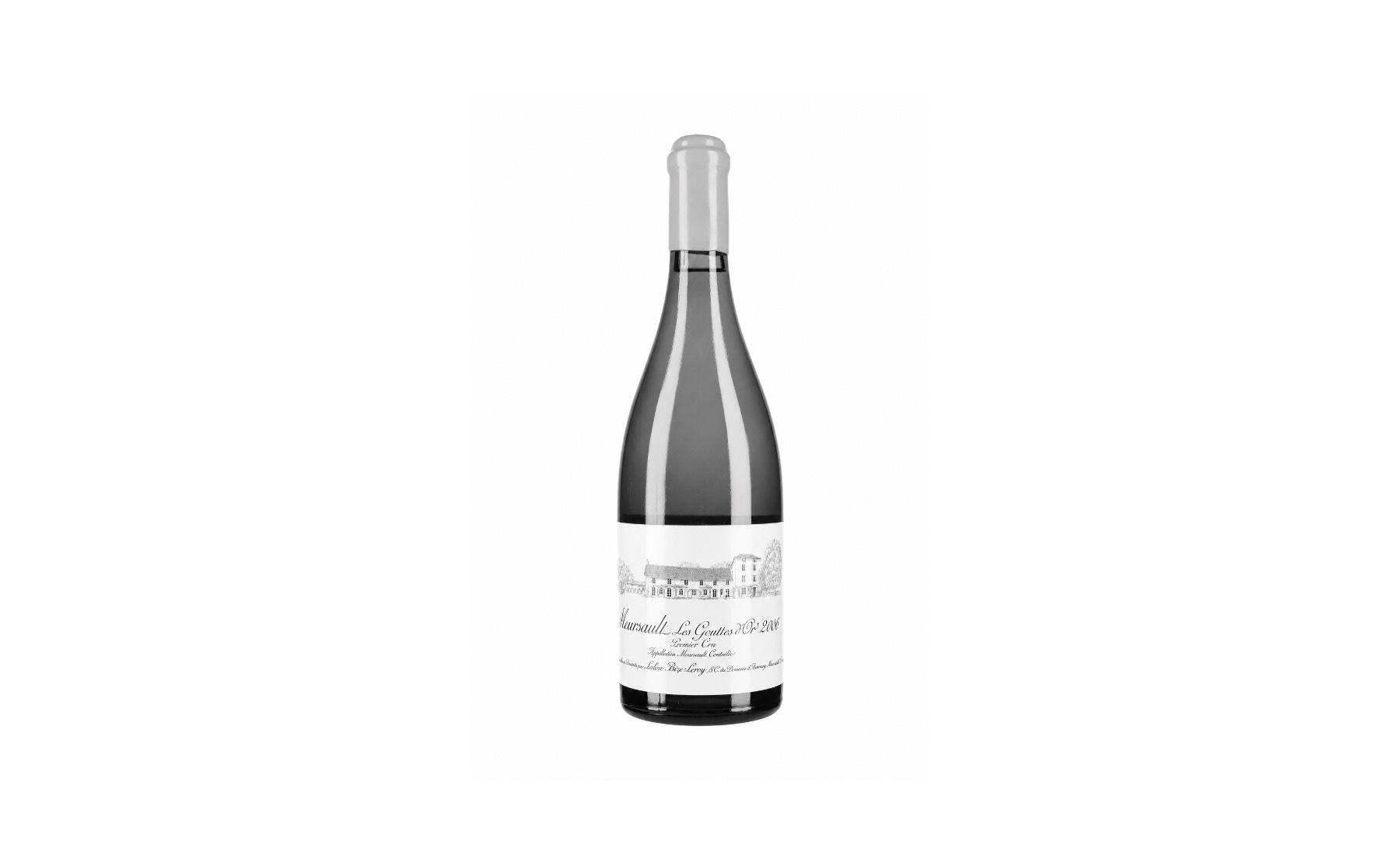
Domaine d’Auvenay: Meursault Premier Cru Goutte d'Or
All-vintage collector profile of Lalou Bize-Leroy’s microscopic Meursault Premier Cru, prized for rarity, authority, and market stature
Introduction
Among white Burgundies, Domaine d’Auvenay’s Meursault Premier Cru Gouttes d’Or occupies a position that is almost paradoxical: it is a premier cru in legal rank, yet it is collected, discussed, and priced with the aura of a grand cru. That status comes from the convergence of three forces that matter deeply to serious collectors: Lalou Bize-Leroy’s near-mythic standing, genuinely microscopic production from a tiny parcel, and a secondary market that repeatedly treats top d’Auvenay wines as trophy assets rather than merely appellation wines. WineCap’s 2024 survey of the world’s most expensive wines placed Domaine d’Auvenay Meursault Premier Cru Les Gouttes d’Or at an average £80,715 per case, while Liv-ex and Sotheby’s both show that d’Auvenay remains one of the rare Burgundy names capable of drawing global high-value trade and auction attention despite a broader market cooling phase.
For collectors, the relevance of this cuvée is not confined to one celebrated harvest. Publicly documented vintages certainly include 1996 through 2007, then 2009, 2011, 2014, and 2015; one specialist release list stops at 2014, while merchant and critic pages confirm at least a 2015 release. That discrepancy itself is instructive: d’Auvenay does not maintain a transparent public technical archive, so buyers must treat vintage-by-vintage verification as part of due diligence. In practical terms, this is not a wine one buys casually. It is a bottle whose value depends on provenance, condition, and exact vintage context almost as much as on intrinsic quality.
Estate, Reputation, and Terroir
Domaine d’Auvenay is Lalou Bize-Leroy’s intimate Saint-Romain-based estate, distinct from both Maison Leroy and Domaine Leroy. Sotheby’s notes that Bize-Leroy created Domaine Leroy in 1988 and made the first vintage at Domaine d’Auvenay in 1989; from the outset, she committed herself to old vines, massal selection, healthy soils, biodynamics, and very low yields. A Dutch specialist importer that has long represented the estate describes d’Auvenay as a property of roughly 4 hectares spread over 16 appellations, with production so small that many cuvées amount to no more than a single barrel. In collector terms, this matters immensely: the domaine’s scarcity is structural, not marketing theater.
That scarcity is amplified by reputation. Sotheby’s has described worldwide demand for Leroy and d’Auvenay as difficult to satisfy, and Serena Sutcliffe MW characterizes d’Auvenay’s largely white-wine range as combining elegance with intensity. Specialist trade commentary indexed from Robert Parker’s historical work places Domaine d’Auvenay among Burgundy’s truly exalted addresses, and recent Meursault-focused merchant analysis still groups d’Auvenay with names such as Coche-Dury, Comtes Lafon, Roulot, and Arnaud Ente when discussing the top echelon of white Burgundy. Whether one agrees with every superlative, the market clearly does.
The climat itself explains why this wine is capable of transcending hierarchy. Gouttes d’Or lies in Meursault toward the Volnay side of the village. Technical sheets from multiple established growers place the climat at roughly 5 to 5.3 hectares, with soils of limestone, marl, and shallow stony material over rock plates, and with eastern to southeastern exposure. A Bourgogne Wine Board geology resource emphasizes that Meursault’s identity is inseparable from its fractured limestone slope and mid-slope drainage, while one climat-specific source notes that the name “Goutte d’Or” references the flint-like golden stones in the soil. In stylistic terms, that geology tends to favor breadth and density, but with the mineral line and tension that prevent richness from becoming heaviness.
Collector orthodoxy has not traditionally ranked Gouttes d’Or alongside Meursault’s most famous premier crus—Perrières, Genevrières, and Charmes. Pierre Morey, quoted by a specialist publication, describes the climat as producing wines of depth, density, long aftertaste, and signatures of spice, pepper, and white flowers. Another specialist account notes that Gouttes d’Or has often been regarded as the “fourth” premier cru in the village hierarchy. What Domaine d’Auvenay does is upset that conventional ordering: the site’s power and spice are preserved, but elevated into a bottle whose prestige exceeds the climat’s normal market lane.
Viticulture, Winemaking, and Technical Record
Verified estate-wide viticultural facts are relatively clear even when cuvée-specific cellar details are not. The importer profile for d’Auvenay states that biodynamics are observed very strictly, that no chemical pesticides or insecticides are used, that work in the vineyards is done by horse and cart, and that soils are ploughed to encourage deeper rooting and mineral uptake. For collectors, this is not just philosophical texture. It helps explain why d’Auvenay’s wines are routinely described as unusually energetic, concentrated, and terroir-driven, even in warm vintages.
For Gouttes d’Or specifically, a trade-facing technical page from the same importer gives unusually useful parcel information: the vineyard is stated to have been planted in 1970, to measure 0.19 hectares, and to yield about 300 bottles per year. That same page lists 13.5% alcohol, natural cork, oak aging, and an aging potential of “10 years and more.” These are valuable data points, but they should be handled with the correct degree of caution: they come from an informed importer rather than from a formal estate technical sheet. I did not find public estate documentation for pH, total acidity, residual sugar, sulfur regimen, or a complete vintage-by-vintage production record.
The same importer’s description also underscores the obsessive sorting culture for which the domaine is famous, describing triage tables staffed by as many as 40 people sorting bunches by hand, with fruit kept cool overnight if necessary to avoid hurrying the process. It further notes that wines may remain in the domaine’s cellars for years after vinification. That combination—tiny crop, radical manual selection, oak élevage, and delayed release—matters enormously for collectibility. These are not “scarce because demand is high” wines; they are scarce because the production method itself is almost anti-commercial.
On the technical composition, the verified baseline is simple: this is 100% Chardonnay from Meursault Premier Cru Gouttes d’Or. Standard format 75cl is consistently documented in trade and auction listings. Larger formats are not consistently indexed in public sources for this cuvée, so collectors should assume that standard bottles dominate the visible market unless a specific larger-format lot is independently verified. Release prices are not publicly documented in the consulted sources.
Vintage Landscape and Tasting Identity
Because this profile addresses all vintages rather than a single year, the most useful approach is to think in cohorts. 1996 was classically structured, with excellent fruit and acidity; 2002 was, in the words of the Bourgogne Wine Board, a great year for Chardonnay, producing elegant, aromatic wines with freshness and minerality. 2005 was exceptional and powerful, with richness and strong laying-down potential. 2007 offered high-quality, highly appealing whites that were always more charming than monumental. 2009 was rich, fleshy, and vigorous. 2011 required severe selection but yielded energetic wines intended for earlier pleasure. 2014 is one of the key benchmark white vintages of the era: the BIVB called it an excellent year, and Jasper Morris has described 2014 as the finest consistently successful white Burgundy vintage of a generation. 2015, by contrast, returned to a more solar register, but the best wines retained remarkable substance and cellar potential.
Professional critical opinion gives the clearest picture of the wine’s sensory identity across vintages. Neal Martin’s note on the 1999 emphasized citrus peel, limestone, apricot, wild honey, and electrifying tension; Antonio Galloni’s 2007 review highlighted perfumed fruit, silkiness, precision, and persistence; the public index of Galloni’s 2011 review described an ethereal, airy Meursault with bright citrus, floral notes, and mineral persistence. A William Kelley excerpt on 2015 adds pear, peach, oats, hazelnut cream, immense concentration, and a stony grip more often associated with red Burgundy. In other words, the recurring profile is not merely rich Meursault. It is rich and mineral, textural and tense, exotic in aroma yet architecturally strict in finish.
That identity also fits the climat itself. Specialist commentary on Gouttes d’Or repeatedly returns to spice, pepper, white flowers, nuts, stone fruit, and a dense but not slack palate. French criticism on the domaine’s Meursault range describes Gouttes d’Or as restrained at first but intensely classy, racy, and silky in texture. For sommeliers and drinkers, that means the wine can show a paradoxical combination of enveloping extract and inward reserve. For collectors, it explains why the best bottles often feel less “hedonistic Meursault” than “structured white Burgundy of serious intent.”
In maturity terms, older cohorts need to be treated with precision, not broad assumptions. Based on vintage character, critic windows, and the known premox era in white Burgundy, 1996–2002 bottles are now squarely provenance-dependent mature wines; 2004–2007are generally at or near full maturity, though top bottles may continue to hold; 2009–2011are mature and highly drinkable, but not infinitely so; 2014–2015 are entering or approaching a first plateau, with the best examples capable of further development. None of these judgments should override bottle condition. White Burgundy has a long-documented history of premature oxidation, especially in the mid-1990s through mid-2000s, and even elite labels are not exempt from bottle variation.
Critical Reception, Collectibility, and Market Position
The publicly indexed critical record is strong enough to establish elite standing, even if some original reviews remain behind paywalls. For the 1999, public indexing shows 95 points from Robert Parker and 93 from Allen Meadows, with an average score of 94. For the 2005, trade references publicly list 100 from Antonio Galloni, 99 from Robert Parker, and 93 from Burghound; because those exact scores appear through merchant indexing rather than directly on the critic sites, trophy-level buyers should still verify the original reviews. For the 2007, Galloni’s public review is 95, while Burghound publicly indexed it at 91 and described it as fully mature but capable of holding at peak. For the 2011, a public index cites 93–95 from Galloni and an average score of 93. Critically, the pattern is not one of unanimous perfection but of repeated recognition that this is a premier cru performing at the highest white-Burgundy level.
Collectibility rests first on rarity. The importer’s estimate of roughly 300 bottles per year is already astonishingly low, and Sotheby’s documented 1,150 bottles for the 2000 and 886 bottles for the 2006—figures that remind buyers how dramatically volume can vary by year. The high-variance production profile matters because it helps explain why auction supply is sporadic and why pristine multi-bottle original-case offerings are disproportionately prized. Wijnkooperij de Lange also states plainly that the wines are sold on allocation, reinforcing the point that most bottles reach the market through long-standing relationships, not open retail availability.
The market evidence is equally striking. iDealwine’s current quoted values for 75cl bottles place the wine at €861 for 1996, €3,459 for 1999, €3,937 for 2000, €7,052 for 2002, €5,193 for 2004, €7,472 for 2005, €9,852 for 2006, €7,001 for 2007, €8,556 for 2009, and €3,202 for 2011. Those are not release prices; they are secondary-market guide values, and they fluctuate by vintage reputation and market moment. Yet even allowing for dispersion, they place Gouttes d’Or vastly above the normal valuation range for Meursault premier cru.
Auction confirmation is robust. Christie’s sold three bottles of the 2000 for HKD 250,000in 2022. Christie’s realized GBP 5,250 for a single bottle of the 2005 in 2025. Sotheby’s offered the 2006 in Hong Kong in 2025 at an estimate of HKD 90,000–130,000 for two bottles, and offered three bottles of the 2011 in original wooden case at GBP 5,000–6,500 in 2026. A specialist French merchant currently lists the 2015 at €9,200. The clean conclusion is that this wine does trade, and at very high levels, but the market is thin enough that bid-ask spreads and bottle-specific condition can change outcomes materially.
Liquidity, therefore, is best described as selective rather than broad. Liv-ex has recently identified Domaine d’Auvenay 2009 among top-traded wines by value in a given week, and additional Liv-ex reporting notes high-value d’Auvenay buying from both UK and US buyers, even while broader Burgundy sentiment has been more cautious after the market’s correction. That is the hallmark of a trophy market: real global demand remains, but it concentrates in the most trusted channels and the best-presented lots. Investment strengths are obvious—prestige, scarcity, global bidder awareness, and a cuvée that already behaves like an icon. The weaknesses are equally serious: white-Burgundy bottle variation, very high entry prices, and a trading pool that is deep enough to matter but not deep enough to guarantee frictionless resale.
In comparative context, Domaine d’Auvenay Gouttes d’Or is one of the rare wines that overrides appellation hierarchy. In pure terroir orthodoxy, Perrières, Genevrières, and Charmes are the names more often cited at the summit of Meursault premier cru. In market reality, Auvenay Gouttes d’Or belongs in conversations that normally include Coche-Dury Perrières, Comtes Lafon, Roulot, Arnaud Ente, and even grand-cru white Burgundy more broadly. WineCap’s global price ranking makes that explicit: this is not merely a top Meursault, but one of the world’s most expensive fine wines. For collectors building across regions, its true peers are not simply other Gouttes d’Or bottlings, but the most coveted white Burgundies of any rank.
Buying Guidance, Pairing, and Final Verdict
Collectors should buy this wine as they would a blue-chip object: with an almost forensic emphasis on provenance. Sotheby’s provenance notes repeatedly stress professional temperature-controlled storage, and its buyer glossary makes original wooden case terminology and ullage language central to auction practice. Liv-ex, for its part, emphasizes formal authentication processes for high-value wines. In practical terms, the most desirable bottles are those bought on release from a trusted merchant, kept in bonded or professional storage, and accompanied by a clear ownership trail. On mature bottles, capsule integrity, label authenticity, seepage history, and fill level are not cosmetic details; they are value determinants.
Auction can be an excellent route for acquisition, but only when the house documents condition and provenance with unusual clarity. A 2011 Sotheby’s offering highlighted original wooden case; a 2006 lot specified same bottle-number series; Christie’s condition notes on the 2000 recorded exact fill heights. Those are the kinds of details serious buyers should demand. Warning signs include vague ownership history, damaged or inconsistent capsules, suspiciously fresh labels on supposedly old bottles, missing condition photography, or prices materially below prevailing market indications. For a bottle this expensive and this rare, “too good to be true” almost always is.
For service and fine dining, this is a wine that deserves cuisine of texture rather than simple delicacy. Bourgogne and producer sources align around dishes such as lobster, scallops, trout or Arctic char, freshwater pike, veal in cream sauce, morels, and truffle-accented preparations; mature bottles can also excel with poultry in white sauce or refined dishes built around nuts, mushrooms, and subtle smoke. Young, powerful vintages want richness and precision. Mature bottles want restraint and resonance.
The collector verdict is clear. This is buy to cellar, buy as a collector trophy, and above all buy only with perfect provenance. For mature vintages from the premox era, it is also buy to drink—but only when condition is exceptional and the seller is beyond reproach. It is not a casual “investment wine,” because liquidity is selective and bottle variation is real. It is, however, one of the handful of white Burgundies whose long-term desirability is anchored by something more durable than fashion: a fusion of famous terroir, impossible scarcity, and an estate name that still commands reverence across merchants, critics, and auction houses. Within Meursault, it stands as one of the village’s most exalted modern collector bottles. Within the d’Auvenay portfolio, it is among the estate’s defining whites. Within the global fine-wine hierarchy, it is a premier cru that the market has already promoted into icon territory.