
Domaine d’Auvenay: Lalou Bize-Leroy’s Most Elusive Burgundy Estate
The rare Burgundy micro-domaine where Lalou Bize-Leroy’s vision reaches its most concentrated form.
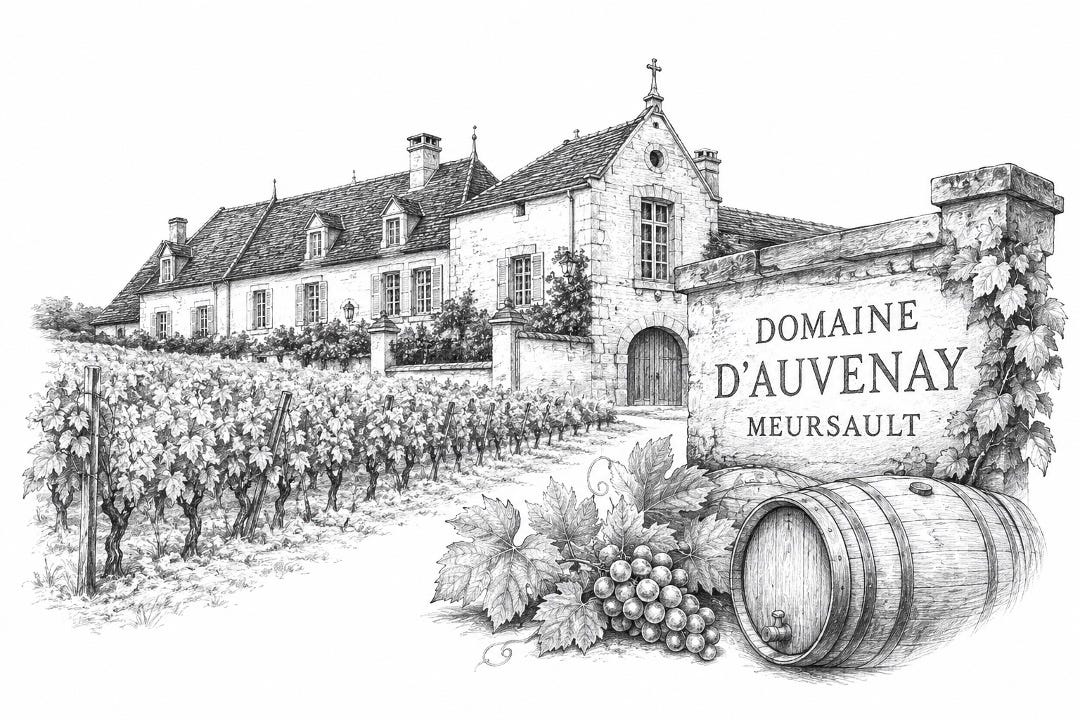
Domaine d’Auvenay is one of Burgundy’s quietest legends. It has no need for spectacle. Its power lies in a handful of vineyards, a severe farming philosophy, and wines that seem to compress an entire landscape into microscopic quantities.
Closely associated with Lalou Bize-Leroy, Domaine d’Auvenay occupies a singular place in French wine. It is smaller and more private than Domaine Leroy, yet in some ways even more revealing. Here, the Leroy vision is distilled: old vines, low yields, biodynamic viticulture, rigorous selection, and an almost uncompromising belief that great wine begins in the soil.
The domaine is rooted in Saint-Romain, high in the Côte de Beaune, but its parcels reach into some of Burgundy’s most resonant names: Meursault, Puligny-Montrachet, Auxey-Duresses, Chevalier-Montrachet, Bonnes-Mares and Mazis-Chambertin. The result is not a conventional estate but a constellation of tiny holdings, each treated as a world of its own.
Domaine d’Auvenay and the Leroy Philosophy
To understand Domaine d’Auvenay, one must begin with Lalou Bize-Leroy. Her influence on Burgundy has been profound, not merely because of the prices her wines command, but because of the seriousness with which she has pursued viticulture.
The domaine is widely described as organically certified and biodynamically farmed. The vineyards are worked with intense attention, often associated with horse work, ploughing, the rejection of synthetic chemical inputs, and yields kept dramatically low. This is not biodynamics as decoration. At d’Auvenay, farming is the central language of the wine.
The estate’s approach reflects a conviction that vines should be allowed to search deeply, struggle honestly, and speak with precision. In a region where classification can sometimes dominate the conversation, Domaine d’Auvenay reminds us that human choices can sharpen, or soften, the voice of terroir.
Why Domaine d’Auvenay Is So Rare
Scarcity is part of the d’Auvenay story, but it is not the whole story. The domaine is tiny, with public sources generally placing it at around four hectares, spread across numerous appellations. Many wines are produced in quantities that feel almost improbable: sometimes a few hundred bottles, sometimes little more than a barrel.
This explains the aura, but not the fascination. Domaine d’Auvenay matters because it has made Burgundy lovers rethink hierarchy. A village Meursault, an Auxey-Duresses, or even a Bourgogne Aligoté can become extraordinary when farmed and selected with this level of severity.
The finest bottles are not admired simply because they are rare. They are pursued because they suggest a different Burgundy: one in which intensity, clarity and texture are not confined to grand cru labels.
The White Wines of Domaine d’Auvenay
Domaine d’Auvenay is most famous for white Burgundy. Chevalier-Montrachet is often regarded as the domaine’s summit, a wine of immense reputation and vanishingly small production. Criots-Bâtard-Montrachet, Bâtard-Montrachet, Meursault Les Gouttes d’Or, Meursault Les Narvaux and Puligny-Montrachet Les Folatières also occupy a rarefied place among collectors and critics.
Yet one of the domaine’s most intriguing wines is Bourgogne Aligoté Sous Chatelet. In lesser hands, Aligoté can be brisk and modest. At d’Auvenay, it becomes a serious wine of tension, depth and mineral drive, showing how dramatically farming and selection can elevate a grape too often treated casually.
The style is not light or decorative. These are concentrated, deeply worked wines, shaped by low yields, careful sorting, native fermentations and maturation in new oak. At their best, they combine density with precision, richness with nerve.
Red Burgundy at Domaine d’Auvenay
Although the domaine’s white wines dominate discussion, its reds are far from secondary. Bonnes-Mares and Mazis-Chambertin place d’Auvenay firmly within the highest ranks of red Burgundy.
The reds are often described as more reserved in youth, perhaps shaped by the cooler Saint-Romain cellar environment. They can demand patience. But that reticence is part of their fascination: power held in suspension, fruit and structure folded tightly into the wine rather than offered immediately.
Market Myth and Burgundy Reality
Domaine d’Auvenay has become one of the most expensive names in white Burgundy. Auction results and secondary-market data repeatedly place its wines among the highest-priced bottles in the region. That market position can be distracting, but it also reveals something important.
The prices are not driven by rarity alone. They reflect a belief, widely shared among serious Burgundy drinkers, that d’Auvenay represents one of the most complete expressions of Lalou Bize-Leroy’s philosophy. The wines are luxury objects, certainly, but they are also agricultural statements.
For most wine lovers, Domaine d’Auvenay will remain more studied than tasted. Yet its influence extends far beyond those who own a bottle. It has helped shape modern Burgundy’s fascination with micro-production, biodynamics, old vines, extreme selection and the idea that even humble appellations can carry grandeur.
The Meaning of Domaine d’Auvenay
Domaine d’Auvenay is not easy to classify. It is a Saint-Romain estate with grand cru reach. A white-wine legend that also produces formidable reds. A tiny domaine with an outsized influence on global Burgundy culture.
Above all, it is a reminder that greatness in French wine is not only a matter of vineyard name. It is also a matter of attention: to soil, vine, fruit, cellar and time.
In Domaine d’Auvenay, Burgundy becomes intensely concentrated. Not louder, not grander in the obvious sense, but more focused. That is why the domaine continues to fascinate: it offers a vision of wine reduced to its essentials, then raised to an almost impossible level.