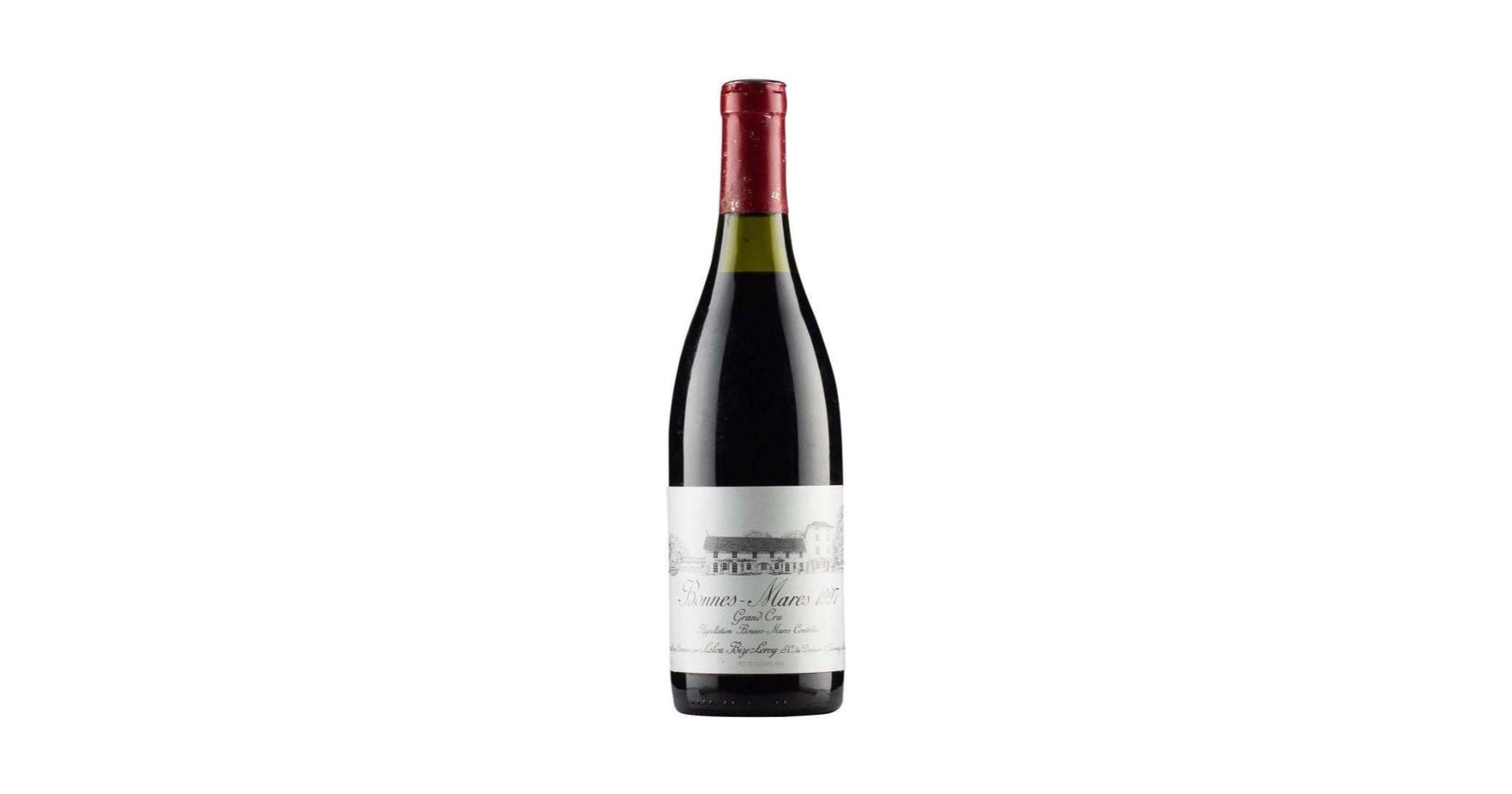
Domaine d’Auvenay Bonnes-Mares: The Cult Grand Cru Benchmark
From a 0.25-ha micro-parcel to biodynamic legend—every vintage, practice, and market milestone behind Lalou Bize-Leroy’s Bonnes-Mares.
Identity and Historical Position
Domaine d’Auvenay’s Bonnes-Mares Grand Cru occupies a singular place in Burgundy. As a Grand Cru of the Chambolle-Musigny appellation (with a portion of the climat extending into Morey-Saint-Denis), it represents one of the Côte de Nuits’ most revered terroirs. Yet it is produced by one of Burgundy’s most iconoclastic figures—Madame Lalou Bize-Leroy—under her personal Domaine d’Auvenay label rather than the more widely known Domaine Leroy.
The Bonnes-Mares vineyard itself has long been celebrated as the “darker side” of Chambolle, yielding Pinot Noir of power and structure to complement the village’s typical silk and fragrance. Domaine d’Auvenay’s rendition, first released in the 1993 vintage after Lalou Bize-Leroy’s acquisition of the parcel, immediately stood out for its combination of Burgundian tradition and the estate’s radical viticultural philosophy. This tiny holding—a mere 0.25 hectares, making d’Auvenay the smallest owner in Bonnes-Mares—produces only a few hundred bottles in the rare years it is deemed worthy of release. Such scarcity and pedigree have given the wine cult status from the outset.
Historically, Bonnes-Mares was already esteemed—formally classified Grand Cru in 1936—but d’Auvenay’s involvement added a new layer to its narrative. Lalou Bize-Leroy, often dubbed the “Queen of Burgundy,” had famously been co-director of Domaine de la Romanée-Conti until 1992. After parting ways with DRC, she focused on her own estates—and the 1993 debut of Bonnes-Mares under Domaine d’Auvenay symbolized her independent vision. Early critical reception noted the wine’s exceptional concentration and character even in its youth, aligning with the estate’s philosophy of uncompromising quality.
Over the ensuing decades, d’Auvenay Bonnes-Mares has evolved into an insider’s legend: produced in tiny quantities, seldom seen on the open market, yet spoken of in reverential tones by those lucky enough to taste it. Its reputation has been cemented by key turning points—for example, the extraordinary 1999 vintage, which has since become a reference point for value appreciation (prices for the 1999 have soared over 2000% in five years amid collector demand). Meanwhile, the estate’s decision not to release certain vintages (such as 1997 or 2004) has only heightened the mystique, underlining that this is a wine made only on its maker’s strict terms.
In the broader narrative of French fine wine, Domaine d’Auvenay Bonnes-Mares represents both continuity and disruption. It embodies the timeless virtues of Burgundy’s climats—a singular site expressing itself through Pinot Noir—while also serving as a manifesto of Bize-Leroy’s ideals. Her early and fervent adoption of organic and biodynamic viticulture in the early 1990s was revolutionary in Burgundy, and the success of wines like d’Auvenay Bonnes-Mares helped shift perceptions of what sustainable, terroir-driven viticulture could achieve. Thus, this wine is not merely a coveted Grand Cru; it is a cultural artifact documenting a paradigm shift in Burgundy.
From a historical standpoint, its evolution tracks the rise of “cult” domaine wines in Burgundy in the late 20th and early 21st centuries—small-production, super-premium bottlings that challenge even the established icons in prestige. Domaine d’Auvenay Bonnes-Mares, once a curious new project born in the aftermath of a Boardroom schism, is today firmly entrenched as a long-term reference point among Burgundy’s elite wines.
Vineyard and Terroir
The Domaine d’Auvenay parcel of Bonnes-Mares is extraordinarily small and perfectly situated. Comprising two micro-plots separated by a narrow footpath, it lies at the southern end of the Bonnes-Mares Grand Cru, on the Chambolle-Musigny side of the vineyard. Just upslope from the holdings of the esteemed Domaine Comte Georges de Vogüé, d’Auvenay’s vines occupy a sweet spot of the climat—high on the slope (approximately 265–280 meters elevation)with an easterly exposition typical of the site. This position captures gentle morning sun and good drainage, crucial in Burgundy’s variable climate.
Notably, the two small plots incorporate both of Bonnes-Mares’ famous soil types: the “Terres Blanches” (white soils)and “Terres Rouges” (red soils). The upper portion of the vineyard consists of light-colored marl rich in limestone and fossilized seashells, while slightly further downslope the earth becomes redder with more clay and iron content. By straddling this geological boundary, d’Auvenay’s vines can draw from the full spectrum of Bonnes-Mares’ terroir—the structure and depth conferred by the heavier red clays as well as the finesse and aromatic lift from the white marl and limestone. In effect, the wine offers a “complete” expression of the climat, as the estate itself puts it, a perfect equilibrium of Bonnes-Mares’ dual nature.
Indeed, the Chambolle-Musigny side of Bonnes-Mares (where d’Auvenay is located) is known to yield silkier, more perfumed wines compared to the weightier, more austere character of the Morey-Saint-Denis side. D’Auvenay’s parcel benefits from these finer Chambolle soils—limestone pavement and pale marl—which imbue the wine with a notably elegant, floral dimension to complement Bonnes-Mares’ inherent depth.
Soil composition aside, the microclimate of this parcel is favorable. The gentle slope and elevated position ensure cold air drainage (frosts are a little less catastrophic up here than on the flats, though the 2016 spring frost still bit deeply across Burgundy) and quick drying of excess moisture. The vine rows face east, soaking in morning sun that helps dry dew and reduce disease pressure, yet avoiding the full brunt of late afternoon heat—valuable in warmer vintages. The altitude near the top of the appellation brings slightly cooler temperatures and a longer growing season, enhancing aroma development and acidity retention. However, it also means the vines are more exposed to elements like wind or, occasionally, hail (a risk evidenced in years like 2012 when some Côte de Nuits vineyards saw hail damage).
The soil depth in these plots is moderate—roughly 30–50 cm of topsoil—with broken limestone slabs beneath. This stony subsoil provides excellent drainage; rain percolates quickly, forcing vine roots to dig deep for water and nutrients, which in turn encourages the uptake of mineral elements that many believe contribute to the wine’s famed mineral tension.
The vines themselves are predominantly old vine Pinot Noir. At the time of acquisition (1993), many plants were already of respectable age—some reportedly planted in the 1950s or 1960s by the previous owners (the Roumier family). Now in the 2020s, many of these vines are 60+ years old, and their gnarled roots and low vigor naturally curb yields. Madame Bize-Leroy has always prized old vines for the complexity and concentration of fruit they yield, and she has maintained these parcels lovingly. Any dead vine is replaced not with modern cloned rootstock, but with massal selections from the domaine’s own best vines—essentially propagating the vineyard’s heritage genetics to preserve its original Pinot Noir plant material.
The viticultural regimen is strictly biodynamic and organic: since the very start, Lalou Bize-Leroy outlawed all chemical inputs here, a pioneering move in Burgundy back in the early 1990s. The soil is cultivated to encourage microbial life; vines are tended with herbal teas (tisanes) and natural preparations rather than synthetic fungicides. Over the decades, this living soil approach has likely enhanced root depth and terroir expression but also rendered the vines sensitive to every nuance of climate. Observers have noted that d’Auvenay’s vines often carry a mantle of biodiversity—natural cover crops and wildflowers between rows—indicative of the ecosystem approach.
The estate employs meticulous canopy management: instead of hedging the vine tips, they practice tressage (braiding or looping the canes) to avoid the trauma of trimming. This technique prolongs the vines’ active photosynthesis and is believed to better balance vigor, leading to riper phenols and more resilient vines in extreme weather. Altitude and exposure do mean this terroir can be a touch cooler, and in difficult years with less sun, achieving full phenolic ripeness can be challenging—but Bize-Leroy’s fanatical crop-thinning and late harvesting (she is often among the last to pick, waiting for optimal maturity) mitigate that risk.
The interplay of these factors—venerable vines, diverse marl soils, high-elevation slope, biodynamic vitality—yields grapes of exceptional concentration but also nuance. Importantly, yields are kept extraordinarily low. Bonnes-Mares is already limited to a low yield by Grand Cru law (around 35 hl/ha), but d’Auvenay goes far lower. Through pruning, strict bud selection, and natural millerandage (many small berries), the estate routinely achieves yields in the range of 15–25 hectoliters/ha—in some years even below that. An average harvest might fill only two barrels or fewer.
For example, the inaugural 1993 vintage saw a relatively generous 1,150 bottles produced, whereas in 1999—a year of both quality and quantity for many Burgundy domains—d’Auvenay harvested just under two barrels, about 895 bottles in total. In challenging vintages the production can be negligible. This extreme paucity means the terroir speaks with a concentrated voice: small berries with a high skin-to-juice ratio give deep color, firm tannins, and dense extract; at the same time, the healthy biochemical balance in the vineyard (and the older vines’ equilibrium) ensures the grapes retain vibrant acids and delicate aromatics.
Year-to-year climatic variation is starkly evident in such a sensitive, low-yield site. The Bonnes-Mares parcel has seen it all—from the cool, late-ripening season of 1993, to the torrid heat of 2003, to the near crop failure of frost-plagued 2016—and in each case, the vines respond in kind. In very hot years, the deep-rooted old vines and biodynamic farming seem to buffer the stress, often preserving acidity surprisingly well. In wet or disease-ridden years, the estate’s ruthless selection (sometimes choosing not to bottle the Grand Cru at all if the grapes aren’t up to standard) maintains quality but at the cost of volume. Indeed, several vintages were skipped entirely—either not vinified as Bonnes-Mares or not released—a reflection of how exquisitely sensitive this little terroir is to the extremes of Burgundy’s weather and how uncompromising the domaine is in its standards.
Grape Composition and Viticultural Choices
Domaine d’Auvenay Bonnes-Mares is, like all red Burgundy, 100% Pinot Noir—but that simple statement belies the complexity behind the vines. The clonal composition of the vineyard is a result of its history: prior to Lalou Bize-Leroy’s acquisition, the Roumier family had planted and tended it for decades, likely with a field selection of Pinot. These are not modern clonal Pinot Noir vines tuned for high yield; rather, they are the old Pinot Fin type vines renowned for small clusters and berries. Bize-Leroy’s philosophy of replanting by massal selection means any younger vines are propagated from cuttings of the oldest, best-performing vines on the estate, preserving genetic diversity and the vineyard’s original character. No other grape varieties are present (any historical interplanting of, say, Chardonnay or Pinot Gris—once common in Burgundy—has long been eliminated). It’s pure Pinot Noir expressing a singular place.
The yields are deliberately kept extremely low, far below what the appellation rules would permit. From winter pruning onward, every viticultural choice aims at concentration and balance in the eventual wine. Lalou Bize-Leroy famously prunes for very few buds, often resulting in yields around or under 20 hl/ha across her estates. Additionally, she practices aggressive green harvesting (cluster thinning) in years where fruit set is abundant, ensuring the remaining bunches ripen fully and uniformly. In many vintages, especially the plentiful ones like 1999 or 2018, this meant sacrificing a large portion of the crop on the vine to focus the plants’ energy. Bize-Leroy’s detractors in the early 1990s thought these ultra-low yields were madness, but the results in the bottle silenced doubters.
The vineyard practices are tuned to maximize quality: hand tending of each vine, frequent passes through the rows to remove any imperfect berries (even before harvest, any signs of mildew or rot are meticulously eliminated). Cover crops are managed to prevent excessive competition but to promote soil health. The use of biodynamic preparations—cow horn manure, silica sprays, herbal infusions—is aimed at strengthening vine immunity and enhancing the uptake of soil minerals, thereby reflecting terroir in the grape composition. There is also a deliberate avoidance of irrigation (standard in Burgundy) and a reliance on the vine’s natural balance; in dry years, the deep roots sustain the plant just enough to ripen a small crop, albeit of very concentrated berries.
The old vines contribute significantly to grape composition. With many vines well past 50 years of age, their root systems delve into various soil strata, absorbing trace elements that can add complexity (the often-cited “minerality”). Old vines also tend to produce fewer clusters and smaller berries naturally. The average cluster weight in d’Auvenay Bonnes-Mares is extremely low, and berries are tiny with thick skins—which means a high ratio of phenolic compounds (color, tannin, flavor precursors) to juice. This is one reason the wine, even in lighter years, has remarkable depth of color and tannic structure. For example, in a moderate-yield season like 2011, where many Burgundies were lighter, d’Auvenay’s selection still yielded a wine of serious substance thanks to the naturally small berry size and strict sorting.
Canopy management choices (the tressage mentioned earlier) allow leaves to continue feeding the fruit late into the season, promoting full phenolic maturity—important for Pinot Noir, which can otherwise be picked early for fear of weather, risking green tannins. Bize-Leroy’s approach is to pick only when seeds are brown and flavors fully developed, even if that means chancing late-season rains. This can lead to exceptionally ripe grapes in great years (in 2005, sugars and phenolics were through the roof, but crucially accompanied by sound acids), or in cooler years it may push the envelope of ripeness just enough to avoid underripeness.
One noteworthy aspect is disease pressure and yields: by avoiding synthetic chemicals, d’Auvenay relies on vine health and meticulous manual work. In benign years, this results in healthier skins and less dilution, as no chemical residues or water-laden berries enter fermentation. In disease-ridden years (like 2004’s onslaught of botrytis and the ladybug taint issue), it sometimes means so much fruit is discarded that yields fall to effectively zero for the Grand Cru. Indeed, Madame Leroy has on occasion declassified or simply not sold the wine under the Bonnes-Mares label if it failed her standards. The gap in released vintages from 1996 to 2001, and again the sporadic releases after 2014, illustrate the estate’s willingness to hold back or skip releases rather than compromise. This underscores a key point about viticultural choices here: quality over continuity. Each year, the decision is whether the terroir’s voice came through clearly enough to merit a separate bottling. When it does, we get a Bonnes-Mares of riveting intensity; when it doesn’t, the tiny quantity might quietly be blended away into a lesser cuvée or retained at the domaine, never hitting the market.
In summary, the grape composition and viticultural regimen of d’Auvenay Bonnes-Mares are all about maximizing the essence of place. The Pinot Noir grown here is essentially a distillation of the site: old-vine fruit, painstakingly nurtured, cropped at minuscule levels, fully ripe, and laden with the imprint of soil and season. These choices yield grapes that at harvest are often described as “perfect”—small black pearls of Pinot with thick skins, ripe stems (more on how they handle stems in vinification below), and an ideal balance of sugar, acid, and tannin potential. Such fruit is the indispensable raw material for a wine that must live up to both Grand Cru expectations and the Leroy reputation.
Vinification and Élevage
From the moment the grapes are picked, Domaine d’Auvenay’s handling of Bonnes-Mares is as exacting as its viticulture. Harvest is done by hand, typically quite late in the season compared to neighbors. A large picking team is mobilized to harvest swiftly at ideal ripeness, often in the cool early morning to preserve fruit integrity. Given the tiny production, the grapes from this 0.25-ha parcel can be brought in and processed extremely quickly—sometimes in the space of a single morning—minimizing any risk of oxidation or fermentation starting in the field.
At the winery in Saint-Romain (where Domaine d’Auvenay is based), the grapes undergo a legendary level of sorting. Lalou Bize-Leroy is known for employing an army of sorters (up to 40 people across her domaines) who examine every cluster and even individual berries. For Bonnes-Mares, this means that only pristine, perfectly ripe grapes make it into the fermentation vat. Any raisined, unripe, or damaged berries are removed, yielding a final selection that might be just a fraction of the already small harvest. This draconian sorting was one of the innovations Bize-Leroy introduced; as William Kelley of The Wine Advocate noted, “the estate’s secrets are hidden in plain sight: in the vineyards,” but equally one could say they manifest on the sorting table, where no expense in labor is spared to ensure absolute quality.
A unique feature of d’Auvenay (and Domaine Leroy) vinification is the approach to destemming. Historically, Mme Bize-Leroy favored using whole clusters (retaining grape stems) for the complexity and structure they bring, much like traditionalists at DRC or Domaine Dujac. However, she felt that the thick rachis of the cluster could add angular tannins if not fully lignified. Her solution was ingenious: at harvest, workers separate the pedicel from the rachis. In practice, this means each grape is carefully removed from the main stem, but often the tiny cap stem (the pedicel attaching the berry) is left on. The resulting ferment is composed of individual berries that are essentially partially destemmed—they have no long stems, but each berry isn’t completely naked either.
This technique, which requires “resizing” clusters by hand, strikes a balance between whole-cluster and destemmed fermentation. The berries with their pedicels bring some of the beneficial aspects of whole-cluster (such as aeration of the cap, stem-derived aromatics and complexity, and perhaps a contribution to acidity and tannin) without the potentially harsh green woodiness of entire bunches. The estate believes this method achieves “the perfect balance from a fully destemmed wine and a non-destemmed wine”—in other words, capturing the best of both worlds. The labor involved is enormous (hence the large team of 40 sorting/destemming workers during harvest across Leroy and d’Auvenay), but the payoff is apparent in the finesse of the tannins and the integrated structure of the resulting wine. It’s worth noting that this practice was long kept somewhat under wraps; outside observers like Allen Meadows once noted that Mme Bize-Leroy “does not destem and never has”, which is true in the traditional sense, but this quasi-destemming method is a proprietary twist that sets her apart.
Fermentation takes place in wooden vats custom-made for small lots. At d’Auvenay, each parcel has its own appropriately sized fermenter—in the case of Bonnes-Mares, a small open-top oak cuve that can accommodate just the scant ton or two of grapes. Fermentation is started with only indigenous yeasts; the native microflora of the vineyard (bolstered by organic farming) kick off the process, aligning with the domaine’s non-interventionist ethos to let terroir express itself even in yeast character. Temperature is monitored but not excessively controlled—in fact, fermentation can peak at relatively high temperatures (up to 33°C). This warm ferment encourages full extraction of color and flavor, given the thick skins and small volume of must.
During cuvaison, gentle pigeage (punch-downs) or remontage (pump-overs) are employed depending on the needs of the vintage; the goal is to extract thoroughly but not roughly. With such concentrated raw material, often a moderate extraction regime suffices to achieve a deep hue and ample tannin. Maceration can last around 2 to 3 weeks, including a period of post-fermentation soak if tannins need softening or integration. Each decision—duration of skin contact, frequency of punch-down—is made with an eye to preserving the identity of the terroir. Over-extraction is scrupulously avoided; indeed, tasters often comment on how velvety and fine-grained the structure of d’Auvenay Bonnes-Mares is, despite its intensity. This is a testament not only to vineyard work but to careful vinification.
After pressing (the estate uses traditional basket presses, though primarily for whites; for reds a modern pneumatic press may be used with a gentle program), the wine is transferred to French oak barrels for élevage. Uniquely, both reds and whites at d’Auvenay are aged in 100% new oak. This might sound excessive for a wine as delicate as Pinot Noir, but the choice of barrels is critical. All barrels are sourced from François Frères cooperage, and Bize-Leroy secures the very top-grade oak from France’s most prized forests. The toasting of the barrels is tailored (likely a medium toast that respects fruit and terroir). The result is that the oak, while entirely new, is of such high quality and so well matched to the wine’s power that it becomes a framing device rather than an overpowering flavor.
During élevage, the wine rests on its fine lees, which can help integrate the oak and add a creamy texture. The cellars in Saint-Romain are cold—about 200 meters higher in altitude than the cellars in Vosne-Romanée—which means fermentations finish slowly and the young wines evolve deliberately in barrel. This cool élevage contributes to d’Auvenay reds being often brooding and closed in youth. They spend typically around 18 months in barrel, though the duration can vary by vintage; some lots might go a few months longer if Lalou feels they need it. A single gentle racking is performed midway through élevage to clarify the wine and perhaps remove heavy lees, but no fining or filtration is applied at bottling. Bottling is done by gravity directly from barrel to bottle, in-house at the domaine. The bottles are sealed traditionally—Domaine d’Auvenay has used both cork and sometimes wax capsules (notably, some auction notes for 2009 mention a wax capsule).
The overarching philosophy of vinification and élevage here is to preserve the imprint of the vineyard. Intervention is minimal (no added yeasts, no enzymes, no filtration) but craftsmanship is maximal in terms of labor and precision. The new oak regime is bold, but due to the wine’s concentration it absorbs and integrates the wood over time, emerging after a decade or more as a balanced whole. At release (which, for d’Auvenay, often comes many years after the vintage—the domaine is known to hold back stock and only offer wines in small tranches, sometimes out of chronological sequence), the Bonnes-Mares can be quite reticent.
Tasters have often found young bottles tightly wound, the cold-cellar upbringing and whole-berry fermentation contributing to a need for oxygen and time to open up. But the track record shows that with proper élevage and bottle age, these wines become something extraordinary: a seamless fusion of fruit, minerality, floral perfume, and subtle spice from the oak. As one critic observed, year after year d’Auvenay produces “exceptional wines” through this obsessive attention to detail in both vineyard and cellar.
The 2015 vintage tasting note by William Kelley captures the result well: even in a warm year, the wine was “medium to full-bodied, tensile and chalky, with incredible intensity and understated depth, built around a bright line of tangy acidity… an elegantly tensile rendition… emphatically Chambolle in personality”. Such vibrancy and elegance alongside power are the hallmarks of d’Auvenay’s vinification choices.
Complete Vintage-by-Vintage Analysis
1993 – Debut of a Vision
The very first Domaine d’Auvenay Bonnes-Mares coincided with an outstanding Burgundy vintage. 1993 offered healthy grapes and classical structure region-wide, and Bize-Leroy’s late-harvest, low-yield approach paid dividends. Despite being her inaugural effort with this terroir, the 1993 was monumental: deeply colored, with robust tannins and piercing acidity framing dark berry fruit and earthy intensity. Observers at the time noted it as a stern, tightly coiled wine—not as immediately lavish as some 1990 or 1985 Burgundies, but quintessentially serious Pinot Noir built for long aging. Indeed, as decades have passed, it has “lasted and developed well,” shedding some austerity and revealing aromatic complexity of sous-bois and spice. Only 1,150 bottles were produced, making it extremely rare. Today, the 1993 (now over 30 years old) is regarded as fully mature, yet still vigorous—a testament to the terroir’s ability to yield wines of longevity even in a winemaker’s first attempt. It established the reputation that d’Auvenay’s Bonnes-Mares would be a force to rival the great domaines’ bottlings.
1994 – Trial by Rain
1994 was a challenging year in Burgundy, marked by heavy summer rains and rot. Many producers made dilute wines if they chased quantity. At d’Auvenay, Lalou Bize-Leroy did bottle a 1994 Bonnes-Mares (one of the few top domaines to salvage something of merit). Thanks to ruthless selection, the estate kept yields extremely low and avoided the worst of the dilution. The resulting wine was lighter and earlier-drinking by the domaine’s standards—with softer structure, gentle red fruit, and earthy tones—but it punched above the vintage norm. It likely reached its peak relatively early (by 2010s) and is not commonly seen now. The mere fact it was released underscores Bize-Leroy’s commitment to quality: presumably the small lot met her standards when many others in 1994 did not. Still, it remains one of the lesser legends in this lineup, a reminder of how Burgundian variability can humble even great terroirs.
1995 – Firm Classicism
The 1995 season brought a hot, dry summer and naturally low yields. The wines were sturdy and tannic in youth, and d’Auvenay’s 1995 Bonnes-Mares epitomized that character. Initially austere, with a brooding dark fruit core and notable grip, it slowly fleshed out in bottle. Meadows and other critics later noted that many 1995s “took on fat in bottle”—in other words, they gained weight and texture over time—and this wine did exactly that. Two decades on, it blossomed into a deliciously rich yet structured Burgundy, with the once-rigid tannins melting into a velvety frame of black cherry, truffle, and gamey nuances. Comparatively, it stood a notch below the 1993 in finesse but provided immense satisfaction. The balance of concentration and acidity was excellent, suggesting that well-stored bottles could continue to hold. It also marked the last release of the 1990s for a while—as the domaine would not release another Bonnes-Mares until 2001 (the reasons being explained by what happened next).
1996 – Acid and Electricity
A year famous for very high acids in Burgundy, 1996 produced some brilliant wines and some shrill ones. D’Auvenay’s 1996 Bonnes-Mares is a study in tension. Picked late to achieve ripeness, it had exceptionally high tartaric acidity—initially almost piercing—but also ripe fruit to buffer it. In youth, the wine was razor-sharp, with a tight coil of redcurrant and cranberry fruit, intense florals, and a steely mineral streak. Some early tasters found it too acidic, but many held faith that it would “bloom” in time. Indeed, by the mid-2010s, bottles began to show a more harmonious profile: the acidity lending freshness to matured notes of dried roses, spice, and sous-bois. The tannins, always fine (helped by the estate’s partial destemming technique), have become silky. The 1996 today comes across as racy and precise—still vibrant at almost 30 years old, and likely to go on. It underscores the age-worthiness of this wine: even in a high-acid matrix, the depth of fruit has sustained it. (It’s worth noting 1996 was the last d’Auvenay Bonnes-Mares of the 20th century to be released for quite some time; what followed was a mysterious gap from 1997 through 2000, likely due to domain decisions or extremely limited production.)
1997 – Not Released (Ripe and Forward)
1997 was an unusually warm year that gave very ripe grapes and low acidity Burgundies, generally meant for early enjoyment. Domaine d’Auvenay did not ultimately release a 1997 Bonnes-Mares. It’s believed that the style didn’t align with Bize-Leroy’s vision of a long-lived, balanced Grand Cru—the vintage’s soft structure and jammy fruit might have lacked the tension she seeks. Another factor could be that yields were relatively high in 1997 across Burgundy, and despite thinning, perhaps the resulting concentration wasn’t up to par. There are whispers that what little Bonnes-Mares was made might have been declassified or blended into something else. A few bottles have surfaced in private circles (suggesting some wine was vinified), often showing plush, low-tannin profiles—enjoyable but without the architectural framework of, say, 1996 or 1999. If Madame Leroy was unsatisfied, her not releasing it is consistent with her no-compromise ethos. For collectors, 1997 remains a ghost vintage: an example of extreme selectivity overriding commercial considerations.
1998 – No Release (Tough and Rustic)
1998 saw a difficult flowering and some hail, yielding thick-skinned grapes and tannic wines in the Côte de Nuits. While several esteemed domaines produced rather hard-edged Bonnes-Mares in 1998, d’Auvenay again did not officially release a Bonnes-Mares from this vintage. The likely scenario is that the tiny crop (if any—hail may have reduced it severely) didn’t justify a separate bottling, or the wine was deemed too rustic. Contemporary accounts of other Bonnes-Mares 1998 describe them as robust, earthy, and slow to come around; one imagines d’Auvenay’s might have been in that vein, but with volume so limited, Bize-Leroy perhaps opted to keep it in barrel for a longer time or use it elsewhere. Thus, 1998 joins the “missing years” where the estate’s strict quality bar resulted in no Grand Cru offering.
1999 – Triumph and Benchmark
The 1999 Burgundy vintage was both exceptional in quality and abundant in quantity—a rare combination. D’Auvenay’s Bonnes-Mares 1999, however, remained extremely limited: just ~895 bottles were produced, illustrating how even in a generous year the estate’s yields were minuscule. What a wine it is: 1999 delivered a seductive richness of fruit (think blackberry, kirsch, and violets in this case) coupled with an effortless balance. Upon release, it dazzled critics—powerful yet charming, with ripe tannins cloaked by lush fruit and a long, mineral finish. Many consider it one of the finest Bonnes-Mares of that fabled year, and over time it has only improved.
Now into its third decade, the 1999 has entered a beautiful drinking window (starting around 2018, by which time its youthful structure relaxed). It shows a kaleidoscope of tertiary aromas—truffle, sandalwood, and game—while still carrying a core of sweet dark fruit. The texture is generous, almost velvet, but with an underpinning of fresh acidity keeping it vibrant. Its market stature has become legendary: as noted, the 1999’s value skyrocketed over 2000% in recent years, partly due to near-perfect quality and utter rarity. For many, this vintage validated Lalou Bize-Leroy’s approach beyond doubt—the 1999 d’Auvenay Bonnes-Mares is a benchmark that can stand alongside Grand Cru icons from the likes of Roumier or Mugnier, yet in its own distinctive, biodynamically-infused style. Importantly, it also demonstrated the longevity: at 24 years old, it’s still on a rising plateau of excellence, with easily another decade or two of life ahead.
2000 – A Gentle Year (Not Released)
Following the drama of 1999, 2000 was a light, early-maturing year in Burgundy. The fruit tended to be amiable but not deep, with lower acidity. D’Auvenay did not release a 2000 Bonnes-Mares, likely reflecting that the wine, while perhaps pleasant, didn’t meet the domain’s threshold for greatness. We do have a clue from Mme Bize-Leroy’s comments on 2000 in general: her yields were about the same or slightly less than 1999 (~20–22 hl/ha), and she felt the wines were surprisingly good albeit not as structured as ’99. It’s plausible that a tiny quantity of Bonnes-Mares 2000 was made (there are rumors of it being poured at the domaine for visitors or kept in the Leroy cellars), offering an elegant, soft-fruited snapshot of the climat. It would have been more forward—red cherries, mild spice, low tannin—likely ready relatively young. But without an official bottling, 2000 remains an anecdote in the d’Auvenay timeline.
2001 – Return and Restraint
After a four-year hiatus in releases, 2001 saw d’Auvenay Bonnes-Mares back on the market. 2001 was a classic-style vintage overshadowed by 2002, yet it produced some beautifully fresh and understated wines. D’Auvenay’s 2001 is often described as an insider’s delight: it doesn’t have the flash of a ripe year, but it is exquisitely balanced. The season’s cooler character translated to a wine of clarity and finesse—fragrant with redcurrant, pomegranate, and rose petal, underpinned by chalky minerality. The tannins were refined and not overly dense, the acidity bright, making for a more mid-weight expression of Bonnes-Mares. Initially, some may have underrated it, given it followed the opulence of 1999; however, with time the 2001 has gained admirers for its delineation and classic proportion. Now in its early 20s, it shows gentle tertiary notes (dried floral, forest floor) and is likely at peak, offering a more ethereal take on this normally muscle-bound Grand Cru. It underscores that in “off” years, d’Auvenay can still produce a wine of remarkable elegance—a testament to meticulous selection and élevage that avoided any greenness or dilution the vintage could have posed.
2002 – Purity and Harmony
2002 was heralded as an excellent year in Burgundy, marked by pure fruit and ample but ripe tannins. D’Auvenay’s 2002 Bonnes-Mares is a jewel of the vintage. It combines the vivid fruit and perfume typical of Chambolle in 2002 (ripe raspberries, black cherry, violets) with the concentration one expects from the domaine. On release it was surprisingly approachable—seductive and silky—yet with a latent structure that promised longevity. Over time, the wine has maintained a superb equilibrium: tannins are now velvety, acidity is just sufficient to keep it lively, and the fruit has deepened into sweet plum and mocha notes mingling with savory nuances of leather and wet earth. Many critics have noted that 2002 provided sheer charm and balance rather than the power of 1999 or 2005, and d’Auvenay’s rendition exemplifies that balance. It may not be as massive as those big years, but as an ensemble it is utterly compelling and arguably entering its prime drinking window in the mid-2020s. Bottles show terrific consistency, indicating the sound corks and unfiltered stability have kept it fresh. It stands among the top few vintages of d’Auvenay Bonnes-Mares for sheer deliciousness when well-stored—a wine that marries elegance with intensity in equal measure.
2003 – Heatwave Opulence
The infamous heatwave of 2003 produced extreme wines in Burgundy—some overripe, tannic monsters, others bizarrely low in acid. Domaine d’Auvenay’s biodynamic vines weathered the heat remarkably; their deep roots and healthy canopies likely prevented shutdown. The 2003 Bonnes-Mares (which the domaine did release) is a massive wine—higher in alcohol than usual (possibly ~14%+), with plush textures and an almost roasted-ripe profile of black fruits, fig, and exotic spices. Upon release it stunned with its sheer weight and heady aromatics (hints of incense, chocolate, and even a touch of port-like richness). Yet, unlike many 2003s that lack structure, this wine had tannins—big, ripe tannins—and a low-ish acidity that left it broad but not flabby. It was a departure from the norm: early on it was almost decadent in style, lacking the typical d’Auvenay tension.
As it has aged, surprisingly it remains intact and enjoyable, though clearly a product of a very hot year. The fruit has dried a bit (notes of prune, balsamic, and leather emerging), and it’s best consumed sooner than later in comparison to other vintages. The estate’s craftsmanship mitigated some 2003 pitfalls—there’s no overripeness or volatile acidity—but one senses this was more a monument to climate than terroir. Still, it has its fans, especially those who appreciate a richer Burgundy; it’s a fascinating outlier in the vertical, showing what Bonnes-Mares can become under extreme sun.
2004 – Skipped Year (Green Dilemma)
2004 brought a large crop but also the notorious ladybug infestation that caused many wines to have a green, herbal off-flavor (pyrazines). Domaine d’Auvenay opted not to release a 2004 Bonnes-Mares at all. Given Bize-Leroy’s acute sensitivity to quality, we can surmise that either the vines were heavily affected by ladybug taint or rot, or that she simply was unsatisfied by the wine’s profile. (Many 2004 red Burgundies have a distinct green bean or peanut-shell note; it’s unlikely such a trait would be tolerated in a d’Auvenay bottling.) Thus, 2004 joins the ranks of vintages sacrificed to maintain the estate’s unblemished reputation. It’s possible the fruit was sold off in bulk or blended, but no official trace remains. Collectors looking for a continuous streak will find 2003 jumps straight to 2005—a telling indication of 2004’s issues.
2005 – Majestic and Monumental
Widely regarded as one of Burgundy’s all-time great vintages, 2005 produced wines of incredible concentration, structure, and balance—tailor-made for a domaine like d’Auvenay. The 2005 Bonnes-Mares Grand Cru from d’Auvenay is nothing short of extraordinary. With just under two barrels made (around 895 bottles), it encapsulates the essence of the site in a year of perfection. On release, it was almost black in color, with a profound nose of blackberry liqueur, cassis, violets, and a kaleidoscope of spices and crushed stones. The palate was full-bodied, massively endowed with tannin and extract, yet thanks to 2005’s innate balance, it wasn’t heavy—rather, it had a coiled energy and fresh acid spine supporting the richness.
Allen Meadows awarded it 95 points and praised its excellence, and indeed early critical reception placed it among the very finest Burgundies of the vintage. At nearly 20 years old, it is only starting to enter a “prime drinking window” (estimated around 2018 and beyond). Many who have tasted it recently report that it still appears youthful—layers of dark fruit, potent and sweet tannins, and a finish that goes on for minutes—but nuances of leather, black truffle, and forest floor are beginning to emerge, hinting at the even greater complexity to come. The 2005 is built for the long haul; it has the power and equilibrium to age 40, 50 years easily. As a long-term reference point, it underscores why this wine matters: few Pinot Noirs anywhere combine such density with such precision. Unsurprisingly, the 2005 has also become a darling of investors, mirroring the 1999’s dramatic price appreciation. But beyond market talk, it stands as a monument of Bonnes-Mares, likely to be mentioned in the same breath as the legendary Burgundies of this era decades from now.
2006 – Elegant Continuation
2006 followed the powerhouse ’05 with a more moderate, early-drinking vintage. D’Auvenay’s 2006 Bonnes-Mares is often described as a charming and finely structured wine—not as dense as 2005 or 1999, but beautifully representative of the terroir’s more feminine side. The season’s slightly cooler harvest period preserved good acidity, and the wine shows a bright aromatic profile: red and blue fruits, floral notes, and a subtle spice. It came across as approachable relatively young, with softer tannins than 2005 and a supple mid-palate. Nonetheless, it had enough stuffing (low yields again) to age. Now in its mid-teens, the 2006 has developed a silky texture, with its initial fruitiness evolving toward savory complexity (tea leaf, undergrowth, faint smokiness from the oak fully absorbed). It isn’t the most intense vintage but offers immense pleasure and a sense of poise. In comparisons, some tasters liken it to a slightly richer 2001 or a more classical version of 2007—either way, a wine of balance and refinement that might be overlooked only because it stands between two giants (2005 and 2008).
2007 – Skipped or Limited (Light and Lithe)
2007 was a light, cool year saved by a warm September—wines are generally early-drinking, with high aromatics but lighter bodies. The domaine did not release a 2007 Bonnes-Mares under d’Auvenay. Perhaps the delicate nature of the fruit didn’t suit the protracted élevage or the wine lacked the density expected of a Grand Cru, in Lalou’s estimation. If any was made, it likely yielded a pale, very floral wine with soft tannins, possibly charming but not long-term. But as it stands, 2007 joins the list of vintages the estate opted to withhold.
2008 – High-Spirited Classic
The 2008 vintage in Burgundy was late, small-yielding, and very high in acidity—somewhat akin to 1996 but with even lower yields and slightly better phenolic ripeness in some cases. D’Auvenay’s 2008 Bonnes-Mares is a vibrant, tightly wound wine that has slowly been coming into its own. Early on, it was defined by its rapier-like acidity and vivid red fruit; the nose brimming with cranberry, pomegranate, rose petal, and a chalky tonality. The palate was linear, with considerable tension—a cooler, more “classical” interpretation after the easier 2006 and 2009 around it. Over time, it has shed some tartness and revealed intense minerality and sweet mid-palate notes as the fruit deepens. It still carries a noticeable acidic cut (likely to persist given the year’s profile), which actually bodes well for further aging—preserving freshness as tertiary notes develop. Now at ~15 years, hints of tertiary character are emerging (dried herbs, autumn leaves), but 2008 is in no rush. This vintage underlines the estate’s success in tough conditions: while many 2008s are praised by Burgundy purists, d’Auvenay’s stands out for its clarity and drive—an energetic Bonnes-Mares that speaks loud and clear of its terroir, unfettered by excessive ripeness. Give it a few more years and it may rival the 1996 in stature for acid-driven longevity.
2009 – Sumptuous yet Grounded
A ripe and solar year, 2009 gave Burgundy wines of plush fruit, lower acidity, and broad appeal. D’Auvenay’s 2009 Bonnes-Mares captures the generosity of the vintage while retaining a surprising freshness. Upon release, it was opulent—loaded with ripe black cherry, crème de cassis, and violet pastille notes, with a velvety mouthfeel and moderate structure. Many 2009s are delicious but potentially soft in structure; however, the domaine’s practices (low yields, late harvest at phenolic ripeness) meant that there was enough tannin and extract here to frame the lush fruit. Indeed, the total production was 1,122 bottles—implying slightly higher yields than usual, but still tiny by any standard—and those extra grapes likely benefited from the fine September conditions to get perfectly ripe.
At around 10–15 years old now, the 2009 is in a beautiful spot: its tannins have mellowed into a silken texture, the fruit remains generous and sweet, and there’s an exotic spice (possibly from the oak and the warm year) interwoven with the fruit. It doesn’t have the acidic verve of a 2008 or 2010, so it is best enjoyed in the medium term. There’s little risk of it cracking up soon, but it’s not expected to improve beyond a certain point—rather, it will gradually trade primary fruit for more secondary notes (it’s starting to show some liquered fruit and cocoa complexity). As a stylistic contrast to 2008 and 2010, the 2009 exemplifies the plush, hedonistic side of Bonnes-Mares—yet executed with enough discipline that it never seems blowsy. Many consider it one of the more immediately pleasurable d’Auvenay Bonnes-Mares, approachable earlier than most, while still undeniably grand in stature.
2010 – Definition of Greatness
If any vintage of the 2000s challenges 2005 for sheer quality in Burgundy, it is 2010. Small yields, cool August nights, and a late harvest yielded reds with everything: ripe fruit, bracing acidity, and fine tannic structure. Domaine d’Auvenay’s 2010 Bonnes-Mares, though not listed in the domain’s 2014-updated releases, almost certainly exists (likely bottled and eventually released after years in the cellar, as per Madame Leroy’s practice of late releases). By all accounts of those who have tasted it (in rare verticals or at the domaine), it is a stunning wine. Combining the intensity of 2005 with the precision of 2008, the 2010 offers deep, pure fruit—black raspberry, blueberry, and currant—with high-toned floral notes and an underpinning of crushed stone minerality. The structure is filigreed: firm yet ultra-fine tannins and vibrant acidity in perfect counterpoint. It feels both weightless and concentrated, a paradox typical of great Burgundy.
While official critical reviews are scarce (given its scarcity), internal reports indicate Lalou Bize-Leroy herself holds the 2010 in exceptional regard, and small quantities were finally released around 2020 (in line with her tendency to offer wines of a certain ending digit in matching years). Those who acquired it are advised to wait—this vintage is destined for long aging, 25+ years easily. Comparatively, 2010 may well be the closest sibling to the legendary 1993 and 2005 in d’Auvenay’s lineage, marrying structural prowess with aromatic elegance. It stands as a reference point for modern Bonnes-Mares: a wine of grand finesse and gravitas.
2011 – Light and Early
2011, coming after two blockbusters, was an early-harvested year with a larger crop and soft textures. D’Auvenay did release a 2011 Bonnes-Mares, which reflects the vintage’s approachable, lighter style but elevated by the domaine’s magic. In its youth it was gentle and red-fruited, with notes of strawberry, red plum, and hints of cinnamon and peony. The structure was relatively modest—lower acidity and mild tannins—making it one of the more forward and accessible young d’Auvenay wines. Critics found the 2011s “surprisingly well” in top hands, and indeed this wine, while not profound, is delightful for mid-term drinking. Now a decade old, it has likely reached its plateau, offering silky textures, resolved structure, and a pretty perfume of dried roses, sweet spice, and underbrush. It won’t gain power with more time, so those holding it typically choose to enjoy its youthful charm. Within the vertical, the 2011 serves as a reminder that even in off-seasons, the terroir’s inherent class shines through as finesse and fragrance. It may lack the density of the great years, but it provides pure drinking pleasure and a snapshot of Bonnes-Mares in a softer key.
2012 – Minuscule and Concentrated (Unreleased?)
2012 was a chaotic year (frost, mildew, hail in parts) with severely reduced yields but excellent concentration in what survived. It’s unclear if d’Auvenay produced Bonnes-Mares in 2012—it was not listed in known releases. Given the microscopic production across the Côte d’Or, it’s possible the crop was so small (or damaged by summer hail which hit nearby vineyards in late June) that a separate bottling didn’t make sense. If any 2012 exists in the Leroy cellars, it might be incredibly dense and plush (2012 wines have sweet fruit and soft tannins akin to a blend of 2009’s fruit with 2010’s low yields). Without official word, one can only speculate that had a 2012 been released, it would have been a dark, fruit-saturated wine with gentle structure—likely delicious but extremely scarce. In lieu of evidence, we count 2012 among the probable “non-releases,” signifying again the estate’s exacting filtering of vintages.
2013 – Delayed and Delicate
2013 was a late, cool year with significant sorting needed. Despite challenges, d’Auvenay did release a 2013 Bonnes-Mares. The wine is on the lighter side of the spectrum—reminiscent in some ways of 2007 or 2011 but with perhaps a bit more backbone due to tiny yields. It displays high-toned red fruits (cranberry, red cherry) with a leafy, peppery note from the late-season weather. Tannins are present but not abundant; acidity is fairly prominent, giving the wine a crisp profile. Early on, some critics noted a slight austerity or herbal streak, but as the wine has settled in bottle, it has integrated and presents as a pleasantly aromatic, if modest, Bonnes-Mares. It likely won’t be one for very long aging—the fruit is not as rich—but over the medium term (now to say 2030) it provides a terroir-driven experience without excessive weight. Given 2013’s difficulties, Lalou’s ability to bottle a Grand Cru of poise at all is laudable. It may be most appreciated by Burgundy purists who value subtlety and acid-driven structure over opulence.
2014 – Poised and Perfumed
2014 was a welcome return to form for red Burgundy after a string of tricky years. For d’Auvenay, the 2014 Bonnes-Mares (the last listed release as of the mid-2010s) is a wine of aromatic charm and balance. The vintage had a cool summer but a fine, sunny September, yielding wines with clean fruit and lively acidity. This Bonnes-Mares is finely etched: the nose offers pretty notes of raspberry, red currant, rose petals, and a touch of spice, very much emphasizing the Chambolle elegance. The palate is medium-bodied, with precise flavors, good freshness, and a refined tannic frame. It doesn’t overwhelm with power, but it has an effortless harmony that makes it very appealing even relatively early. Still, being a d’Auvenay, it was by no means simple—the concentration from low yields gives it a serious core that will allow further aging.
Now about 10 years old, it’s entering a lovely phase where primary fruit and emerging secondary nuances intersect. It can be enjoyed now for its youthful vigor and perfume, or cellared for another decade to gain more complexity. The 2014 also has the distinction of being (so far) the last vintage widely circulated by the domaine before another apparent pause. It thus closes one chapter—and it did so on a high note, with a wine that reminded observers of the classic finesse that Bonnes-Mares can display in a balanced year.
2015 – Power Meets Grace
While not officially noted in the earlier release list, the 2015 was indeed produced and later released (around 2018–2019, in small quantities). The growing season was hot and dry, akin to 2005 but with even higher early-season heat. The result for d’Auvenay was a majestic 2015 Bonnes-Mares that somehow marries the warmth of the year with the estate’s signature vibrancy. William Kelley’s June 2018 Wine Advocate review captures it well: the wine “wafts from the glass with a beautifully complex bouquet of peonies, cassis, raspberries and fragrant citrus zest… medium to full-bodied, tensile and chalky, with incredible intensity and understated depth, built around a bright line of tangy acidity even in this warm vintage… an elegantly tensile rendition… emphatically Chambolle in personality.” In short, despite 2015’s ripe character, this wine retains a remarkable line of acidity and minerality, likely due to the high position of the vines and meticulous picking decision.
It has layers of dark fruit, floral perfume, and a palpable stony, saline touch that give it spine. The tannins are plentiful but very fine-grained, and the finish is long and perfume-laden. It earned about 96 points from Kelley, placing it among the top echelon. Though somewhat approachable thanks to its fruit succulence, the 2015 is structured for the long term (Drink 2030–2060 was advised). Many tasters consider it one of the highlights of the 2010s—a masterful balance of concentration and elegance that shows the domaine’s skill in a potentially challenging warm year. It will likely evolve along the lines of 2005, entering a closed phase and then blossoming in 15+ years with spectacular complexity.
2016 – Scant but Superb?
2016 was marked by a severe April frost that devastated yields in much of Burgundy. Bonnes-Mares, being on a slope, may have partially escaped the worst, but overall production was tiny. Quality, however, for what survived, was excellent—combining ripeness from a sunny summer with fresh acid due to lower crop load and a cool start. D’Auvenay’s 2016, if produced (there’s indication that it was, given the domaine released other wines like Aligoté 2016 in later offerings), would be extremely rare and potentially not yet released widely. Extrapolating from domain Leroy’s experience, the 2016 likely has dense fruit (small berries, concentrated by the low yields) with a lifted aromatic profile and fine tannins, somewhat like a blend of 2015’s richness and 2014’s finesse. If held back, it might come out in a special release or remain mostly with the domaine. We await confirmation, but one suspects a 2016 d’Auvenay Bonnes-Mares, should it appear, will be a sought-after gem combining intensity with vivacity.
2017 – Happily Classical
2017 was a welcome generous harvest with wines that are charming and on the softer side—often compared to a modern 1985 or 2000 in their easy appeal. If d’Auvenay bottled 2017 Bonnes-Mares (not confirmed by early lists, but likely given the decent quality), it would represent the more open-knit, fruit-driven face of the climat. One can imagine a wine with juicy red and blue fruits, moderate structure, and earlier accessibility. It would serve as a contrast to the tension of 2016 and 2018 around it—a vin de plaisir perhaps, but knowing the domaine, still with impeccable balance. Without a confirmed release, any analysis is conjectural, but 2017 across many top addresses yielded delicious wines for mid-term enjoyment, so d’Auvenay’s could be a hidden treasure of immediacy and fragrance, likely to drink well relatively young (within 10–15 years of vintage).
2018 – Sun and Abundance
2018 was an exceptionally hot year but also one with a large crop, which, when managed, led to concentrated but often plush wines. D’Auvenay’s approach of severe yield reduction would have been crucial in 2018 to avoid diluted flavors from the high potential crop. Presuming a Bonnes-Mares was made, it likely has very ripe fruit (perhaps akin to 2009 but with even more extract due to the estate’s practices). High alcohol might be a factor (some 2018s reached 14–14.5%). Yet, biodynamic vines often weather heat with surprising acidity retention, so the wine could be big but not flabby. Tasting reports from analogous producers suggest 2018 Bonnes-Mares wines are rich, opulent, and accessible, but the best have a solid backbone. If any single word describes what a 2018 d’Auvenay might be, it’s “lavish.” It would need many years to digest its oak and integrate, and questions remain on ultimate longevity given the lower perceived acid of the vintage. But as with 2003, one trusts the domaine coaxed something remarkable out of an extreme year.
2019 – Concentrated and Complete
2019 returned to lower yields naturally (frost and heatwaves shrank the crop) and produced superb wines often marrying 2015’s ripeness with 2010’s structure. If d’Auvenay made 2019 Bonnes-Mares, it could be another legend in the making. Likely very dark, powerful, and taut, 2019 combines high tannin and concentrated fruit—meaning the wine would be formidable young, probably requiring significant age. Early accounts from other Bonnes-Mares 2019s speak of great depth and balance, so one imagines d’Auvenay’s would be of that ilk but dialed up: massive extract wrapped around a vibrant core. With Bize-Leroy’s current pattern of releasing later, we might see the 2019 offered years down the line, by which time its reputation could precede it. It has every potential to rival 2015 or 2005 in stature given the vintage’s attributes.
2020 and Beyond
The years 2020, 2021, 2022 each brought different challenges (2020 very early and dry, 2021 disastrous frost and mildew, 2022 hot drought). While specific details on d’Auvenay’s Bonnes-Mares for these are scant, one can expect the estate to continue its pattern: extraordinary results in good years, and perhaps no wine in the worst. For instance, 2020’s warm season likely gave a rich, bold wine (with the saving grace of cool nights preserving acid—many 2020s are excellent); if made, it could echo the 2015/2019 style of power with freshness. 2021 was so bad yield-wise (some vineyards down 80%) that perhaps only a handful of cases could have been made, if any—likely too little to release. 2022, a year of surprising successes despite heat, might produce something akin to 2018 or 2009—plush but with an inner vitality. Early 2024 finds us awaiting news if Lalou Bize-Leroy will release these recent vintages or hold them back longer.
What is evident from the vintage record is an emphasis on how the wine expresses time, context, and decision-making: in each bottle of Domaine d’Auvenay Bonnes-Mares, one can read the fingerprint of the year—be it the stern grip of a 1996, the generosity of a 1999, the monumental balance of a 2005, or the fragrant charm of a 2014. The narrative arc from 1993 to the 2010s is one of consistency in excellence but delightful variability in personality, each vintage a chapter in the wine’s ongoing story. Such is the benefit of a conscientious approach in a marginal climate—the wine becomes an honest chronicle of each growing season’s trials and triumphs, etched in Pinot Noir.
Style, Identity, and Structural Sensory Profile
Across the oscillations of vintage, Domaine d’Auvenay’s Bonnes-Mares Grand Cru maintains a core stylistic signature that is unmistakable. In its youth, the wine is often almost opaque in color—a deep ruby tending to garnet with age—signaling the concentration derived from its low-yield, old-vine origins. The aromatic profile consistently marries power with intricacy. A hallmark is an intense floral note (violets, peonies, rose petals) intertwined with pure dark fruits (black cherry, cassis, wild blackberry) and high-toned red fruits in cooler years (cranberry, redcurrant). These sit atop complex accents that evolve: in some vintages, a crystalline mineral aroma (crushed limestone, wet rock) is evident from early on, reflecting the marl-rich soils; in others, a spicy herbal or incense-like quality wafts up, perhaps a vestige of the whole-berry fermentation with pedicels. The use of new oak imparts subtle notes of vanilla, clove, and toasted almond, but interestingly, overt oakiness is rarely a defining trait—by the time the wine is mature enough to drink, the oak is usually well integrated, providing structure more than flavor.
Structurally, balance is the watchword. Even when young and massive, there is a remarkable equilibrium between fruit, acidity, tannin, and alcohol. The mouthfeel is often described as spherical or three-dimensional—there is density and weight, but also a lifting energy from acidity and minerality. William Kelley’s note on the 2015 encapsulates this tension: “medium to full-bodied… with incredible intensity and understated depth, built around a bright line of tangy acidity… elegantly tensile”. Indeed, a “tensile” or tightly coiled quality is frequently observed in the wine’s youth. Owing to the cold cellar and whole-berry approach, young d’Auvenay Bonnes-Mares can be reserved or even closed aromatically. It often requires substantial aeration or years in bottle to unfurl. When it does unfurl, the textural polish is something to behold: the tannins, while abundant, are silken, granular, never rough—a likely result of the delicate extraction and careful stem handling. Acidity is typically higher than many peer wines, lending the wines a certain vibrancy and longevity even in ripe years. Tasters consistently note a “chalky” or “saline” sensation on the palate, a direct imprint of terroir that gives a mouthwatering finish and sense of refinement amidst the wine’s richness.
One striking feature of d’Auvenay’s Bonnes-Mares is its evolution in bottle and over decades. In the first 5–10 years, it often goes through a muted “closed” phase, as noted, where the structure dominates and the fruit seems to hide. Patience is rewarded: by 10–15 years, tertiary nuances begin to emerge—earthy truffle, forest floor, and often a signature dried rose or potpourri scent that adds haunting complexity. The best vintages (e.g. 1993, 1999, 2005, 2010) can comfortably evolve for 20, 30, even 40+ years, becoming more ethereal with time but losing little intensity. Because of the robust tannin and acid backbone, older bottles rarely feel tired; instead, they transmute that youthful power into sublime finesse. The mid-palate retains sweetness of fruit even as fresh fruit turns to dried and candied tones. The finish, which in youth is long but emphatic with tannin, in age becomes kaleidoscopic—an interplay of fruit, spice, earth, and a lingering mineral resonance.
In comparison with other benchmark Bonnes-Mares (say, those of Domaine Georges Roumier or Comte de Vogüé), d’Auvenay’s style is both familiar and unique. Bonnes-Mares is generally known for being more muscular and robust than Musigny, often with a certain wild or “sauvage” character and a sturdier tannin profile. D’Auvenay’s version, thanks to Bize-Leroy’s meticulous viticulture and winemaking, tends to emphasize the Chambolle side’s elegance a bit more. William Kelley observed that while Bonnes-Mares can be “wild and brawny,” d’Auvenay’s take is “elegantly tensile… emphatically Chambolle in personality”. That is a key insight: this wine, despite its power, foregrounds perfume and silkiness akin to a great Chambolle (like a fine Les Amoureuses or even hints of Musigny-like grace) more than the rusticity or feral notes sometimes found in Bonnes-Mares from the Morey side.
To put it another way, if Roumier’s famed Bonnes-Mares often showcases a mix of dark fruit and gamey, soil-driven depth, d’Auvenay’s might show equally deep fruit but with more floral high notes and a certain polished purity. The identity of the wine lies in this intersection: it is indubitably Bonnes-Mares—with the fullness, the “peacock’s tail” expansion on the finish, and the durability—but it is Bonnes-Mares viewed through Lalou Bize-Leroy’s lens of absolute refinement and terroir clarity.
Texturally, many comment on an almost otherworldly mouthfeel. Allen Meadows once marveled at the “incredible texture, or mouth feel” of Leroy’s wines, noting that even across a powerful range, the palate is not fatigued because of the wines’ finesse. D’Auvenay Bonnes-Mares fits this description: powerful but not ponderous, intense but not heavy. The fine tannins and integrated acidity mean the wine can be deeply concentrated yet drinkable and fresh. This balance also means the wine is deceptive in youth—one might not notice its structure because the tannins are so fine, only to realize it’s built for the long term once it shuts down for a while.
Another identity marker is the strong sense of energy or “life force” in the wine—something often attributed to biodynamic practices. There is a notion of “magical energy” that Leroy’s wines possess. In concrete terms, this manifests as vivacity on the palate: the wines feel alive, with dynamics across the taste (they unfold in waves rather than hitting one note). Perhaps it’s the lees contact, the unfiltered state, or simply the low yields, but certainly the wines often give an impression of contained power ready to burst forth—which, given enough time, they do.
In terms of flavors, the fruit spectrum leans towards black and blue fruit in warmer years, red and black in cooler ones, always very pure and concentrated. Spices can range from sweet (anise, cinnamon, vanilla) in youth to savory (pepper, soy, gamey notes) with age. There is usually a floral top-note, and a telltale streak of minerality—sometimes perceived as a chalky texture or a sort of ferrous, sanguine hint on the finish owing to the clay-iron in the soil. Particularly because the parcel covers white and red soils, one finds a mix of the delicate and the earthy: perhaps a white-soil-derived violet and chalk alongside a red-soil-derived moss and iron filing note.
Avoiding clichéd tasting notes, one can say structurally the balance of elements—fruit weight, acidity, tannin extraction, oak—is impeccable. It’s a wine that is complete across the palate: front (immediate aromatic impact), middle (depth and weight), and finish (length and lift) all deliver. This completeness is part of its identity; it feels like a distilled essence of great Burgundy.
Aging in the long term, d’Auvenay Bonnes-Mares tends to develop a profound bouquet reminiscent of autumnal woods, dried rose petals, sweet decaying leaves, truffles, and sometimes that ineffable “old Burgundy” perfume that connoisseurs chase. Yet, because of the concentration, even 30- or 40-year-old examples retain fruit sweetness and structure. For instance, those who’ve tasted the 1993 or 1995 in recent times report that they are still full of life, with fruit presence alongside tertiary notes. The best bottles from the 1990s are only just now at maturity, with no rush to consume. That bodes very well for the 21st-century vintages which in many cases are even more optimally ripe and well-made.
In comparing with other benchmarks: it stands shoulder to shoulder with the likes of Roumier’s Bonnes-Mares (often considered the reference for power and ageability) but offering a different textural experience—perhaps a shade more sumptuous and perfumed in youth due to whole-berry techniques. Versus a Comte de Vogüé (whose Bonnes-Mares is known for elegance), d’Auvenay’s might be denser and more intense, bridging the gap between elegance and muscle. In some ways, one might say d’Auvenay Bonnes-Mares is to Bonnes-Mares what a great Romanée-Saint-Vivant is to Romanée-Conti—a slightly more feminine (for lack of a better word) interpretation without sacrificing any grandeur. It’s certainly recognized now as a benchmark in its own right, with critics and collectors increasingly mentioning it in the same breath as the best of Burgundy.
Overall, the style of Domaine d’Auvenay Bonnes-Mares is one of harmony between seemingly opposite qualities: massive concentration and delicate finesse, opulent fruit and stern structure, immediate seduction and long-haul reserve. It requires and rewards contemplation. In the glass, it asserts its individuality—clearly the product of a singular vision and an extraordinary patch of earth.
Aging Potential and Cellaring
One of the most remarkable aspects of Domaine d’Auvenay Bonnes-Mares is its longevity. This wine is engineered—through low pH, high extract, and conscientious élevage—to age for the long term. In the short term (0–5 years from release), most vintages are in a quiet or tightly coiled phase. The estate often delays releasing bottles until they’ve had some time to settle; even so, wines like the 2011 or 2014 that might be approachable young are exceptions—typically, this Grand Cru is structured to evolve slowly. Collectors who have opened bottles too early often encounter a reticent nose and a palate dominated by structure. The conventional wisdom, borne out by experience, is to give d’Auvenay Bonnes-Mares at least 10+ years from vintage before broaching, even in “charming” vintages. In robust years like 1996, 1999, 2005, or 2010, 20 years may be the minimum for the wine to really start showing its pedigree.
In the medium term (5–15 years), one can witness the wine’s evolution from primary to secondary. For example, around age 10, many report the wine opening up: fruit aromas becoming more expressive, oak fully assimilated, and the beginnings of tertiary notes emerging. A vintage like 2006, by 2021 (15 years on), was providing delicious drinking, with both youthful fruit and some mature complexity—a good indicator of a medium-term peak for certain vintages. The drinking window often cited for stellar years (by critics like Kelley or Meadows) frequently begins around 15 years and extends for multiple decades. Kelley suggested to start drinking the 2015 at 2030, which is 15 years after vintage, and then enjoy it through 2060—a 30-year window beyond that point. This is consistent with what we see historically: the 1993, at about 25–30 years old now, is superb and arguably still improving; 1995 and 1996, around 27 years, have plenty of life; 1999 at ~24 years is hitting a stride but by no means in decline. These wines clearly have staying power.
For long-term aging (20–40+ years), provenance becomes crucial—pristine, well-stored bottles can evolve spectacularly, whereas any heat or poor storage could amplify ullage or lead to premature oxidation (though unfiltered wines with good corks tend to be resilient). The domain’s practice of re-corking very old bottles before release (as they have done with ancient vintages of Leroy wines) demonstrates an awareness of ensuring longevity. We might anticipate that down the line, if d’Auvenay chooses to release some library stock of 1990s wines, they could examine and re-cork if necessary, preserving them further.
Properly stored (12–14°C, consistent humidity, dark, vibration-free), a great vintage of this wine from the 1990s should easily last to 30-40 years of age in top form. Some Burgundies of great pedigree last far longer—50, 60 years—and it’s reasonable to believe d’Auvenay Bonnes-Mares has that potential, given that even lesser Leroy wines from mid-20th century have survived a long time when reconditioned.
That said, extended aging always carries risks and rewards. The rewards here are immense: tertiary complexity, silky integration, the transformation of a powerful Pinot into something ethereal and profound. The risks include the usual suspects—cork failure is perhaps the greatest (one bad cork can undo the best wine). Also, bottle variation can creep in after many decades. Leroy/D’Auvenay bottles are often sealed with wax capsules (especially in later releases) which can help minimize cork moisture loss, but it’s not foolproof. As these wines become older and ever more valuable, the temptation to open them at the right time vs hold them longer is a fine line each collector walks.
For someone cellaring this wine, ideal storage conditions are critical. The general advice would be a cool cellar (around 10–12°C (50–54°F) actually might be even better than the often-cited 55°F, to slow aging further), high humidity (70–75%) to keep corks swollen, and absence of light or movement. Under those conditions, one can plan to let vintages like 2005 or 2010 rest comfortably for 20+ years before even considering pulling a cork. Short-term, if one must open a younger bottle, a strategy is long decanting or “audouzing” (opening hours in advance without decanting) to let it breathe, and serving in large Burgundy stems to allow the bouquet to develop.
One should also note that because these wines are unfined and unfiltered, they throw a significant sediment over time. A 15- or 20-year-old bottle will likely have fine sediment, so careful upright resting for days prior and a gentle decant off the sediment is advisable when serving, to avoid cloudiness or bitterness from the lees.
A curious aspect of aging here is how the biodynamic farming and low sulphur regime (the wines are not zero sulphur, but presumably modestly dosed) might influence aging. Some have posited that such wines evolve in a slightly different pattern, often showing a phase of “closed, then explosive” rather than linear development. Indeed, the common theme of d’Auvenay’s reds being muted in youth then magnificently opening decades later might speak to this phenomenon. The wines also tend to keep a remarkably healthy color deep into life—perhaps due to high polyphenols from small berries and good acidity (for example, 1993 and 1995 bottles reportedly still show a vivid ruby core). This bodes well for continued aging, as browning and oxidation seem to set in very slowly.
Proven longevity can be partly inferred from Leroy’s own track record: Leroy (Maison) wines from the 1940s, 1950s, stored at the domaine, were recorked and released after ~70 years still in sound condition. While those were different vineyards, the meticulous care suggests that d’Auvenay wines, given similar treatment, could also last for many decades. Lalou Bize-Leroy’s attention to closures is worth noting—she has often been critical of cork quality and is known to use some of the best available. With such measures, the aging expectations are high.
In terms of recommended drinking windows for recent vintages:
Lighter years like 2011 or 2014: perhaps optimal at 10–20 years (e.g., 2014 might drink beautifully 2024–2035).
Big years like 2015: best probably 2030–2050 and beyond.
Middle-road years like 2006 or 2002: likely peak at ~15–25 years (2002 is gorgeous now at ~21 years, likely great through 2030s).
1990s: 1993 is at maturity around 30, can go longer; 1995 and 1996 now entering prime late 20s; 1999 probably nearing a first peak at 25 but with fuel for another 20 easily given its balance.
Risks of extended aging include the possibility that the wine may outlive its fruit or dry out if one pushes it too far. However, given the depth and extract, that risk is lower here than with, say, a delicate Village wine. Another risk is external: not drinking it at its apogee. There is a fine line between optimal maturity and decline. For example, some might argue a wine like the 1988 (if it existed under d’Auvenay) might now be too old (though d’Auvenay started in 1989 for whites, 1990 for reds, aside from acquiring these vines in ’93). But with the vintages at hand, none have yet shown signs of being “over the hill” when well-kept—even the “earlier” ones like 1994 or 1997 are more a matter of them never being great rather than falling apart.
For those investing in cellaring d’Auvenay Bonnes-Mares, it is sage to also consider bottle size: If any magnums were made (extremely rare if at all, given so few bottles total), those would be treasurable for even longer aging due to slower oxygen ingress. Mostly though, 750ml format is what exists, and given the wax seals on many, one should inspect for any cracks or seepage if storing very long-term.
In summary, the aging potential of this wine is exemplary. It is built to evolve over decades, and the reward for patience is a Burgundy experience of the highest order—where structure and flavor harmonize into something profound and evocative. Proper cellaring is essential to realize this potential, and the domaine’s own practices (like re-corking older stocks) indicate that they view these wines as future testaments, meant to be savored not just years but generations after they were made.
Market Value and Investment Perspective
Domaine d’Auvenay Bonnes-Mares Grand Cru is not only a vinous masterpiece but also one of the most sought-after wines on the market, commanding stratospheric prices and intense competition among collectors and investors. Its market trajectory over the past two decades illustrates the forces of rarity and reputation at work. Historically, the wine was produced in such tiny quantities (a few hundred bottles per vintage, often fewer than 1,000) that it rarely appeared in retail or auctions in its early years. Bottles were mostly sold through tightly allocated channels or directly to loyal clients. However, as the secondary market for fine Burgundy exploded in the 2000s and 2010s, d’Auvenay Bonnes-Mares emerged as a holy grail for Burgundy enthusiasts.
The price evolution has been dramatic. For instance, the 1999 vintage, initially sold at a high yet reasonable price upon release, saw an astronomical rise: an increase of over +2070% in just five years, according to an investment report. Such a spike is almost unheard of, making it a poster-child for wine as an investment asset. In concrete terms, bottles that might have traded for a few hundred dollars in the early 2000s were by the 2020s selling for many thousands (if one can even find them). Similarly, the 2005—already lauded by critics—gained further cachet when Allen Meadows’ 95-point rating and the wine’s scarcity were highlighted, fueling demand. Its value climbed significantly as it approached its drinking window in 2018, and given it was “one of the finest years in Burgundy’s history”, many investors snapped it up, expecting continued appreciation. Indeed, by mid-2020s, a single bottle of 2005 d’Auvenay Bonnes-Mares can fetch tens of thousands of dollars on the rare occasions it appears at auction.
Several factors drive this market performance:
First, extreme scarcity. With roughly 600–900 bottles in good years (and far fewer or none in others), it’s rarer than a Romanée-Conti by an order of magnitude. And unlike some top wines that have large formats or library releases, d’Auvenay rarely floods any supply—if anything, Lalou Bize-Leroy holds back stock, further tightening availability. This scarcity is reflected in auction catalogs—for example, an auction of a “Marvelous Leroy Collection” in Hong Kongmight feature just a few bottles of 1993 or 2009 Bonnes-Mares, and those lots garner fierce bidding. The fact that entire cases seldom exist outside the domaine (many releases were 3 or 6 bottle allocations at most) adds to the allure; even the wealthiest collectors struggle to accumulate quantity.
Second, demand from a global pool of collectors and investors has surged. Burgundy in general saw massive interest from new markets (Asia, in particular China and Hong Kong, as well as increased activity in the US and Europe) in the 2010s. Lalou Bize-Leroy’s wines—both Domaine Leroy and Domaine d’Auvenay—became status symbols and objects of connoisseurship, sometimes even outpacing demand for DRC in certain circles because of their comparative rarity. The narrative around her (ex-DRC director turned biodynamic revolutionary) gives these wines a certain legend that appeals culturally. Timeless Investments specifically cited “growing global demand for luxury goods, especially from emerging markets such as China” as a driver for collectible wine, with wine indices performing strongly. D’Auvenay sits firmly in that category of prestigious collector wines benefiting from these trends.
Third, performance relative to comparable wines is noteworthy. If we compare to, say, a Comte de Vogüé Musigny or a Roumier Bonnes-Mares—both legendary wines—we find that d’Auvenay’s smaller production and perfect provenance (direct from domaine releases) often put its prices at a premium. In recent years, a single bottle of d’Auvenay Bonnes-Mares can cost more than an entire case of some other Grand Crus. According to Liv-ex or other indices, Leroy wines (which would include d’Auvenay) consistently rank among the top performers. In Knight Frank’s Wealth Report, fine wine (led by Burgundy) was the second-best performing asset class over a decade. Wines like this contributed to that surge. Even during broader market volatility, the liquidity for d’Auvenay bottles at auction is strong—they routinely sell, often above high estimate, indicating robust demand. That said, the actual number of transactions is low due to scarcity, which can make pricing volatile (one big result can set a new benchmark).
In terms of collectors versus investors: this wine appeals intensely to both. Serious collectors—those who admire the artistry and intend to drink the wine—covet it for their cellars, its near-mythic drinking experience, and as a crown jewel of a Burgundy collection. Investors—those more focused on financial returns—see in it the formula for high appreciation: limited supply, high demand, critical acclaim, and the backing of a famous name. The dual nature of these buyer groups means that some bottles will disappear into private cellars never to re-emerge, while others might trade hands multiple times as assets. Importantly, because Bize-Leroy herself sells directly to some long-term clients, there is a kind of built-in collector base that cherishes the wine (it’s not entirely flipper-driven). When these collectors do consign bottles (often via estate sales or special auctions), the market response is significant.
Risks to the market performance include a few considerations. One is the potential effect of climate change on future vintages—if, say, in decades ahead the style of the wine changes significantly (imagine consistently 15% alcohol, or more frequent zero-production years due to extreme weather), could that temper demand? Possibly, though thus far each unique vintage has its interest. Another risk is the eventual transition of leadership—Lalou Bize-Leroy is in her 90s, and while her team is highly capable (Frédéric Roch was integral at Domaine Leroy, but he sadly passed in 2015; others like her vineyard manager and cellar master remain), any change can cause market jitters. Often, the passing of a legendary figure can spur short-term spikes (for collectibility) but long-term questions about consistency. However, given the firm establishment of the Leroy ethos, continuity plans likely exist, and these wines could very well maintain quality or even become more mythical as “Lalou era” bottles.
Another market risk is broader economic or regulatory: fine wine prices soared in a low-interest, high-liquidity environment. Should economic tides turn, demand might cool or shift. That said, top Burgundy has shown remarkable resilience (wine outperformed gold and equities in certain periods, as was observed in 2021). The very small production and passionate following insulate it to a degree; there will always be someone with means looking for that last missing bottle.
There is also the matter of counterfeits. With such high prices, wines like d’Auvenay Bonnes-Mares have inevitably attracted counterfeiters. The Rudy Kurniawan scandal famously involved fake wines of many top Burgundy producers including purported Leroy bottles. This risk means investors and buyers must exercise caution—provenance is key, and buying from trusted auctions or directly from Leroy’s distribution is essential. The existence of counterfeit risk can slightly dampen the market if buyers get spooked, but in response, the community has become more vigilant. Some measures like bubble codes or more detailed labels were not historically in place for Leroy wines, so older bottles rely on paper trail trust. This risk underscores the importance of professional verification in transactions, but thus far hasn’t visibly hurt the upward trajectory; it’s more of a caveat empti or in the background.
Scarcity and production volume also mean the wine is relatively illiquid (in financial terms). It’s not like you can find a case on the market at any given time—one might have to wait for an auction or a broker offering. This illiquidity can lead to big jumps; if one collector decides to pay an unprecedented sum to complete a vertical, that sets a new price level. Conversely, if in a downturn a few bottles hit the market and few buyers are immediately ready, a lower price might print. Thus, as an investment, it’s a high-risk, high-reward asset—but historically, the trend has been strongly upward due to diminishing supply (bottles being consumed) and increasing global wealth chasing them.
From an investment perspective, those who secured bottles a decade ago have seen immense returns, and many are holding for even more. Some funds or platforms have even fractionalized such wines (like the Timeless investment platform offering shares in a 2005 d’Auvenay Bonnes-Mares at a valuation of €42,050 for presumably a few bottles), highlighting how it’s treated almost like an artwork or rare asset. Timeless’s rationale even pointed to the 1999’s explosive appreciation as justification for 2005’s potential.
However, the domain has never marketed the wine as an investment—this is a market phenomenon. Bize-Leroy famously cares more about who gets to enjoy her wines (hence the tight allocations). But ironically, that exclusivity has only heightened its allure.
Another aspect: performance vs comparable Grand Crus. We can note that, for example, a Mugnier or Roumier Bonnes-Mares (with larger production) appreciated strongly too, but perhaps by lower percentages simply because they started higher or were more available. D’Auvenay’s tiny base made it a rocket when demand hit. And relative to Domaine Leroy’s own wines (like Leroy Chambertin or Musigny), d’Auvenay’s might have once played second fiddle in fame, but now absolutely equals them in price and desirability. In some markets, certain d’Auvenay whites (like Chevalier-Montrachet) even surpassed some DRC prices. The reds, especially Bonnes-Mares and the equally rare Mazis-Chambertin, have in a way outstripped the more “established” names because hardcore collectors realize how seldom they come up.
Long-term, one might ask: could the market ever saturate or bubble? With production so small, saturation seems unlikely—it’s not as if Leroy can suddenly increase output (if anything, climate change might reduce it). Market corrections can happen (like in 2008–2009 or potentially in future recessions), but top Burgundy has historically rebounded. The risk of a bubble bursting would probably need either a drastic change in collector sentiment or a flood of supply—neither appears on the horizon.
Climate change, as mentioned, is a lurking concern: If, hypothetically, by 2035 Burgundy becomes too warm and the style of these wines changes (e.g., too alcoholic or lacking the tension that has defined them), collector preference might shift to cooler climate proxies or older vintages. However, Burgundy’s allure is such that people adapt; plus, the domaine’s viticulture (like higher canopies and old vines) may mitigate some warming effects.
Regulatory pressures could include things like tariffs (as we saw with US tariffs on EU wines recently, now suspended, which had a short-term effect on US buying) or anti-alcohol measures in certain countries that could dampen demand. But these factors tend to be minor relative to the global pool of buyers.
In essence, the wine’s market value is underpinned by genuine quality and rarity, not just hype. As long as it continues to garner the highest praise and stays extremely limited, it will remain a blue-chip of wine collecting. For collectors, the “appeal” is multifaceted: the sensual reward of drinking it, the bragging rights of owning it, and the confidence that it’s a sound store of value. For investors, it’s the near-perfect asset (aside from lack of dividends): tangible, improving with time, finite in supply, and internationally recognized as valuable.
One must be cautious not to frame it in promotional terms—investing in wine carries risks and should never be purely speculative. But descriptively, the performance of d’Auvenay Bonnes-Mares in the secondary market has been stellar, outpacing many famous peers. It has become a symbol of Burgundian prestige, as much a collector’s trophy as a profound drink.
In conclusion of this section, we can say the market perspective on Domaine d’Auvenay Bonnes-Mares Grand Cru is that of a cult rarity that has transcended mere wine to become a cultural commodity in its own right. Savvy collectors prize it for both palate and portfolio, and its trajectory suggests it will continue to hold a special place—provided one can find or afford it. Those fortunate enough to own multiple bottles face the enviable dilemma: sell into a hot market, or hold and eventually drink a piece of vinous history that may never be replaceable. Given the ethos of this audience, many will opt for the latter, which in turn keeps supply thin and the legend intact.
Cultural and Gastronomic Significance
Beyond the realm of auction prices and cellar trophies, Domaine d’Auvenay Bonnes-Mares Grand Cru holds a significant place in the cultural and gastronomic tapestry of fine wine. In France, where wine is as much about heritage and identity as about taste, this wine has come to symbolize a few key narratives: the triumph of terroir-focused viticulture, the legacy of a visionary vigneronne, and the ongoing dialogue between great wines and cuisine.
Culturally, Lalou Bize-Leroy herself is a near-mythic figure—and her wines, especially from Domaine d’Auvenay, are often discussed in almost reverential terms. Within French wine circles, to have tasted a d’Auvenay Bonnes-Mares is a badge of honor, something typically achieved only at the most exclusive tastings. It appears on legendary tasting menus and verticals: for instance, in 2018, Neal Martin’s Vinous article “The Magic of d’Auvenay: 1989–2011” detailed a rare vertical tasting including Bonnes-Mares, underscoring its status as one of the greats. Such tastings—usually small gatherings of top collectors or wine writers—are part of how the wine’s reputation is promulgated. Each time one of these bottles is opened at a top event, it feeds the lore: people speak of the near-spiritual experience of drinking, say, the 1999 or 2005, cementing its position in the pantheon of Burgundy.
On wine lists, it’s almost never seen in casual settings—but in the most upscale, iconically wine-focused restaurants (think three Michelin star establishments with deep Burgundy cellars), d’Auvenay wines occasionally appear. For example, Parisian temples of gastronomy like Restaurant Alain Ducasse at the Plaza Athénée or sommelier-driven venues like Lallement’s L’Assiette Champenoise have been known to have Leroy and d’Auvenay bottles for their elite clientele. Particularly in Japan and Hong Kong, where high-end French restaurants often curate impressive Burgundy collections, a bottle of d’Auvenay Bonnes-Mares might feature as the crowning jewel on a wine list, often priced accordingly (if one has to ask, one can’t afford). Its presence signals that the restaurant is serious about offering the very best of Burgundy—on par with having DRC’s Romanée-Conti or Leroy’s Musigny.
Within French wine culture, the wine embodies a bridge between tradition and innovation. It is steeped in Burgundy’s most cherished concept—climat (vineyard terroir)—yet it was born from a modern re-interpretation of how to care for that terroir (biodynamics, extremely low yields). Thus, it has become a reference point in discussions about biodynamic farming’s results at the highest level. Many winemakers in Burgundy who converted to organic or biodynamic in the 2000s cite Leroy’s early example in the 1990s. The consistent excellence of wines like d’Auvenay Bonnes-Mares effectively answered critics of these methods; culturally, it has validated an approach now widely emulated. In that sense, it’s more than just a wine; it’s part of the legacy of the natural farming movement in fine wine, demonstrating that respect for nature and tradition can go hand in hand.
Gastronomically, pairing a wine of this stature with food is both a challenge and a delight. In its youth, the wine’s power and tannin suggest hearty fare. Classic pairings for Bonnes-Mares (which tends to be robust relative to other Chambolle wines) include game dishes—for example, a rich dish like civet de lièvre (hare stew with red wine and blood) or coq au vin made with an old Burgundy, or roasted venison in a grand sauce. These can mirror the wine’s intensity and allow its fruit to shine while the protein softens the tannin. The estate’s own style being a bit more elegant means that, once aged, the wine can pair with somewhat more delicate dishes too.
At different stages, different food pairings make sense. A young d’Auvenay Bonnes-Mares (say 10 years old, still vigorous and structured) might best accompany a dish like pheasant or duck breast with a fruit reduction, which can pick up on the wine’s fruit and provide enough fat to handle the structure. The gamey notes in such meats would resonate with the wine’s earthy undertones. A well-aged bottle (25+ years) develops such complexity and softness that it could be served with more nuanced dishes: for example, a classic Burgundian pigeon with truffles, where the wine’s truffle and underbrush notes complement the actual truffle on the plate, or even simply a perfectly roasted Bresse chicken with morels, allowing the wine to be the star.
One pairing often mentioned for top Burgundy at maturity is simply itself—that is, sometimes these wines are best savored with minimal gastronomic distraction or with very subtly flavored foods (like a delicate veal or mushroom dish) so that the palate is tuned to the wine. Another beloved pairing in Burgundy is Époisses or Ami du Chambertin cheese (washed-rind cow’s milk cheeses) with older red Burgundy. The pungency and creaminess of the cheese can bring out the sweet core of fruit and soften tannins in a wine like this; however, some purists avoid such strong cheese with something as fine as d’Auvenay, lest it overpower the finish.
In the context of historic tastings, d’Auvenay Bonnes-Mares has featured in comparative events that explore terroir differences. For instance, a tasting might compare Bonnes-Mares from different producers across decades—inevitably, the d’Auvenay bottle (if present) is a highlight, often noted as a unique expression, possibly “a bit overlooked due to limited production” but astonishing when experienced. These events contribute to the academic and enjoyment side of wine culture, enriching the understanding of how one climat can be rendered by different hands.
The wine also carries significance in that it’s part of Lalou Bize-Leroy’s legacy. As she has often said, she considers her wines not just beverages but documents of terroir. D’Auvenay Bonnes-Mares is thus a cultural artifact—a document recording the essence of a particular corner of Burgundy as captured by one of its most meticulous guardians. This resonates culturally in France, where land and patrimony are deeply valued. There’s pride that such wines exist upholding Burgundy’s reputation, especially since Bize-Leroy famously parted from the DRC mainstream; her success is sometimes seen as a validation of Burgundy’s plurality (that greatness isn’t just monopolized by one or two domaines).
In terms of gastronomic relevance, sommeliers who have access to this wine (a rare few) relish the challenge of presenting it. It’s not uncommon for a top sommelier to speak almost poetically when serving a d’Auvenay: explaining the story of the vineyard, the significance of the vintage, and often decanting it with great ceremony. In pairing menus, if a diner orders something like this, the chef might adapt or present a special course—say, aged squab with a reduction of the wine itself or a sauce civet—to honor it. Essentially, it is treated not as an accessory to the meal but as a main event within the meal.
Interestingly, some connoisseurs feel that Burgundy of this caliber is best enjoyed on its own or at most with simple foods, to fully appreciate the nuances. There are tales of collectors opening a bottle of d’Auvenay Bonnes-Mares at the end of a meal, perhaps with only a bite or two of Comté cheese or nothing at all, as a kind of liquid dessert (not sweet of course, but as the culminating treat). In such moments, the wine transcends being a mere drink and becomes akin to a meditation, a cultural experience in itself.
Another cultural aspect is how the wine factors into discussions of sustainability and the future of fine wine. Bize-Leroy’s methods, once ridiculed, are now lauded, and the continued brilliance of wines like this in the face of climate fluctuations is frequently cited in arguments in favor of organic/biodynamic approaches. Culturally, within the wine community, this wine is an exemplar that natural and high-end are not mutually exclusive; it’s a counter to any notion that organic is only for rustic wines.
The wine’s role within French wine culture can also be framed as part of the storied rivalry/contrast between great domaines. It often invites comparison with Domaines like Romanée-Conti or Rousseau—and therein lies a cultural conversation: what constitutes greatness in Burgundy? D’Auvenay Bonnes-Mares is a relatively “new” great (first vintage 1993) compared to, say, DRC’s centuries of Romanée-Conti. Yet it has achieved recognition on par with the grands anciens. This is a point of pride for some: it shows Burgundy’s capacity to innovate and still produce new legends late in the 20th century. It also stirs that ever-ongoing cultural debate: who makes the “best” wine? Many Burgundy aficionados have moved beyond that to appreciate each top estate for what they offer, but in a way, the existence of d’Auvenay Bonnes-Mares adds rich material to those endless conversations and comparative tastings that are a beloved part of wine culture.
In gastronomy, if one were to imagine a perfect meal progression with this wine at center, it might be a seasonal game menu in autumn: start with something like wild mushroom tart or truffle egg (with a d’Auvenay Chevalier-Montrachet white, perhaps), then a course of game bird or venison with the Bonnes-Mares decanted and ready, followed by a well-chosen cheese. Such pairings have been recounted in fine wine magazines and forums, reinforcing how the wine elevates a meal into an unforgettable occasion.
Finally, from a cultural artifact standpoint, every bottle of d’Auvenay Bonnes-Mares that remains unopened is like a time capsule of Burgundy. People treat it as such—some collectors will say they intend to open a certain vintage on a meaningful future date (a child’s 21st, a 50th birthday, etc.), weaving the wine into personal and family narratives. Thus the wine accrues not just market value but sentimental value, becoming part of stories and memories. In a sense, it “continues to matter not as myth or marketing symbol, but as a cultural artifact, historical document, and long-term reference point within French fine wine,” to echo the final instruction. It is a living piece of Burgundian heritage: every time a bottle is shared among friends or at a special dinner, it reinforces communal bonds, educates palates, and passes on the lore of Burgundy to a new generation.
When future historians of wine look back at the late 20th and early 21st century, Domaine d’Auvenay Bonnes-Mares Grand Cru will likely be cited as one of the era’s defining wines—encapsulating shifts in winemaking philosophy, extremes of quality, and the heights of Burgundy’s global cultural influence. It continues to matter not just because it is rare or expensive, but because it encapsulates an ideal: the notion that a wine can be a profound expression of place and time, crafted with almost obsessive care, and that tasting it can be akin to experiencing art, history, and nature all at once.
In the end, Domaine d’Auvenay Bonnes-Mares Grand Cru endures as far more than a cult collectible. It stands as a benchmark—a liquid chronicle of Burgundy’s terroir and a testament to one woman’s unyielding vision. From its minuscule vines above Chambolle to the cellars of Saint-Romain and onwards to the world’s finest tables, it carries with it a legacy of excellence and authenticity. As a cultural artifact, it documents a revolutionary chapter in Burgundian viticulture; as a historical record, each vintage captures the nuances of climate and craft; and as a long-term reference point, it inspires vignerons and enchants wine lovers, reminding us why great wine holds an almost timeless relevance. In a rapidly changing world, this wine—born of patient tradition and relentless pursuit of quality—continues to matter deeply, bridging past and future in the glass.