
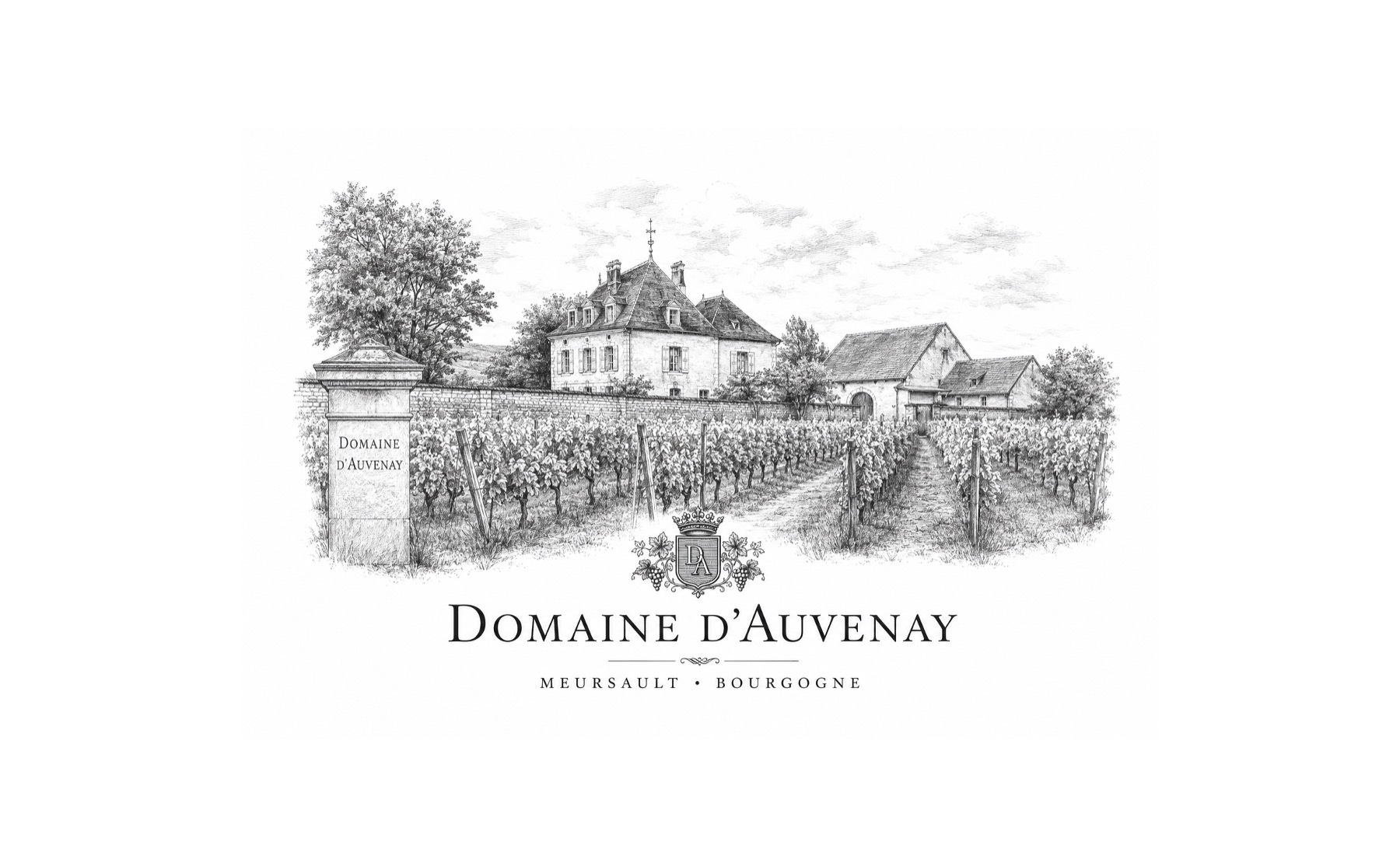
Domaine d’Auvenay
The Ultimate Collector's & Investment Guide to Burgundy's Most Elusive Cult Estate.
Collector thesis and estate trajectory
Introduction and collector thesis
Domaine d’Auvenay occupies a very unusual place in the fine-wine hierarchy. It is not a “blue-chip” wine in the Bordeaux sense of broad, daily liquidity. Nor is it merely a cult domaine for Burgundian insiders. It is better understood as an ultra-prestige collectible with selective blue-chip characteristics: globally recognized, fiercely scarce, critically revered, and capable of commanding top-tier retail and auction prices, yet intrinsically narrow in trade depth because so little wine ever reaches the market. That combination makes it exceptionally important to trophy collectors and long-horizon private-cellar investors, but less suitable for anyone who defines investability primarily as ease of exit.
The estate’s global relevance is obvious in current market positioning. On Wine-Searcher’s 2025 ranking of the world’s most expensive Chardonnays, Domaine d’Auvenay’s Bâtard-Montrachet, Chevalier-Montrachet, and Criots-Bâtard-Montrachet occupied the first three places, ahead of Montrachet from Domaine Leflaive and Domaine de la Romanée-Conti. Even d’Auvenay’s premier cru and village-level whites appeared at prices that many grand cru estates never approach.
For collectors, that has an important consequence: d’Auvenay is not simply “another great Burgundy.” It is one of the clearest examples in wine of a producer whose brand prestige, critic standing, and microscopic supply elevate nearly the entire range into collectible territory, including Bourgogne Aligoté and village Meursault. That breadth of collectibility is rare even among the great names of Burgundy.
Historical background
Public information on Domaine d’Auvenay is thinner than for many comparably prized estates, so precision matters. The historic farm itself is much older than the modern wine estate: Decanter’s Clive Coates profile records that the Saint-Romain property known as Domaine d’Auvenay has documentary traces back to a donation in 1180, and that it belonged to Henri Leroy’s bachelor brother before Lalou Bize-Leroy made it her home.
The modern collector-relevant estate took shape in the late 1980s and early 1990s. Clive Coates records a sequence of acquisitions under the Auvenay name: Puligny-Montrachet Les Folatières in 1989, Criots-Bâtard-Montrachet in 1990, Chevalier-Montrachet from Jean Chartron in 1992, Bonnes-Mares in 1993, Mazis-Chambertin from the Collignon family in 1994, and then seven ouvrées of Bâtard-Montrachet plus Puligny Les Enseignères in 2011. He also notes that a new cuverie was installed at Auvenay in 1994.
Two historical points matter most for collectibility. First, this was never a large domaine built on volume; it was assembled plot by plot, with acquisitions targeted at elite terroirs. Second, its prestige rose in tandem with Lalou Bize-Leroy’s own ascent from important Burgundian figure to near-mythic one. Neal Martin’s and William Kelley’s later writing makes clear that by the 2010s d’Auvenay had already become one of Burgundy’s most elusive and admired estates.
Ownership, leadership and strategic direction
Documented fact is straightforward at the top: Domaine d’Auvenay is Lalou Bize-Leroy’s personal estate. Public detail becomes much thinner below that level. Official Leroy history notes that long-term advisor Frédéric Roemer, who joined in 1994, assists in vineyards and cellar, while Gilles Desprez is at the helm of sales. Fine+Rare reporting from 2020 described Roemer and Desprez as Lalou’s “right-hand men.”
What is not publicly documented in equivalent detail is a modern, estate-specific organizational chart for d’Auvenay. Serious collectors should therefore assume continuity of philosophy is strongly tied to Lalou herself and to a small circle of long-serving collaborators rather than to a highly transparent institutional structure. That matters because succession risk is real at any single-vision estate, especially one where external reporting still presents Lalou as the decisive stylistic force and, as recent coverage notes, a proprietor now in her 90s.
Analytically, that concentration of authority has been positive for quality and prestige. It has produced an estate whose identity is unusually coherent across terroirs and vintages. But it also means the estate’s long-term investment story is inseparable from the question of post-Lalou continuity, a matter on which reliable public disclosure remains limited.
Terroir, farming and cellar practice
Terroir and vineyard holdings
Reliable sources converge on one essential point: Domaine d’Auvenay is tiny, totaling roughly four hectares. Decanter described it in 2018 as “just about four hectares,” while Sotheby’s wrote in 2023 that the entire holding was “just four hectares,” predominantly white and spread across fourteen appellations, including five grands crus. Public counts vary slightly by source because some later additions and village bottlings are counted differently, so “roughly four hectares” is the most responsible formulation.
The estate’s geographic base is the Saint-Romain plateau above the Côte de Beaune. The BIVB records Saint-Romain as an appellation created in 1947, with vineyards at 280 to nearly 400 meters, on slopes of limestone, marl, and some clay, facing south/south-east and north/north-east. That altitude is important today: recent Decanter reporting emphasized that warming seasons have materially improved prospects in Saint-Romain and other “behind the hill” villages.
Auvenay’s wider vineyard mosaic matters more to collectors than the home base alone. The estate includes elite whites in Puligny and Chassagne—Chevalier-Montrachet, Criots-Bâtard-Montrachet, later Bâtard-Montrachet, Folatières, Enseignères—as well as notable Meursault and Auxey-Duresses parcels, and two celebrated Côte de Nuits grands crus in Bonnes-Mares and Mazis-Chambertin. Sotheby’s notes the Chevalier holding at 0.16 hectares; auction-house lot records show just how tiny some outputs are, including 182 bottles of 2005 Criots-Bâtard-Montrachet, 622 bottles of 2003 Bonnes-Mares, and 659 bottles of 2011 Mazis-Chambertin.
Terroir expression varies widely across the range, but the official BIVB descriptions help explain the structural signatures collectors prize. Meursault’s best sites sit around 260 meters on Jurassic marls and marly limestones with east-to-south exposures; Chevalier-Montrachet sits higher, at 265 to 290 meters, on thin, stony rendzinas over marls and marly limestones; Auxey-Duresses combines marl-limestone and limier soils, with Mélian prefiguring Meursault and Puligny. Those distinctions matter because d’Auvenay’s signature is not to erase site differences, but to intensify them.
Viticulture practices
Here the evidence is strong on philosophy and somewhat thinner on estate-specific annual detail. Decanter records that both Leroy and Auvenay went beyond organic farming to embrace full biodynamics, and attributes Lalou’s conversion in part to the influence of Nicolas Joly. The same profile reports minimal sulfur and copper, strict pruning, selection massale for replanting, horse ploughing where possible, and canopy management that avoids clipping back summer foliage.
Yield discipline is central to quality and scarcity. Coates wrote that yields historically averaged around 15 hl/ha, later moving closer to 25 hl/ha in many years, while more recent commentary on Auvenay specifically still emphasizes very low yields around 15 hl/ha. Fine+Rare’s visit report on the 2019 vintage stated that most d’Auvenay cuvées amounted to only one barrel each, and that Criots-Bâtard-Montrachet came in at less than 100 liters.
The collector implication is obvious: scarcity at d’Auvenay is not a marketing fiction. It is structurally embedded in farming choices and reinforced by plot size. That is one reason the estate’s wines can behave more like art objects in the market than like conventional fine wines.
Winemaking philosophy and techniques
Reliable public documentation is more limited here than at major classed-growth estates, but the broad profile is clear. Coates describes Leroy cellar practice as severe sorting, no destemming for reds, long cuvaison, incorporation of press wine, retention of lees, 100% new oak, no filtration, and bottling that tends to be relatively early—often after 12 to 15 months—to preserve fruit. Jancis Robinson later wrote that the wines were being bottled “slightly earlier than they used to be,” accentuating their precision.
A World of Fine Wine article, surfaced via search, reports that white grapes are pressed immediately without crushing in a pneumatic press, with a specific exception for Auvenay’s tiny parcel of Criots. Merchant and importer reporting also consistently describes extremely labor-intensive sorting, including large teams working by hand and, for reds, whole-cluster or whole-bunch vinification. Because d’Auvenay does not publish technical sheets in the manner of some larger estates, those more granular points should be treated as well-sourced but less formally documented than the biodynamic and élevage information above.
Analytically, these choices explain the paradox of d’Auvenay’s style. The wines are often massively concentrated, yet they are not broad or lazy. They tend instead toward unusual tension—reduction, salinity, chalk, and cut—wrapped around formidable extract. That combination is exactly why critics so often write about them in the language of paradox: density without heaviness, richness without softness, grandeur without obvious sweetness.
Portfolio and house style
Portfolio of wines
There is no “second wine” architecture at d’Auvenay. The portfolio is a mosaic of tiny terroir bottlings: grand crus such as Chevalier-Montrachet, Criots-Bâtard-Montrachet, Bâtard-Montrachet, Bonnes-Mares, and Mazis-Chambertin; premier crus including Meursault Gouttes d’Or and Puligny-Montrachet Les Folatières; village wines such as Meursault Les Narvaux and Puligny Les Enseignères; Auxey-Duresses wines from holdings including Les Clous, Les Boutonniers, and La Macabrée; and the cult Bourgogne Aligoté Sous Châtelet. Public sources differ slightly on the exact current count of labels, but not on the essential reality: the range is unusually broad for so small an estate, and nearly all of it is scarce enough to matter to collectors.
Not all labels are equally investment-relevant. The core trophy wines are the grand cru whites, especially Chevalier-Montrachet, Criots-Bâtard-Montrachet, and now Bâtard-Montrachet. The connoisseur’s arbitrage wines—to the extent arbitrage still exists here—are Meursault Les Narvaux, Les Gouttes d’Or, Puligny Les Folatières, and Bourgogne Aligoté Sous Châtelet, because the market treats them with a seriousness usually reserved for grand cru bottlings.
Production data from auction catalogs shows why the hierarchy is so compressed. Chevalier-Montrachet output has been recorded at 907 bottles in 2004, 600 bottles in 2009, and 914 bottles in 2011. Meursault Les Narvaux, by contrast, has reached 3,109 bottles in 2007 and 2,093 bottles in 2009—larger, but still tiny by fine-wine standards. The red grands crus remain microscopic: 622 bottles for Bonnes-Mares 2003 and 659 bottlesfor Mazis-Chambertin 2011.
House style and tasting identity
Critical consensus places d’Auvenay among Burgundy’s most intensely individual white wines. William Kelley’s notes on 1999 and 2007 Narvaux, on 2015 Aligoté, and on 2016 Chevalier all point toward a house style built on concentration, texture, youthful reduction, tangy or incisive acidity, and an almost architectural finish. Antonio Galloni’s barrel notes on 2011 Narvaux and 2011 Folatières emphasize purity, depth, minerality, and silk-like texture; Neal Martin’s 2023 note on 2015 Aligoté describes a wine of “gobsmacking intensity” and “laser-like focus.”
The white house style therefore sits at an unusual intersection of power, reduction, minerality, and longevity. These are not easy, early, generously open white Burgundies. Even village wines can require patience. Kelley explicitly wrote that the 2007 Narvaux only began to show all its cards after an hour in the glass, and Robinson’s comments on earlier bottling suggest that precision rather than overt volume has become more accentuated over time.
Public tasting evidence on the reds is less abundant, but what exists is consistent. Decanter’s note on 1996 Bonnes-Mares speaks of extraordinary concentration and power; auction-house and critic commentary repeatedly frames Bonnes-Mares and Mazis-Chambertin as wines of formidable density and rarity. In collector terms, the reds are less universally defined by a single stylistic shorthand than the whites, but they clearly belong to the same family of concentrated, long-lived, market-conscious rarities.
Vintages, critical reception and cellaring
Vintage performance and cellaring strategy
The strongest investment vintages, based on verified critic scores and market response, are the obvious modern landmarks: 2010, 2015, and 2016. Robert Parker Wine Advocate records 100 points from William Kelley for 2010 Chevalier-Montrachet, 2015 Chevalier-Montrachet, and 2016 Chevalier-Montrachet, with long drinking horizons into the 2060s and 2070s. At the top of the hierarchy, those are the clearest targets for collectors seeking indisputable benchmark status.
Where d’Auvenay becomes especially interesting is in non-classically “easy” vintages. The 2011 whites show that the estate can outperform the broader vintage narrative: Galloni rated the 2011 Meursault Les Narvaux 93–95 and the 2011 Folatières 94–96, while Neal Martin gave Narvaux 93 and Folatières 92 in Wine Advocate. That suggests a cellar strategy more nuanced than simply buying the headline years.
For mature-drinking collectors, 1999 and 2007 deserve special emphasis. Kelley rated the 1999 Narvaux 95 and the 2007 Narvaux 98, describing both in terms that indicate serious age-worthy structure rather than nostalgia-driven reverence. Neal Martin also singled out mature d’Auvenay as among his most memorable Burgundy experiences, naming 1996 Chevalier-Montrachet in his greatest wine-drinking experiences of 2016 and placing a major d’Auvenay retrospective among Vinous highlights.
The Bourgogne Aligoté should not be dismissed as a curiosity. Neal Martin moved from 90 points on the 2011 in Wine Advocate to 94 points in 2023, and then gave the 2015 Sous Châtelet 96, while William Kelley rated the 2015 92 with a projected window to 2040. For drinking value there is none, but for connoisseur prestige and long-term cellar interest it is one of the most unusual wines in Burgundy.
Format strategy is necessarily conservative because market data by format is thin. What is clear from auction practice is that original wooden cases, original tissues, consecutive bottle numbers, and large-format provenance are strongly valued signals. Where magnums exist and can be verified, they are desirable; but for most buyers, pristine standard bottles in original packaging will offer the best balance of security and resale practicality.
Critical reception and reputation
Critical consensus around d’Auvenay is unusually emphatic. William Kelley wrote in 2021 that Lalou Bize-Leroy was “making wines for eternity,” a phrase that captures the way the estate is framed in top-tier criticism: not merely as excellent, but as intentionally built for decades.
The hard-score record confirms that rhetoric. Wine Advocate’s documented peaks include 100 points for 2010, 2015, and 2016 Chevalier-Montrachet; 98 points for 2007 Meursault Les Narvaux; 95 points for 1999 Meursault Les Narvaux; and 92 points for 2015 Bourgogne Aligoté. These are not isolated grand cru triumphs. They show a critic system willing to reward d’Auvenay across classification levels.
Neal Martin’s reception is similarly revealing. He gave the 2011 Bourgogne Aligoté Sous Châtelet 94 in 2023 and the 2015 Aligoté 96 in 2024, while his earlier Wine Advocate notes on 2011 Narvaux and 2011 Folatières confirm that even in lesser-celebrated Burgundy years d’Auvenay remained a critical event. His famous line that most people have a better chance of spotting a yeti dining with a dodo than drinking d’Auvenay has become shorthand for the estate’s scarcity.
Jancis Robinson and Allen Meadows also matter here, even where their influence is less headline-driven than Wine Advocate. Robinson has published dedicated reviews of mature d’Auvenay wines including 1999 Chevalier and 1999 Narvaux, while Fortnum-level merchant records citing Burghound show mature Narvaux reviewed at 93 and earlier releases at 92–93. The result is not dependence on one critic, but a broad, elite critical consensus.
Market standing, provenance and comparisons
Market position and investment perspective
Market evidence is unequivocal on prestige and more nuanced on liquidity. Liv-ex shows a Burgundy market that is presently stable rather than euphoric—the Burgundy 150 was up 1.1% year to date and 2% over one year, but down 9.6% over two years as of current data. Even in that more selective market, Liv-ex reporting continues to single out d’Auvenay as one of the scarce, high-value Burgundies driving trade value in active weeks.
That matters: d’Auvenay is not immune to broader Burgundy cycles, but it clearly remains in the cohort buyers pursue when confidence returns. Liv-ex’s older Burgundy report also warned that Burgundy is volatile and that liquidity can be thin, with single bottles sometimes all that is available; that observation is highly relevant here. D’Auvenay therefore qualifies as investment-grade, but niche rather than fully liquid.
Auction evidence is exceptionally strong. Christie’s reported that a three-bottle lot of Chevalier-Montrachet 2011 sold for HK$562,500 at Sotheby’s Hong Kong in 2022, while Christie’s records show Chevalier-Montrachet 2011 at HK$125,000 for a single bottle in 2023, Chevalier-Montrachet 2007 at HK$400,000 in 2026, Mazis-Chambertin 2003 at GBP 4,750 in 2026, and Bonnes-Mares 1996 at HK$812,500 for twelve bottles in 2022. Christie’s also reported in 2021 that an “Exceptional Private Cellar” centered on d’Auvenay was 100% sold, with d’Auvenay totals hitting 177% over low estimate and a lot of 1999 Puligny En La Richarde realizing HK$812,500 for nine bottles.
Current auction estimates remain extraordinary. Sotheby’s July 2026 sale priced Chevalier-Montrachet 2016 at HK$400,000–550,000 for three bottles, Chevalier-Montrachet 1998 at HK$350,000–500,000 for four, Meursault Les Narvaux 2007 at HK$130,000–180,000 for three, and Bonnes-Mares 2003 at HK$55,000–75,000 for one bottle. These are not theoretical values; they are live auction-house estimates in one of the world’s most important luxury-wine markets.
iDealwine’s auction reporting further underlines the estate’s current heat. In April 2025 it described Auvenay and Leroy as making a strong comeback, noting that prior annual volume had peaked at 133 bottles for Domaine d’Auvenay, an exceptionally low figure in aggregate market terms. Drinks Business reported in 2026 that d’Auvenay ranked second on iDealwine for average hammer prices, behind only Domaine de la Romanée-Conti, and highlighted prices such as €16,875 for a 2005 Criots-Bâtard-Montrachet and €5,250 for a 2002 Meursault.
Provenance, authenticity and comparative context
With d’Auvenay, provenance is not a side issue; it is central to value. Auction houses repeatedly catalogue details such as bottle numbers, original wooden cases, original tissues, levels, capsule condition, label condition, and exact production totals. That is both a practical warning and a buying template. The estate’s microscopic supply and price levels make it a natural candidate for authenticity risk, so serious buyers should favor original-case stock from leading merchants, reputable auction houses, or directly traceable private cellars.
Comparatively, d’Auvenay now sits at or above the summit of the white-wine market. Wine-Searcher’s 2025 ranking placed Auvenay Bâtard-Montrachet at $25,947, Chevalier-Montrachet at $23,168, and Criots-Bâtard-Montrachet at $22,753, above Domaine Leflaive Montrachet at $18,456 and DRC Montrachet at $11,053. Even Auvenay’s Les Gouttes d’Or, Les Enseignères, Les Folatières, and Meursault village bottlings appeared around or above the high-four-figure to low-five-figure threshold.
That is the decisive differentiator. Auvenay is not just expensive because its grands crus are rare. It is expensive because its village and premier cru wines also inhabit the luxury apex, making the entire estate function as a prestige platform rather than a classic Burgundy ladder. For collectors, that creates enormous cachet; for investors, it means entry-level access is effectively gone.
Significance, risks and final verdict
Cultural significance, risks and limitations
Domaine d’Auvenay matters culturally for two verified reasons. First, it is one of the estates most closely associated with Lalou Bize-Leroy’s role in legitimizing and popularizing biodynamic viticulture among elite Burgundian producers. Second, it helped change perceptions of Saint-Romain and the off-axis villages behind the Côte de Beaune; Decanter’s recent reporting explicitly notes that St-Romain’s modern visibility owes much to Mme Leroy’s establishment of d’Auvenay there.
The risks are equally clear. Entry prices are extreme. Liquidity is selective rather than broad. Burgundy remains a volatile market segment on Liv-ex. The estate’s public identity is strongly tied to Lalou herself, making succession a legitimate concern even if long-serving aides remain in place. And because stocks are often single bottles or tiny parcels, building or unwinding a position can be slow and provenance-sensitive.
There is also a more subtle risk: d’Auvenay can be overowned by prestige motive. These wines are so desirable that some buyers ignore the practicalities of drinking windows, storage, and resale mechanics. A collector who buys d’Auvenay without the patience to cellar, the discipline to verify provenance, and the stomach for illiquidity is buying status more than investment. That is not necessarily irrational, but it should be recognized as such.
Final collector verdict
Domaine d’Auvenay is one of the great prestige estates of the modern wine world and one of the most powerful symbols of how Burgundy rarity can translate into global luxury pricing. Its white wines in particular have crossed from elite Burgundy into a category of their own, where grand cru pedigree, microscopic production, critic reverence, and trophy demand reinforce one another continuously.
For classification purposes, the estate is best described as a trophy collectible and long-horizon luxury asset with strong but niche investment-grade credentials. It is not the ideal wine for traders who need broad market depth. It is an exceptional wine for collectors who can afford to think in decades, who value provenance as much as label, and who understand that rarity itself is part of the return.
The most attractive targets are Chevalier-Montrachet in benchmark vintages such as 2010, 2015, and 2016; Meursault Les Narvaux in mature and critically validated years such as 1999 and 2007; Bourgogne Aligoté Sous Châtelet for connoisseur prestige in 2011 and 2015; and, for red-wine specialists, Bonnes-Mares and Mazis-Chambertin when provenance is impeccable and pricing is not egregiously ahead of recent auction evidence.
The collector call is Buy Selectively. Buy not for quantity, and not for short-cycle flipping, but for apex white-Burgundy exposure, for a prestige-driven cellar, or for a diversified luxury-wine portfolio that can tolerate illiquidity. The ideal owner is a trophy collector, Burgundy specialist, or long-term private-cellar investor who wants one of the few estates whose village wines can stand in the same market conversation as other estates’ grands crus.