
There is something almost suspiciously composed about Domaine Chandon de Briailles.
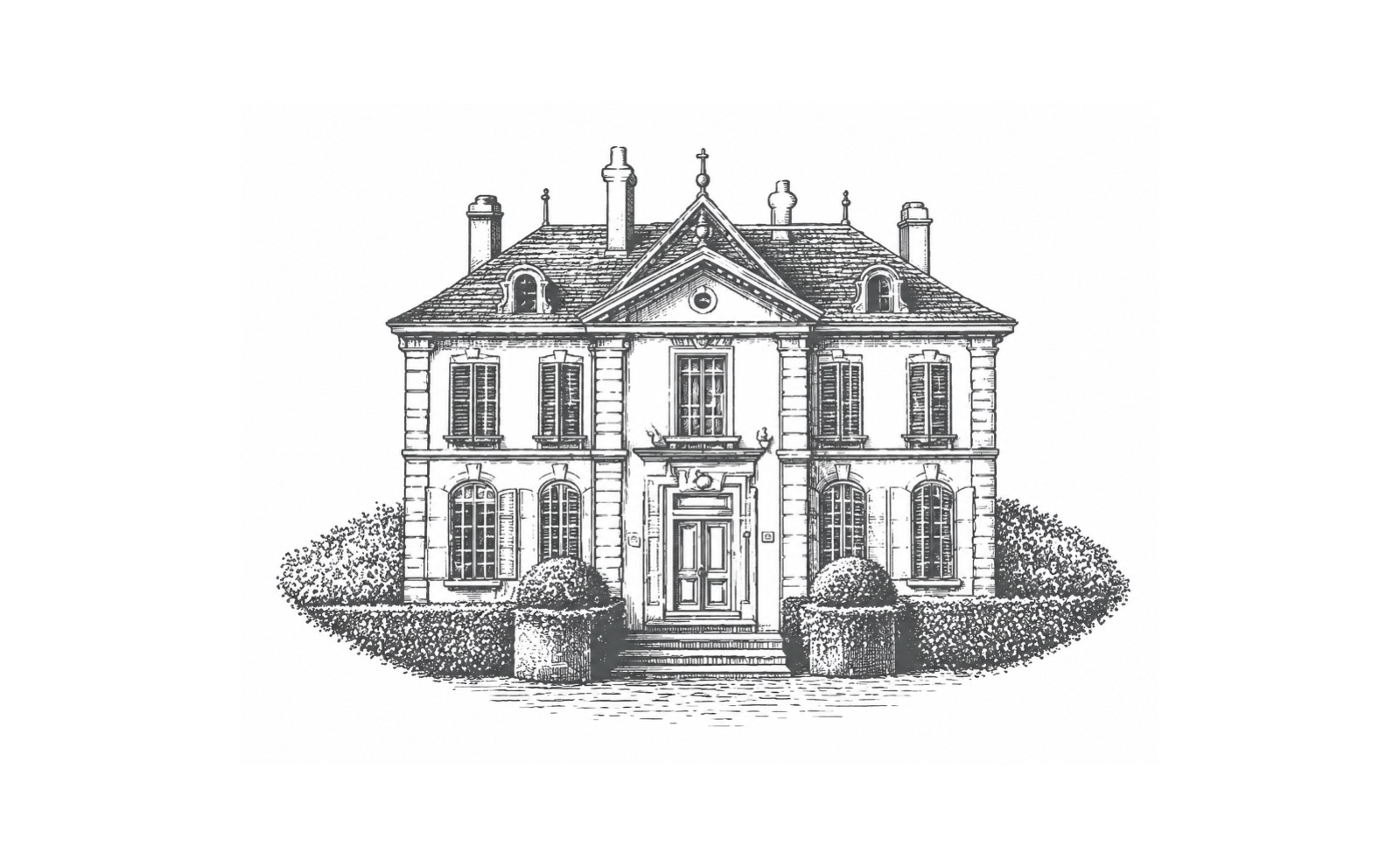
Its house at Savigny-lès-Beaune belongs to the late seventeenth and early eighteenth centuries, a world of symmetry, proportion and formal gardens. Beneath it lie much older cellars. Around it, the family has accumulated nearly two centuries of continuity since acquiring the property in 1834. As an image of Burgundy as inheritance — architecture, lineage, vineyard and bottle held together across generations — it is difficult to improve upon.
Then walk into the vineyards.
Here, four horses do the work once assigned to tractors. Synthetic treatments disappeared decades ago. Biodynamics became the organising principle. Powdery mildew may be confronted with skimmed milk rather than a conventional fungicide. In the cellar, Pinot Noir can begin fermentation as intact bunches before the vats are emptied, the fruit destemmed and fermentation resumed. New oak is restrained. Sulfur is not an automatic recipe but a decision.
This is not Burgundy preserved in aspic.
Chandon de Briailles complicates the easy distinction between traditional and modern. Much of what it does looks old-fashioned: horses, whole bunches, long élevage, old cellars, patient wines. Yet the reasoning behind those choices is distinctly contemporary. Soil compaction, sap flow, microbial life, gentle extraction and the physiological ripeness of stems belong to a Burgundy that has spent the past two decades questioning interventions once considered routine.
And then came 2024.
It was a vintage that turned philosophy into ordeal. Disease pressure was relentless. Frost and hail compounded the difficulties. Yields collapsed, and Burgundy produced one of its smallest crops of recent years.
At Chandon de Briailles, the consequences reached all the way to Corton.
In a normal vintage, the domaine bottles three red Cortons separately: Les Maréchaudes, Bressandes and Clos du Roi. Their separateness is the point. Burgundy is built on distinctions of slope, soil, exposure, altitude and drainage, sometimes measured over remarkably short distances. Growers preserve those differences; drinkers are trained to search for them.
In 2024, there was not enough wine.
The three Cortons became one.
The resulting cuvée, Trilogie Royale, tells a story before the cork is pulled. Three climats normally defended in their individuality were joined by necessity. For an estate whose reputation rests on sensitivity to place, the decision poses a particularly Burgundian question: what happens to the idea of terroir when the vintage refuses to cooperate?
A family estate that learned to change
The Chandon de Briailles story is usually told through continuity. The estate has remained in the same family since the nineteenth century and is today run by siblings Claude and François de Nicolay. The château, gardens and cellars supply all the historical atmosphere one expects of old Burgundy.
Continuity, however, is only half the story.
The more consequential inheritance may be the family’s willingness to change the way the land is farmed.
A decisive shift began under Nadine de Nicolay in 1989, when synthetic chemical treatments started to disappear from the vineyards. Claude and François later pushed the estate further, beginning conversion to biodynamic viticulture in 2005. Demeter certification followed in 2011.
That chronology matters because biodynamics has become familiar enough in Burgundy to risk becoming part of the scenery. At Chandon de Briailles, it is better understood not as a badge but as an accumulation of practical choices, each of which demands time, labour and conviction.
Since 2016, the estate has removed tractors from cultivation of the vineyard soils. Four horses — Diva, Epi, Farandole and Gipsy — now do that work. Light tracked vehicles are retained where necessary for treatments, but the principle is straightforward: keep heavy machinery off the ground.
The argument is physical before it is philosophical. Repeated tractor passes compact soil. Compaction affects the movement of water and air, root development and the conditions in which soil organisms live. A horse does not solve every viticultural problem, but it places far less pressure on the earth.
It also requires labour.
That is the side of biodynamics less easily reduced to an attractive photograph. Horses need handlers. Vineyard passes take time. Treatments must be prepared and applied. Disease still has to be controlled. For fewer than fourteen hectares, Chandon de Briailles maintains a substantial permanent workforce.
The meaningful question is therefore not whether a horse looks beautiful between Burgundian vines. It is whether this degree of manual farming can be sustained as vintages become more erratic and growing seasons more extreme.
In 2024, the question became acute.
The estate had to intervene in the vineyards far more frequently than in a normal season. That apparent paradox is important. Low-intervention farming does not necessarily mean less work. In a difficult year it can require more observation, more passes through the vineyards and a much narrower margin for error.
The romance of biodynamics tends to centre on preparations, lunar rhythms and horses. Its reality in a year such as 2024 is closer to endurance.
The grand cru that isn’t
For all the prestige of Corton, the vineyard that may explain Chandon de Briailles most clearly sits lower in Burgundy’s official hierarchy.
Pernand-Vergelesses Premier Cru Île des Vergelesses is one of the domaine’s defining holdings. François de Nicolay has called it the family’s cheval de bataille — its workhorse, its standard-bearer.
That is a revealing description from a producer with grand cru Corton in the cellar.
The domaine owns a substantial part of Île des Vergelesses and makes both red and white from the site. Pinot Noir occupies the old red-wine parcels; Chardonnay another portion of the vineyard. It lies in that compelling zone around Pernand-Vergelesses where the hill of Corton begins to assert itself but the labels have not yet acquired grand cru status.
Burgundy encourages us to read its hierarchy vertically: regional, village, premier cru, grand cru. Reality is less orderly.
A great grower can make a village wine more compelling than a mediocre grand cru. Certain premier crus possess exposures, histories and reputations that make their official position seem inadequate to what is actually in the glass. Île des Vergelesses belongs to that category.
At Chandon de Briailles, its importance is reinforced by scale. The family owns enough of the vineyard for it to become not merely another cuvée but part of the estate’s identity. The domaine has even spoken of the site in terms of a kind of “super premier cru.”
The phrase captures one of the tensions at the heart of serious Burgundy drinking. Classification is indispensable; without it, the region becomes almost impossible to understand. Yet the longer one drinks Burgundy, the less sufficient classification seems.
Île des Vergelesses offers Chandon de Briailles something its small grand cru parcels cannot: continuity, repetition and an unusually deep archive of experience. A grower comes to know a vineyard not through prestige but through decades of working it, in heat and rain, abundance and scarcity.
If Corton is Chandon de Briailles at its most exalted, Île des Vergelesses may be the domaine at its most articulate.
Whole bunches, but not dogma
The cellar provides another example of an apparently old method being reconsidered through a modern lens.
Whole-cluster fermentation has become one of contemporary Burgundy’s great stylistic debates. During the decades in which destemming became close to universal, stems were often regarded principally as a source of vegetal flavour or hard tannin. Their return at many ambitious domaines has brought its own vocabulary: perfume, freshness, spice, structure.
At Chandon de Briailles, however, “whole cluster” does not quite describe what happens.
The current approach to the reds begins with intact bunches undergoing several days of intracellular fermentation. The vat is then emptied. The fruit is destemmed, after which juice and solids are returned to continue fermentation. Extraction depends largely on comparatively gentle pumpovers.
It is an unusual sequence: whole bunches first, destemming later.
The reasoning is more experimental than nostalgic. The domaine wants some of what stems can contribute without necessarily accepting everything they contain. François de Nicolay has explained the method in terms of tannin management: the first phase can capture a finer contribution from the stems while avoiding the harder extraction that may develop later in fermentation.
The same pragmatism governs oak. The wines mature predominantly in traditional Burgundian barrels, but the proportion of new wood remains low. Oak is not there to advertise itself.
Sulfur follows a similar logic. The domaine avoids routine additions during vinification, but sulfur-free winemaking is not treated as a purity test. A small addition can be made before bottling if a wine needs protection.
This matters because “natural wine” is often too imprecise a category for estates such as Chandon de Briailles. The domaine shares many practices associated with that movement — biodynamic farming, spontaneous fermentation, low additions, whole bunches — yet its methods are technically detailed and carefully controlled.
The objective is not to do nothing.
It is to intervene deliberately.
The slow whites
The whites apply much the same philosophy to time.
Whole bunches are pressed, and the wines can remain on their lees in larger-format oak vessels for more than two years. Twenty-six or twenty-eight months is a long élevage for white Burgundy, particularly when commercial pressure favours earlier bottling and release.
A second winter in the cellar is not an incidental detail. It ties up vessels, cellar space and capital. The domaine accepts those costs because it believes the wines benefit from developing at their own pace.
That patience helps explain Chandon de Briailles better than the language of modernity or tradition alone. Its changes have rarely been cosmetic. They concern cultivation, extraction, sulfur, vessel size and time.
The château still looks like the château.
The process behind the wine has been repeatedly reconsidered.
What 2024 exposed
This is why 2024 matters beyond the quality of a single vintage.
It placed pressure on the whole philosophy.
Biodynamics is easiest to admire in a dry, balanced growing season. Its real test comes when mildew pressure becomes ferocious, treatments are repeatedly challenged by rain and a grower faces the possibility of losing a substantial part of the crop.
Terroir is easiest to celebrate when each climat produces enough wine to be bottled separately. Its limits become more interesting when three grands crus yield so little that preserving their separate identities no longer makes practical sense.
And low-intervention cellar work is easiest when pristine fruit arrives at the winery. The real test is how rigorously a producer sorts and adapts after months of difficult weather.
Chandon de Briailles did not abandon its principles in 2024. Nor could philosophy cancel the conditions of the year.
That is what makes Trilogie Royale so interesting. It is both concession and statement.
In most wine regions, blending three neighbouring parcels would barely require explanation. In Burgundy, it touches one of the region’s central beliefs. Generations of growers, merchants and drinkers have been trained to care about exactly where a vine stands. An enormous intellectual and commercial structure has grown around the conviction that one climat should taste different from the next.
By combining Bressandes, Clos du Roi and Les Maréchaudes, Chandon de Briailles temporarily set aside one of Burgundy’s most cherished habits.
But perhaps that was the more truthful expression of 2024.
A vintage belongs to terroir too.
A site does not exist independently of rain, temperature, disease and the choices made by the person farming it. A climat is not a museum specimen but an agricultural place, and agriculture occasionally refuses the neatness demanded by labels.
Trilogie Royale may therefore express something broader than any one of its constituent parcels: not simply Corton, but Corton subjected to 2024.
Burgundy without nostalgia
It would be easy to romanticise Chandon de Briailles.
The temptation is everywhere: the château, the formal gardens, the old cellars, the horses moving between rows of vines, a family estate approaching two centuries under the same ownership. Burgundy provides an almost inexhaustible vocabulary for nostalgia.
But nostalgia is not what makes the domaine interesting.
Claude and François de Nicolay inherited an old estate, not an obligation to repeat every old habit. Their achievement has been to distinguish between tradition that carries knowledge and convention that merely carries momentum.
Tractors need not remain in the vineyards simply because they are efficient. Synthetic chemistry need not be used simply because it became normal. Stems need neither be rejected nor worshipped. Sulfur need neither be added reflexively nor excluded ideologically. And a premier cru need not be treated as emotionally secondary to a grand cru simply because the classification says so.
Even the château offers a useful analogy.
A building survives for centuries not because nobody touches it, but because successive generations decide what must be preserved, what must be repaired and what can be changed. A wine estate is no different.
The next generation is beginning to enter that conversation. After the transformations introduced by Claude and François, the question is becoming not simply what they will hand on, but what they expect their successors to question in turn.
The inheritance is obvious in one sense: vineyards in Savigny, Pernand and Corton; old vines; cellars; a remarkable house; bottles carrying one of the Côte de Beaune’s established names.
The harder inheritance is a way of thinking about those things.
That may be what makes Chandon de Briailles feel most contemporary. Its future does not depend on looking modern, nor on discarding the trappings of history to demonstrate relevance. Its modernity lies in refusing to confuse age with authority.
The old house can remain.
The old assumptions do not have to.