
Coteau Libre: High-Altitude Precision in Auvergne
Granite slopes at 650m shape a fresh, structured 2023 from Fleuriet and Aublet-Cuvelier
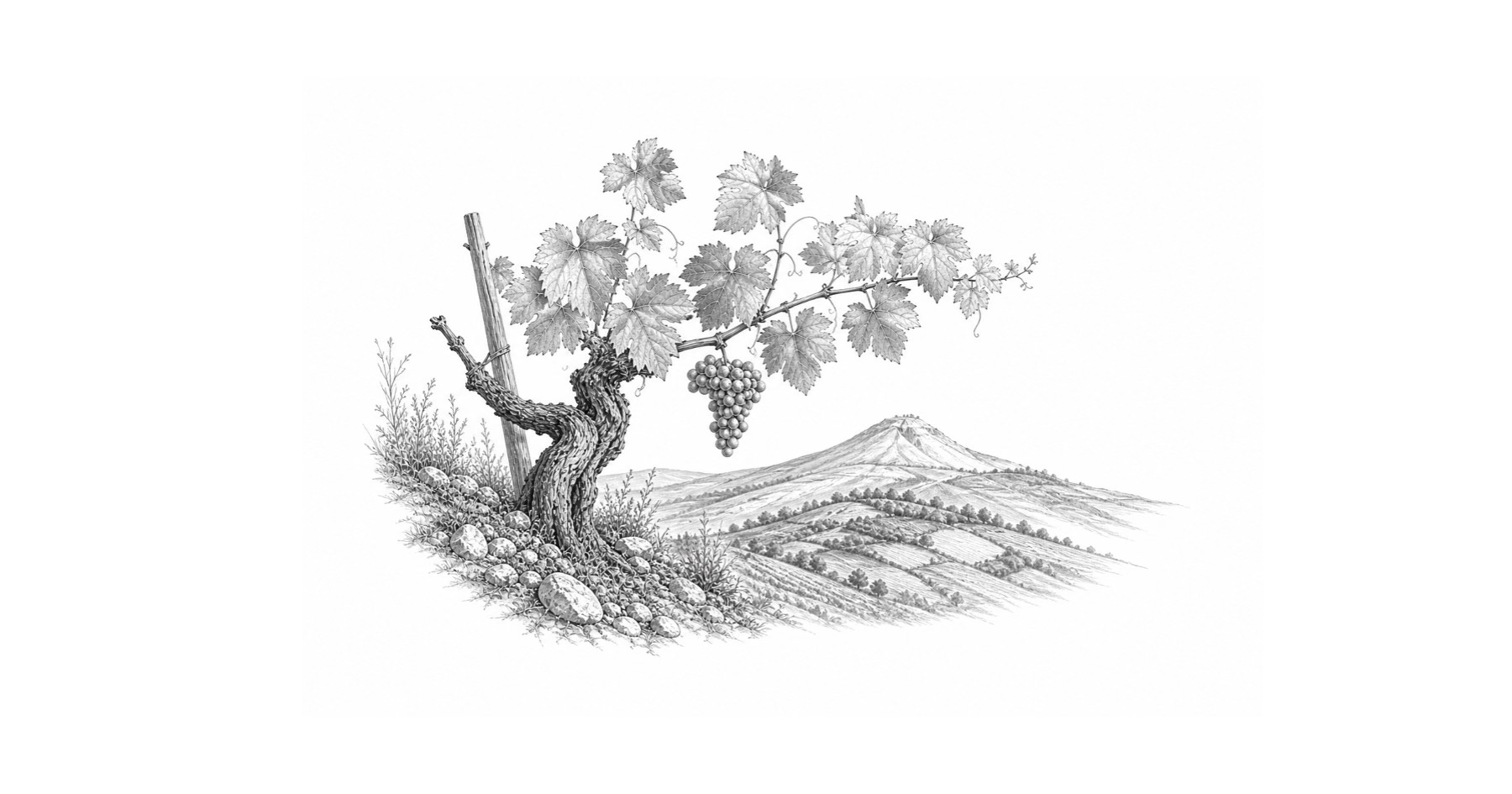
A discreet project in an unlikely landscape
In Saint-Privat-du-Dragon, south of Brioude, a small vineyard has been established on terrain more often associated with pasture than with vines. Here, at 650 metres above sea level, Mathieu Fleuriet—known for his roots in Sancerre—has joined forces with Paul Aublet-Cuvelier to create Domaine Coteau Libre.
The scale is modest: 5.5 hectares planted on granitic slopes. Yet the ambition is clear—not in volume, but in the attempt to define a site that sits outside established appellation logic.
Granite, altitude, and constraint
At this elevation, ripening is neither guaranteed nor uniform. Temperature variation, wind exposure, and the inherent poverty of granite soils impose strict limits. These are not conditions that favour exuberance. Instead, they encourage measured growth, slower maturation, and naturally moderated alcohol levels.
Granite, in this context, contributes more than drainage. It frames the wines structurally, often lending a firm, linear backbone rather than breadth. Combined with altitude, it produces profiles that lean toward tension and precision rather than generosity.
Varietal choices beyond convention
The vineyard composition reflects a willingness to step outside regional expectations. On the white side, chenin, roussanne, and pinot gris coexist—varieties not typically associated with this part of Auvergne, yet each bringing a distinct structural element.
Chenin provides acidity and length, roussanne contributes texture and mid-palate weight, while pinot gris introduces a subtle aromatic breadth. The blend is not designed for immediate clarity of identity but for balance across contrasting traits.
The red cuvée, “Le Rouge,” combines syrah, gamay, and pinot noir. Here again, the logic is structural rather than stylistic. Syrah offers backbone, gamay introduces energy, and pinot noir refines the tannic frame. The result is not a hybrid of regions but an attempt to respond directly to site conditions.
The 2023 vintage: definition through restraint
The 2023 vintage provides an early indication of how these elements converge. The wines are marked by clarity and composure rather than amplitude.
The white blend shows a controlled profile, where acidity drives the palate without sharpness. Texture is present but not dominant, and the finish maintains a steady, mineral line shaped by the granitic substrate.
“Le Rouge” is equally measured. The structure is fine-grained, with moderate extraction and a clear emphasis on drinkability without dilution. The interplay between varieties is evident but not fragmented; each contributes without asserting dominance.
Positioning without appellation
Operating outside a major appellation framework, Coteau Libre occupies a space that allows for flexibility but demands coherence. Without the support of established typicity, the wines must define themselves through consistency and site expression.
The pricing of the 2023—positioned at €35—places it firmly within a category where expectations are precise. In this context, the wines rely less on narrative and more on their ability to convey balance, structure, and origin.
A site in formation
Coteau Libre remains, at this stage, a project in development. Young vines, evolving farming decisions, and ongoing refinement in the cellar all suggest that the current wines are only a first articulation.
What is already apparent, however, is a clear direction: one that privileges tension over weight, structure over expression, and site over formula. In a region still defining its modern identity, such an approach carries particular relevance.