
Cîteaux Abbey Wine Auction: Burgundy’s Grand Crus Return to Their Source
Burgundy’s domaines unite behind a Christie’s sale and Clos de Vougeot dinner to restore a rare Cistercian monument.
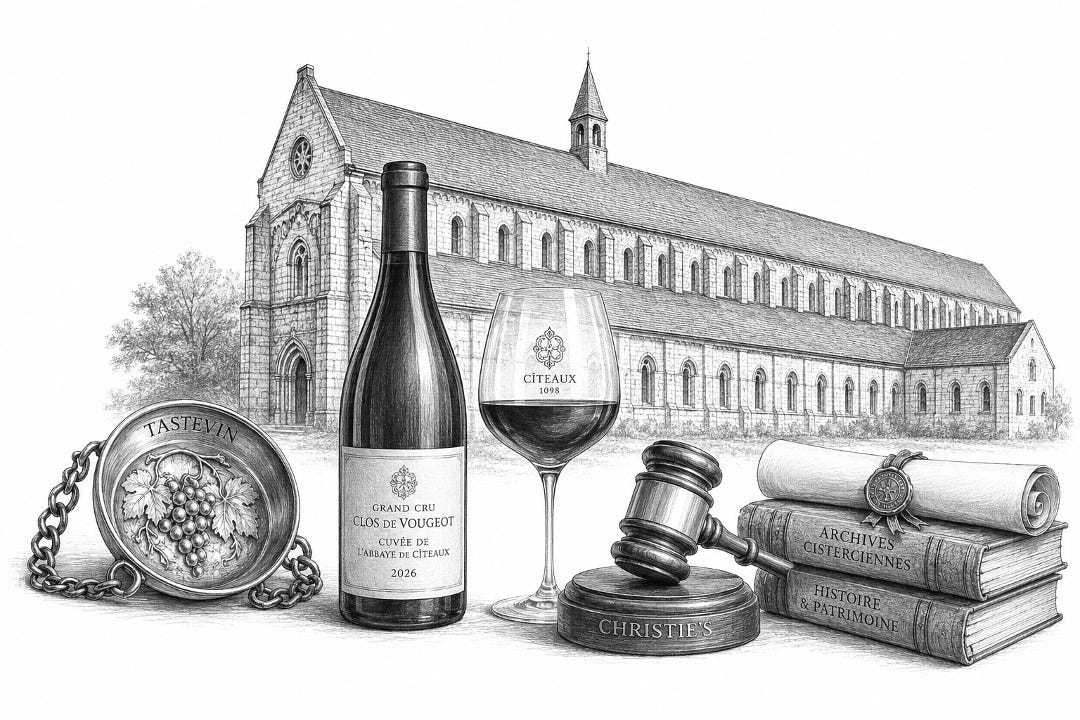
In Burgundy, wine is rarely only wine. It is memory, landscape, labour, inheritance and, at times, gratitude made visible. The forthcoming Cîteaux Abbey wine auction gives this idea unusual clarity. In September 2026, the Confrérie des Chevaliers du Tastevin will bring together collectors, domaines and admirers of Burgundy for a charity dinner and Christie’s auction in aid of the restoration of the abbey’s historic definitorium.
The cause reaches beyond architectural preservation. Cîteaux is not a picturesque footnote to Burgundy’s wine story; it is one of its deep sources. The Cistercian order helped shape the region’s understanding of place, parcel and patient observation — the sensibility that later generations would recognise in the language of climats. For today’s growers to support the abbey is, in a sense, to acknowledge one of the intellectual and spiritual foundations of Burgundian terroir.
From Clos de Vougeot to Cîteaux: A Wider Burgundy Charity Auction
This is not the first time Burgundy has rallied around Cîteaux. A first charity sale in 2022, organised with the Fondation du Patrimoine, raised €650,000 for the abbey. On that occasion, 24 domaines contributed wine to create a special Clos Vougeot Grand Cru cuvée dedicated to Cîteaux.
The 2026 edition is broader in scope. Rather than return to the same circle of donors, the organisers have sought to involve a larger part of the Côte-d’Or. The response has been striking: around 150 domaines and Burgundy houses have contributed bottles, lots or experiences. Such participation speaks not only to the prestige of the project, but to a shared awareness that Burgundy’s wine culture and Cistercian history remain inseparable.
For many vignerons, this is not nostalgia. It is continuity. The abbey, the Clos de Vougeot, the Côte de Nuits and Côte de Beaune, the grands crus and village vineyards — all belong to a landscape where stone, vine and human intention have long answered one another.
What Collectors May Find in the Cîteaux Abbey Wine Auction
The auction promises a remarkable cross-section of Burgundy. The lots are expected to include 24 grands crus, 19 premiers crus and wines from 17 village appellations. For collectors of rare Burgundy wines, the range is notable not only for the appellations involved, but also for the provenance: the donations are described as coming directly from the cellars of the participating estates.
That detail matters. In the world of fine wine, especially mature Burgundy, condition and storage history can be as important as the label itself. Direct-from-domaine bottles offer a level of reassurance that is difficult to replicate on the secondary market.
Among the anticipated highlights are unusual formats, special series and mature vintages reportedly extending from 1937 to 2025. A six-vintage vertical of Clos de Tart Grand Cru is among the lots already mentioned. The catalogue is also expected to reach beyond Burgundy in one symbolic instance, with a German Pinot Noir from Eberbach Abbey, another Cistercian house.
The full catalogue will determine the character of the sale. Yet even before its publication, the outline suggests an auction of genuine interest: not a simple parade of trophy bottles, but a collection shaped by memory, solidarity and a shared cultural inheritance.
The Definitorium: Why This Cistercian Building Matters
At the centre of the project stands the abbey’s definitorium, a vast 17th-century building measuring approximately 16 by 80 metres. It was created as a meeting place for the abbots known as definitors, who prepared decisions for the annual general chapter of the Cistercian order.
Its function gives the building unusual historical resonance. The definitorium was part of a sophisticated institutional culture, one concerned with deliberation, governance and continuity across a far-reaching monastic network. Its importance is not merely monastic or regional. It belongs to a broader history of European organisation, law and collective decision-making.
The French Revolution brought that original role to an end. In 1791, the abbey’s holdings were confiscated and sold as national property. The Cîteaux estate was vast, and included Clos de Vougeot. Many abbey buildings were dismantled, their materials reused elsewhere. The definitorium survived, in part because its brickwork made it less attractive as a quarry for local construction.
Survival, however, is not preservation. The building has endured various uses over time, including industrial ones, and its condition has become a serious concern. The Cistercian community, which returned to Cîteaux in 1898, now sees its restoration as a way to protect not only a structure, but an institutional memory.
Restoration, Research and Transmission
The restoration has already begun, with an initial phase of work running from March 2025 into 2026. The roof and wall repairs alone are estimated at €8 million, while the overall project is expected to reach approximately €15 million.
The ambition is not simply to stabilise an old building. Once restored, the definitorium is intended to become a place of transmission and conservation. The ground floor is planned as a visitor route devoted to nine centuries of Cistercian history, spirituality and governance. The upper level is expected to house a conservation centre for significant Cistercian documentation, including community archives.
This dual purpose is well judged. Burgundy’s wine heritage is often approached through bottles, vineyards and cellars; Cîteaux reminds us that archives, buildings and monastic institutions also form part of the same story. The public opening is planned for 2030.
Christie’s, Clos de Vougeot and a Dinner of Rare Burgundy Wines
The Cîteaux Abbey wine auction will be conducted by Christie’s, giving the sale an international platform and allowing collectors outside France to participate remotely. Online bidding is scheduled to open on 4 September 2026 at 12:00 CEST and to conclude on 19 September during a charity dinner at the Château du Clos de Vougeot.
The dinner itself will be closely tied to the spirit of the sale. Led by chef Alexandra Bouvret and her team, it will pair the occasion with wines donated by participating estates. Bottles mentioned include Chassagne-Montrachet 2023 from Domaine Jean Chartron and Bâtard-Montrachet 2018 from Domaine de la Romanée-Conti, the latter reportedly planned with a course centred on abbey cheese.
Seats for the dinner are priced at €500 including tax, with the possibility of a reduced net cost for eligible private individuals and companies through a tax receipt issued by the Fondation du Patrimoine.
Burgundy Wine Heritage in Action
The restoration of the definitorium may appear, at first glance, to belong to the world of monuments rather than wine. In Burgundy, the distinction is never so simple. The Climats of Burgundy, inscribed on the UNESCO World Heritage list in 2015, are not merely vineyard names. They are the result of centuries of close attention to land, exposure, soil, boundaries and human practice. The Cistercians were among the great early interpreters of that landscape.
This is why the auction feels unusually apt. Burgundy’s growers are not lending their names to an unrelated charitable cause. They are supporting a place that helped shape the mental world from which Burgundy wine emerged. The gesture has elegance because it is practical: bottles from living cellars will help restore the stones of a building that speaks to the origins of Burgundy’s culture of terroir.
For serious lovers of French wine, the sale is therefore more than a collecting opportunity. It is a reminder that the greatest wine regions are not built by geology alone. They require institutions, habits, memory, discipline and a capacity to transmit knowledge across generations.
The Cîteaux Abbey wine auction brings those elements together with rare coherence. It places Burgundy’s grands crus, its domaines, its monastic past and its future custodianship in the same frame. For those who care about French wine as culture, not merely as consumption, it is an event worth following closely.