
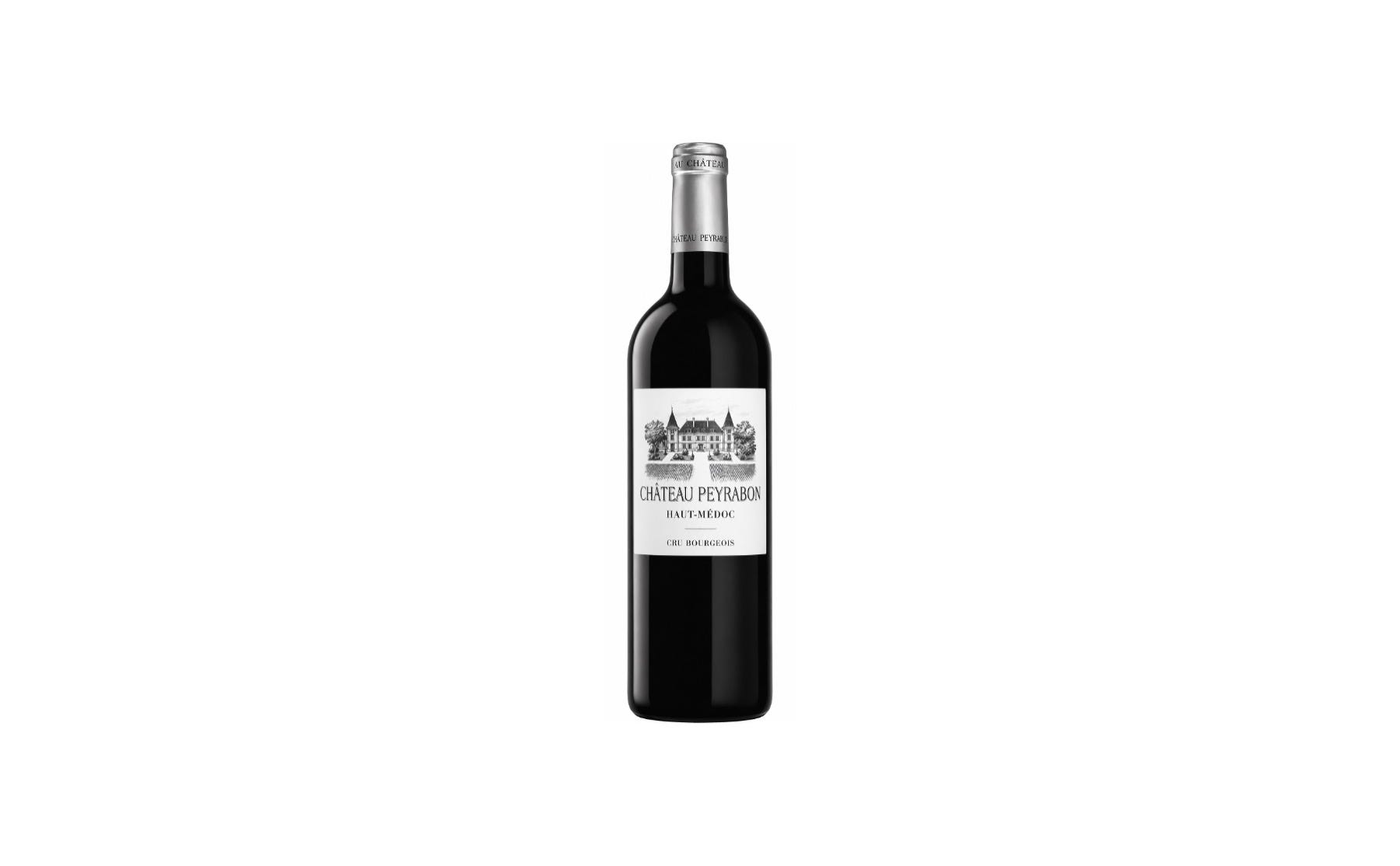
A short distance from the prestigious vineyards of Pauillac, Château Peyrabon has spent generations building a reputation on Cabernet Sauvignon, gravel-rich soils and traditional Médoc character. Now under the ownership of the Castéja family, this historic Cru Bourgeois Supérieur offers something increasingly attractive to Bordeaux enthusiasts: serious winemaking, genuine ageing potential and the opportunity to collect distinguished vintages without paying classified-growth prices.
In Bordeaux, geography can determine reputation almost as decisively as the quality of the wine itself. The distinction is particularly apparent in the northern Médoc, where the celebrated appellations of Pauillac and Saint-Estèphe command international recognition, while neighbouring vineyards classified simply as Haut-Médoc often remain comparatively overlooked.
Château Peyrabon occupies this fascinating borderland. Its vineyards lie in Saint-Sauveur-en-Médoc, just north of Pauillac, on gravelly soils traditionally associated with Cabernet Sauvignon and the structured red wines of Bordeaux’s Left Bank.
Yet Peyrabon’s identity is more than a question of proximity. With documentary origins reaching back to the eighteenth century, a long history of vineyard reconstruction and an established place among the Médoc’s Crus Bourgeois Supérieurs, the property possesses a heritage that extends well beyond its modest commercial positioning.
Its principal wine, Château Peyrabon, combines Cabernet Sauvignon’s aromatic definition and tannic architecture with the roundness of Merlot and the complementary characteristics of Cabernet Franc and Petit Verdot. The resulting style is recognisably Médoc: dark-fruited, savoury, moderately powerful and capable of developing attractive tertiary complexity over time.
For collectors accustomed to the considerable premiums attached to classified-growth Bordeaux, Peyrabon’s appeal rests on a different proposition. It offers the pleasures of traditional claret, and the possibility of following its development across vintages, at a fraction of the cost.
An Estate Shaped by History and Ambition
The earliest documented reference to Château Peyrabon dates to 1766, when the property appeared on Pierre de Belleyme’s celebrated map of the Bordeaux region.
The château’s architectural character developed during the nineteenth century, notably with the construction of its towers in 1821. Its ambitions, however, were not confined to architecture.
During that century, proprietor Arnaud Armand Roux sought greater recognition for the estate’s wines. According to the château’s historical account, Roux challenged publications that placed Peyrabon beneath Bordeaux’s established classified growths, believing that the quality and reputation of his property merited a more distinguished position.
His legal challenge ultimately failed, but the episode illustrates the longstanding tension between established classifications and the aspirations of estates outside their boundaries.
Château Peyrabon was not included in the Bordeaux Classification of 1855. Instead, its historical trajectory became associated with the broader Cru Bourgeois tradition, which developed as an alternative means of recognising quality among Médoc properties.
The category’s first formal modern classification appeared in 1932, although its origins as a description of bourgeois-owned vineyards extend considerably further into Bordeaux’s commercial history.
Peyrabon’s more recent classification record confirms its position within this tradition. The estate received Cru Bourgeois Supérieur status in the classification published in 2020 and retained that distinction in the 2025 classification, applicable to the 2023–2027 vintages.
This is a meaningful distinction. The contemporary Cru Bourgeois system separates participating estates into three categories: Cru Bourgeois, Cru Bourgeois Supérieur and Cru Bourgeois Exceptionnel. Recognition is based on a separate assessment framework rather than the historic hierarchy of the 1855 classified growths.
Reconstruction, Modernisation and New Ownership
Much of Peyrabon’s present vineyard identity was shaped by the twentieth century.
The devastating Bordeaux frost of 1956 destroyed or severely damaged vineyards throughout the region. When the Babeau family took control of Peyrabon in 1958, extensive reconstruction was necessary.
Over the following four decades, the family replanted much of the estate, renovated the winemaking facilities and expanded the vineyard. A significant addition came in 1977, when Peyrabon acquired parcels from neighbouring Château Liversan.
The next transformation began in 1998, when Patrick Bernard, owner of the Bordeaux fine-wine merchant Millésima, purchased the property.
Bernard initiated an investment programme of approximately €2 million, directed towards modernising the estate’s technical facilities and improving consistency. Greater precision in vineyard management, grape selection and cellar work gradually strengthened Peyrabon’s position among the Haut-Médoc’s established Crus Bourgeois.
A further chapter opened in September 2022, when the Castéja family acquired Château Peyrabon and Château La Fleur Peyrabon.
Through the BCAP group, the family already controlled several notable Bordeaux properties, including Château Batailley and Château Lynch-Moussas, both Fifth Growths in the 1855 Classification.
The acquisition placed Peyrabon within a group possessing considerable expertise in vineyard management, winemaking and international wine distribution.
Importantly, the estate retained technical continuity. Long-serving technical director Xavier Michelet remains closely associated with its wines, supported by oenological expertise that includes Éric Boissenot.
The Castéja family’s stewardship creates the possibility of further improvements in quality and visibility, although the long-term effect on Peyrabon’s commercial reputation remains to be established.
The Terroir: Gravel, Clay and the Influence of the Gironde
The vineyards of Château Peyrabon occupy a gravel ridge in Saint-Sauveur-en-Médoc, within the Haut-Médoc appellation and close to the Gironde estuary.
Recent estate technical documentation identifies approximately 36.57 hectares of Haut-Médoc vineyard, divided into 33 contiguous parcels.
The geological composition is central to the wine’s identity.
Much of the vineyard is planted on well-drained Garonne gravels over clay subsoil, while approximately five hectares occupy clay-limestone soils.
Gravel has long been associated with the most successful Cabernet Sauvignon vineyards of the Médoc. Its drainage properties help prevent excessive water accumulation, while its capacity to absorb and retain warmth can encourage the ripening of this relatively late-maturing grape variety.
The clay beneath provides a complementary function, retaining moisture that may become particularly important during periods of summer drought.
The clay-limestone parcels introduce another element into the blending possibilities, allowing the estate to draw on grapes grown under different water-retention and ripening conditions.
Proximity to the Gironde and the Atlantic Ocean contributes a maritime influence, moderating some temperature extremes but also exposing the vineyard to the variable rainfall and humidity characteristic of Bordeaux.
These conditions help explain the enduring importance of Cabernet Sauvignon at Peyrabon. The variety benefits from well-drained, relatively warm soils and can provide the structural backbone necessary for medium- to long-term ageing.
The vineyard’s planting proportions have evolved. The estate’s general terroir description gives approximately 57% Cabernet Sauvignon, 35% Merlot, 5% Cabernet Franc and 3% Petit Verdot, while individual technical sheets document different proportions for particular years.
The finished wine is not a fixed blend. Its composition changes according to the quality and characteristics of each harvest.
The oldest vines exceed 70 years of age, although the average age reported for recent vintages is approximately 28–30 years. Planting densities range from around 6,500 to 8,900 vines per hectare.
These figures reveal a vineyard with both established old-vine material and substantial plantings renewed during the estate’s more recent history.
Two Wines, Two Appellations
A distinction is essential for anyone exploring the property.
Château Peyrabon is the estate’s principal Haut-Médoc wine. It is an estate blend rather than a single-vineyard bottling.
Château La Fleur Peyrabon, by contrast, comes from approximately five hectares of vines within the Pauillac appellation.
Although the two wines share ownership and technical expertise, they originate from different appellations and occupy distinct positions within the estate’s portfolio.
The presence of a Pauillac wine reinforces the property’s geographical connections with that celebrated commune, but it does not change the identity of Château Peyrabon itself, which remains firmly rooted in the Haut-Médoc.
Winemaking: Precision Without Excess
Château Peyrabon’s contemporary winemaking philosophy combines established Médoc practices with technical measures designed to improve grape selection and control extraction.
Vineyard management is adapted to individual parcels and grape varieties. Pruning systems include traditional Médoc two-cane pruning for Cabernet Sauvignon, alongside shorter pruning approaches for Merlot and Petit Verdot.
Shoot thinning, leaf removal and green harvesting help regulate canopy growth and fruit exposure. The estate also employs measurements of anthocyanin richness to assist with assessing grape maturity before picking.
Recent technical documents record environmentally conscious practices, including grassed inter-rows, mechanical soil cultivation and integrated crop protection.
The property has documented High Environmental Value certification and ISO 14001:2015 environmental management standards. These credentials should not be confused with certified organic or biodynamic production.
Harvesting methods vary by vintage and parcel, with both mechanical and manual picking documented.
After reception, grapes undergo destemming and sorting. Optical sorting equipment, introduced in 2017 according to the producer, allows more precise selection before fermentation.
Vinification takes place in temperature-controlled stainless-steel and concrete vats. Individual parcels or homogeneous lots are fermented separately, preserving options for the final assemblage.
Fermentation temperatures in recent vintages have generally been around 23–25°C, with maceration commonly lasting approximately three weeks.
Extraction is adjusted according to grape maturity and tannin quality. Press wine is kept separate and incorporated only after tasting and selection.
Depending on the vintage, a proportion of Cabernet Sauvignon may undergo a separate vinification intégrale process, adding another dimension to the estate’s blending possibilities.
Fourteen Months in French Oak
The grand vin generally spends approximately 14 months in French oak barrels.
The proportion of new oak has varied between approximately 25% and 30% in recent vintages, a relatively measured approach compared with Bordeaux properties employing much higher percentages of new barrels.
This choice has important stylistic consequences.
Oak contributes structure and complexity, introducing notes of cedar, spice, tobacco and subtle toast. Used with restraint, it supports the underlying fruit rather than dominating the wine.
Combined with controlled extraction, the maturation regime helps produce a wine that is structured enough to age but sufficiently supple to provide enjoyment relatively early in its development.
For Peyrabon, the objective is not the greatest possible concentration. It is the integration of Cabernet structure, ripe fruit, freshness and oak into a coherent expression of the Haut-Médoc.
In the Glass: Classical Médoc Character
Across producer descriptions and independent critical assessments, Château Peyrabon displays a recognisable sensory profile.
Young vintages generally show a deep ruby colour, sometimes with pronounced purple reflections.
The aromatic register is dominated by blackcurrant, blackberry and dark cherry, with occasional notes of blueberry and raspberry. Floral nuances may appear, particularly violet, while liquorice, cedar, cocoa and sweet spice contribute complexity.
Cabernet Sauvignon supplies much of the wine’s aromatic definition and tannic structure. Merlot provides a rounder fruit expression and additional generosity in the middle palate.
Cabernet Franc can introduce freshness and aromatic lift, while Petit Verdot contributes colour, spice and tannic depth.
On the palate, Peyrabon is typically medium-bodied to moderately full-bodied. Its tannins are recognisably Médoc in character but, in successful vintages, show increasing polish and integration.
Acidity plays an important role, particularly in preventing the wine from becoming heavy in warmer years.
The finish is generally driven by dark fruit, savoury spice and an underlying freshness rather than overt sweetness or excessive oak.
Age introduces a different dimension.
After several years in bottle, primary fruit can gradually develop towards dried cherry, tobacco, leather, forest floor, truffle and earthy spice.
Well-preserved mature bottles may display the aromatic complexity that makes traditional claret so rewarding, although individual results depend heavily on vintage quality and storage conditions.
Peyrabon’s signature is therefore one of balance rather than extravagance. Its appeal lies in the interplay between fruit, structure and the savoury nuances that develop with time.
The Vintages That Define Modern Peyrabon
Vintage variation is essential to understanding Château Peyrabon. The estate’s relatively Cabernet-dominant vineyard makes differences in temperature, rainfall and harvest conditions especially apparent.
Several years offer particularly instructive comparisons.
2016: Classical Structure and Freshness
The 2016 vintage is one of the most convincing modern reference points for Peyrabon’s traditional style.
Its blend comprised 67% Cabernet Sauvignon, 27% Merlot, 4% Petit Verdot and 2% Cabernet Franc.
The wine combines dark fruit, lively acidity and substantial but refined tannins. Decanter awarded the vintage 90 points.
As the wine develops in bottle, the relationship between its still-present fruit and emerging savoury complexity becomes increasingly important.
For collectors seeking an established vintage with meaningful maturity ahead, 2016 remains an attractive choice.
2019: Harmony and Immediate Appeal
The 2019 blend was composed of 60% Cabernet Sauvignon, 31.5% Merlot, 5% Cabernet Franc and 3.5% Petit Verdot.
Bordeaux’s favourable growing conditions produced a vintage noted for balance, ripe fruit and relatively supple tannins.
At Peyrabon, the wine offers a combination of cassis, dark cherry, subtle tobacco and freshness.
Published assessments include 91 points from Decanter and 90 from Neal Martin at Vinous.
Its combination of quality, accessibility and modest market pricing makes 2019 particularly appealing for buyers seeking a wine that can be enjoyed now while retaining further development potential.
2020: Balanced Ripeness
The 2020 vintage contains 53% Cabernet Sauvignon, 35.5% Merlot, 7% Cabernet Franc and 4.5% Petit Verdot, with an alcohol level of 13%.
Harvesting took place from 17 September to 6 October, and the estate recorded a yield of 30.92 hectolitres per hectare.
The vintage combines ripe fruit with freshness and an organised tannic structure.
Critics have generally received the wine favourably, with assessments ranging from the upper 80s to the low 90s.
Its principal appeal lies in the balance between concentration and restraint, offering an attractive expression of contemporary Left Bank Bordeaux.
2021: The Return of a Cooler Style
The challenging 2021 vintage brought a markedly different expression.
Across Bordeaux, spring frost, cool summer conditions and significant mildew pressure complicated the growing season.
Peyrabon’s blend contained an unusually high 65% Cabernet Sauvignon, alongside 26.5% Merlot, 3% Cabernet Franc and 5.5% Petit Verdot.
Alcohol was comparatively restrained at 12.5%, while the yield fell to 25.17 hectolitres per hectare.
The resulting wine is more linear and freshness-driven than the estate’s warmer vintages.
For enthusiasts who appreciate traditional claret, with moderate alcohol and a more restrained fruit profile, 2021 provides an interesting stylistic alternative.
2022: Concentration and Cellaring Potential
The 2022 growing season was characterised by exceptional heat and drought across Bordeaux.
At Peyrabon, yields fell sharply to 19.9 hectolitres per hectare, reflecting the demanding conditions.
The final blend comprised 55% Cabernet Sauvignon, 34% Merlot, 8% Cabernet Franc and 3% Petit Verdot, with alcohol reaching 14.4%.
The wine displays greater concentration and weight than 2021, supported by a more substantial tannic framework.
Critical opinion has been positive but not unanimous. Decanter awarded 91 points, while Neal Martin’s assessment of 89 points was more reserved.
This divergence is worth considering. The vintage offers considerable ripeness and structure, but its ultimate harmony will depend on how the fruit, alcohol and tannins evolve with age.
For patient collectors, 2022 is among the estate’s more interesting recent candidates for extended cellaring.
2023: Freshness and Approachability
The 2023 blend contains 56% Cabernet Sauvignon, 41% Merlot and 3% Petit Verdot, with alcohol at 13%.
The estate recorded a yield of approximately 25 hectolitres per hectare.
Decanter awarded 91 points, highlighting the wine’s attractive fruit, freshness and approachable structure.
Compared with 2022, the vintage presents a less concentrated expression, favouring balance and accessibility.
It offers a useful introduction to the estate’s contemporary style and a promising candidate for medium-term drinking.
Ageing Potential: Patience Without Excess
Château Peyrabon has sufficient structure and acidity to reward bottle ageing, particularly in stronger vintages.
Its longevity, however, should be considered in proportion to its style and commercial positioning.
While the finest Médoc classified growths may develop for several decades, Peyrabon’s most reliable strength lies in medium-term maturation, with longer development possible in outstanding years and well-preserved bottles.
For collectors assessing recent vintages in 2026, the following drinking horizons are reasonable editorial estimates.
The 2019 should offer attractive drinking now and through approximately 2032, combining remaining primary fruit with emerging tertiary complexity.
The 2020 has the balance and structure to develop towards the mid-2030s.
The more restrained 2021 is likely to reward earlier consumption, with a suggested horizon extending to approximately 2030.
The concentrated 2022 merits additional patience. Its most rewarding phase may begin around 2027 and could extend towards 2040 under favourable storage conditions.
The 2023 should be approachable comparatively early, with potential development through the mid-2030s.
These windows are estimates, not guaranteed limits. Bottle condition, closure performance and storage history can substantially alter the trajectory of any individual wine.
Older vintages from the 1990s and early 2000s may now provide fascinating mature drinking, but provenance becomes increasingly important.
Serving Château Peyrabon
Young Peyrabon is best served slightly below typical room temperature, ideally around 16–18°C.
A generous Bordeaux glass allows the aromatic profile to open and provides sufficient space for the wine’s Cabernet-derived structure.
Recent vintages such as 2020 and 2022 can benefit from approximately an hour of decanting, although the appropriate duration depends on the individual bottle.
More mature vintages require a gentler approach.
Bottles should be stood upright before opening to allow sediment to settle. After careful extraction of the cork, the wine should be tasted immediately and decanted only if necessary.
Excessive aeration can diminish fragile tertiary aromas, particularly in bottles that have already reached an advanced stage of maturity.
At the Table
Peyrabon’s combination of tannin, acidity and savoury complexity makes it especially suitable for traditional French cuisine.
Roast lamb, particularly carré d’agneau with rosemary, provides a natural pairing. The richness of the meat softens Cabernet tannin, while the wine’s acidity refreshes the palate.
Duck breast with a restrained red-wine reduction works equally well, particularly with younger vintages displaying generous dark fruit.
For mature Peyrabon, pigeon, veal with wild mushrooms or gently roasted game can be more compelling. Their earthy and savoury flavours complement the tobacco, leather and undergrowth notes that emerge with bottle age.
Cèpes and black truffles are particularly attractive partners for well-developed examples, where aromatic harmony becomes more important than sheer intensity.
Among cheeses, aged Comté and Cantal offer a complementary combination of fat, texture and umami, whereas intensely salty blue cheeses can overwhelm the wine’s more delicate aromatic qualities.
Scarcity, Production and the Fine-Wine Market
Unlike Bordeaux’s most sought-after classified growths, Château Peyrabon is not defined by limited allocations or exceptional scarcity.
The producer describes average annual production of approximately 120,000 bottles of its principal Haut-Médoc wine.
Actual production varies substantially by vintage. The 2020 technical sheet projected around 117,000 bottles, while the difficult 2021 harvest produced approximately 102,000.
The exceptionally low yields of 2022 reduced projected production to about 72,420 bottles.
These figures demonstrate that availability is influenced by vintage conditions, but Peyrabon remains a wine produced in meaningful commercial quantities.
This has important consequences for its market position.
European retail observations during autumn 2026 placed many recent vintages around €11–16 per 75cl bottle, depending on the year, merchant and sales conditions.
At such prices, Peyrabon occupies an attractive position for enthusiasts seeking authentic Médoc character without entering the substantially more expensive classified-growth market.
From an investment perspective, however, the picture is less compelling.
iDealwine’s indicative market assessments placed the 2019 vintage at approximately €12 per bottle and the 2010 at around €15. Both figures represent price estimates rather than guaranteed transaction values.
Although they suggest some nominal appreciation relative to historical release pricing, the increases are modest once inflation, professional storage, insurance and selling costs are considered.
This distinction is crucial. A wine can improve significantly in the cellar without becoming a financially attractive investment.
Auction Performance and Secondary-Market Liquidity
Château Peyrabon appears only occasionally in the public auction record, particularly when compared with Bordeaux’s established investment labels.
One documented example occurred on 26 April 2024, when Dorotheum sold five bottles of the 1975 vintage for €293, including buyer’s premium and VAT.
The result illustrates the appeal of mature bottles with historical interest, but it cannot be treated as a representative valuation for more recent vintages.
Christie’s has also catalogued older Peyrabon, including a 36-bottle lot of the 1996 vintage. The catalogue noted damp-affected and damaged labels, demonstrating the extent to which condition can influence the assessment of mature Bordeaux.
The available evidence does not establish a deep or consistently liquid secondary market for Château Peyrabon.
That matters because investment performance depends not only on an increase in theoretical value but also on the ability to sell at a satisfactory price.
Transaction costs, limited bidding activity and potentially wide differences between merchants’ asking prices and actual resale proceeds restrict the wine’s financial appeal.
Peyrabon is therefore better understood as a wine for drinking and collecting than as a conventional investment asset.
The Collector’s Perspective
For enthusiasts building a personal cellar, Château Peyrabon offers a different set of advantages.
Its historical continuity, established terroir and approachable pricing make it particularly suitable for vertical collecting.
A collection spanning 2010, 2015, 2016, 2019, 2020 and 2022 would provide an instructive exploration of Bordeaux vintage variation, revealing how changing conditions influence Cabernet ripeness, tannin structure and aromatic development.
Unlike many prestigious Bordeaux estates, Peyrabon makes this kind of comparative exploration financially accessible.
Its relatively modest replacement cost also encourages collectors to open bottles at different stages of maturity rather than preserving every purchase for a hypothetical future sale.
Large formats offer further interest. Magnums can provide favourable conditions for slower bottle development, although their commercial premiums have generally remained modest compared with those attached to highly allocated wines.
Provenance is essential when purchasing mature bottles.
Collectors should examine fill levels, capsule integrity, signs of seepage, label condition and documented storage history.
Since 2010, the Crus Bourgeois classification system has employed numbered traceability stickers on classified bottles presented for sale. These provide an additional point of inspection, although they are not a substitute for professional authentication.
At Peyrabon’s price level, the economic incentive for sophisticated counterfeiting is considerably lower than for celebrated first growths, but poor storage and bottle deterioration remain genuine risks.
The most suitable buyer is therefore not the speculative investor seeking rapid appreciation.
It is the Bordeaux enthusiast, Haut-Médoc specialist or mature-wine collector who values the opportunity to explore ageing and vintage expression without excessive financial exposure.
Peyrabon Among Its Médoc Peers
The most instructive comparisons for Château Peyrabon are other Haut-Médoc Crus Bourgeois Supérieurs.
Château Beaumont, Château Cissac, Château Lamothe-Bergeron, Château Liversan and Château Peyrat-Fourthon all appear within the same classification tier in the official 2025 classification.
These estates provide a useful framework for evaluating differences in terroir, vineyard management, winemaking and stylistic expression.
Peyrabon’s particular advantages include its gravel-dominant vineyard, historical connections with the northern Médoc, proximity to Pauillac and technical continuity through several ownership periods.
The Castéja family’s arrival introduces another dimension, bringing experience from recognised classified-growth properties.
Nevertheless, the estate’s standing should be judged primarily by the quality and consistency of its own wine rather than by association with more prestigious neighbours.
At the prevailing retail prices, Peyrabon’s principal attraction remains its quality-to-price relationship.
It offers Cabernet-led structure, meaningful oak maturation, recognised Cru Bourgeois Supérieur status and credible ageing potential at a cost considerably below that of many better-known Left Bank properties.
Its value is therefore supported chiefly by wine quality, terroir and drinking pleasure, not by rarity or speculative demand.
Gallico Vinum Verdict
Château Peyrabon represents one of the more persuasive arguments for looking beyond Bordeaux’s celebrated classifications.
Its history is substantial, its gravel-based terroir well suited to Cabernet Sauvignon, and its modern winemaking combines technical precision with a recognisably traditional Médoc style.
The estate’s strongest vintages offer dark fruit, freshness, balanced tannins and the ability to acquire attractive savoury complexity with age. Consistent recognition as a Cru Bourgeois Supérieur reinforces its standing among quality-conscious Haut-Médoc producers.
For collectors, Peyrabon’s relatively accessible prices make vertical exploration and medium-term cellaring particularly rewarding. The 2016 and 2019 offer attractive opportunities for bottles approaching maturity, while 2020 and 2022 provide interesting prospects for further development.
Its investment appeal is considerably more limited. Production is not exceptionally scarce, international secondary-market demand remains modest, and transaction costs can readily outweigh nominal price appreciation.
The Castéja family’s ownership may strengthen the estate’s future reputation, but greater commercial recognition will depend on sustained quality, critical reception and demand rather than pedigree alone.
Château Peyrabon’s greatest distinction is the seriousness of its wine relative to its price. It offers the character, history and ageing possibilities of the Médoc without requiring the financial commitment normally associated with its most famous names.
For the enthusiast who collects wine to understand it, cellar it and ultimately drink it, that is a compelling proposition.