
Château Cos d’Estournel (Rouge)
Cos d’Estournel: terroir, power, and precision—an analytical deep dive into Bordeaux’s most distinctive “super-second”
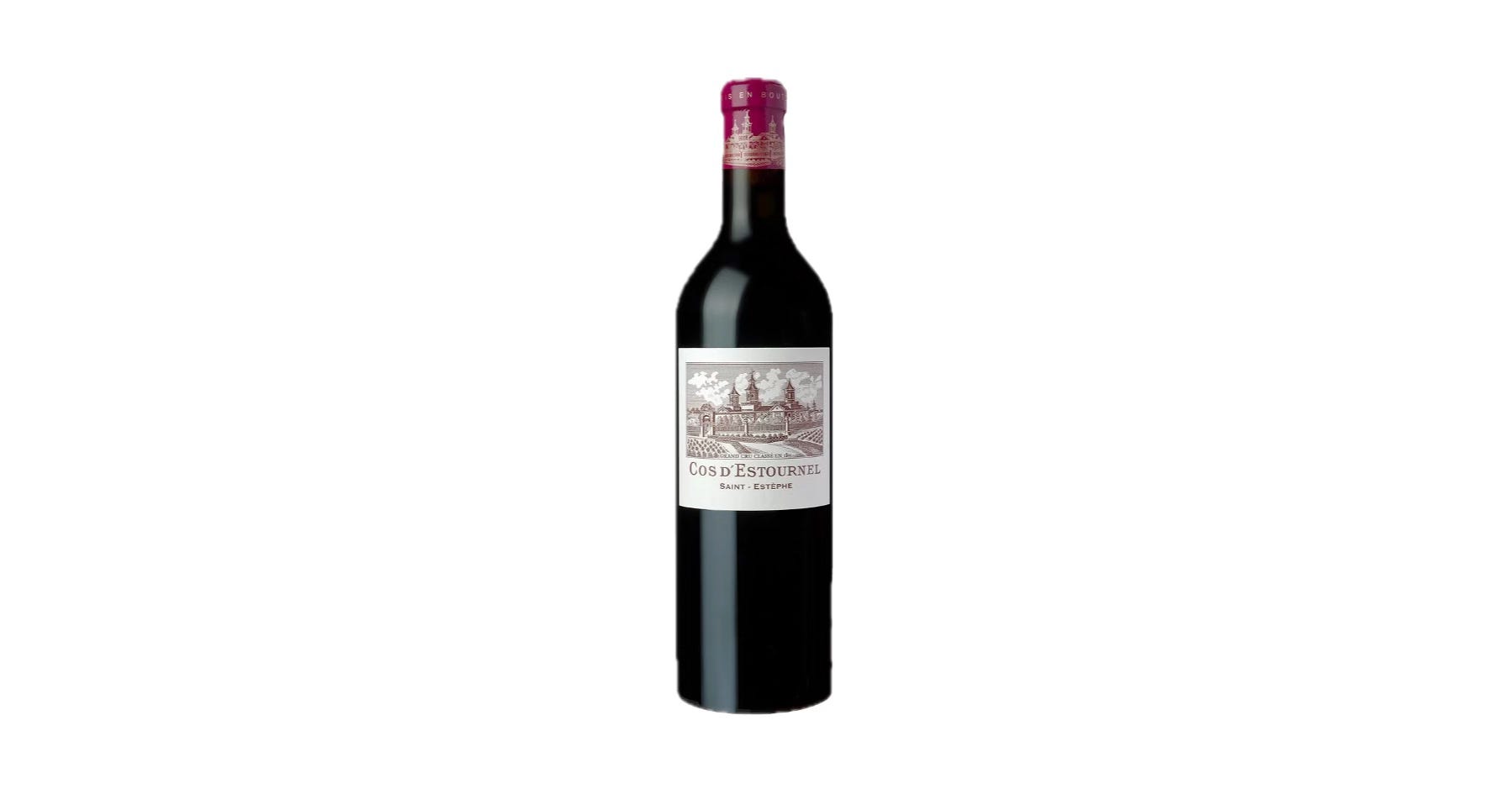
Place in Saint-Estèphe and in the history of fine Bordeaux
Within Saint-Estephe, Cos d’Estournel occupies an unusual position. It is formally a Deuxième Cru Classé under the 1855 classification, yet in collector language it has long behaved like a “super-second”: not because the classification changed, but because the estate’s best wines have repeatedly challenged the qualitative ceiling normally associated with second growths. Founded in 1811 by Louis-Gaspard d’Estournel, the property gained renown early by bypassing the standard Bordeaux négociant model and selling directly abroad, particularly into India; that commercial audacity also helps explain the estate’s famous Indo-orientalist architecture and the enduring “Maharajah of Saint-Estèphe” mythology that still surrounds the brand. By the time of the 1855 classification, Cos had already become the reference point of its commune.
That historical singularity matters because Cos has never been merely another classified growth. Its identity joins three narratives that matter in French fine wine: the nineteenth-century expansion of Bordeaux as an export luxury; the twentieth-century endurance of great terroir through variable farming and cellar regimes; and the twenty-first-century transformation of a historic estate into a technologically ambitious, globally visible luxury brand. Under Michel Reybier, who bought the estate in 2000, Cos entered a new phase of capital investment, cellar redesign, selective premiumization, and stylistic self-consciousness. The wine’s cult following rests precisely on that combination of old prestige and modern assertiveness: the estate has reference vintages from the pre-modern era, a string of landmark wines from 2000 onward, and a style that can be recognizably Cos even when the vintage profile changes radically.
If one wants to place Cos in the broader story of French fine wine, the crucial point is that it offers an alternative Left Bank grand vin model. It is not the most austere expression of the northern Médoc, nor the most prima facie “classical” in the old school sense. Instead, it has often sought amplitude without heaviness, sensuality without abandoning structure, and polish without losing the ferrous, gravelly, graphite-bearing spine that makes great wines of the northern Left Bank age. That quest has not always looked the same. In the first decade of the twenty-first century, some observers saw the wines as pushed toward size, alcohol and spectacle; more recently, both the estate and outside commentators describe a move toward greater precision, lighter toast, less new oak, shorter élevage, and clearer articulation of tension and freshness. That arc is one of the critical turning points in Cos’s modern reputation.
Vineyard, site, and farming philosophy
Cos sits at the southern edge of Saint-Estèphe, near the border with Pauillac and just north of Chateau Lafite Rothschild, on the hill of Cos overlooking the estuary corridor. Recent technical sheets describe the vineyard around the château as 91 hectares, while broader independent profiles of the estate cite about 100 hectares under vine; taken together, the public record suggests a large, tightly parcelled holding rather than a tiny grand-vin nucleus. The site rises to about 65 feet above the river corridor and combines a central plateau with two slopes, especially valuable in warm and wet years because ripening can be paced differently by exposition and soil depth. Public sources also describe the red estate as divided into dozens of parcels or micro-sites, reinforcing the idea that Cos is less a single block than a mosaic managed as a coherent massif.
The geological logic of Cos is one of the foundations of its difference within the commune. Cabernet Sauvignon is favored on the top and south-facing gravel sectors, while Merlot performs best on eastern slopes and areas where the Saint-Estèphe limestone base comes closer to the surface. Deep gravel, clay, sand, and limestone all appear in public descriptions, but what matters qualitatively is their sequence: thin gravel over structured subsoils, with clay and limestone deeper down, producing moderate hydric stress in dry years while still giving roots access to water reserves. The estate and independent profiles stress that there is, relative to many neighbors, a high-gravel, lower-clay expression in parts of Cos—yet not at the expense of clay’s buffering role. That combination helps explain why the château can be both precocious in certain parcels and remarkably resilient in drought, and why Merlot can remain important here without making the wine feel soft-centered.
Microclimate is not incidental at Cos; it is one of the estate’s recurring explanatory tools. Official material repeatedly cites natural ventilation, the moderating effect of the nearby estuarine corridor, and—in the case of 2023—the balancing role of adjacent marshland during late heat spikes. In 2021 the estuary-tempered site helped spare the hill from frost that damaged less protected sectors elsewhere; in 2024 the estate credits its earliest-ripening terroirs and the southern exposure of part of the vineyard with making precision harvest decisions possible in a difficult year; in 2022 old vines and deep rooting mitigated extreme heat. Cos is therefore highly sensitive to climatic variation, but in a particular way: it is less a terroir that erases the year than one that widens the menu of viable responses.
Planting density is very high by international standards, at roughly 8,000 to 10,000 vines per hectare in the estate’s public technical material. Recent estate sheets also distinguish clearly between vine age classes: the grand vin is made from the oldest vines, averaging about fifty-five years in the 2021 and 2024 presentations, while technical sheets also note that only fruit from vines more than twenty years old can bear the Cos d’Estournel name. The broader vineyard average is lower, around thirty-five years in some public sheets, which helps explain the coexistence of the grand vin with plot-specific second-wine selection. In practical terms, old vines and high density are central to concentration, but they also support the estate’s recurring claim that the wine’s power should come from root architecture and low yield per vine rather than from brutal extraction alone.
On farming philosophy, the open public evidence is precise on environmental management and more cautious on completed organic status. The estate was certified HVE in 2019 and ISO 14001 in 2020. The reviewed sources also document extensive use of cover crops, plot-specific leaf thinning, selective cessation of ploughing in mildew years, and late or targeted canopy work depending on slope and exposure. These are not cosmetic interventions; in the estate’s own yearbooks they are presented as the main means by which fruit health, polyphenol maturity, and freshness are protected under stress. What the public record reviewed here does not conclusively establish is a completed, estate-wide organic certification date for the red grand vin. The most defensible description, therefore, is that Cos has moved well beyond conventional farming in its day-to-day practice, but should be described from open sources as environmentally certified and highly interventionist-in-the-vineyard rather than simplistically “organic” full stop.
Grape composition, selection, vinification, and élevage
Cos’s broad vineyard mix in public independent sources is about 56% Cabernet Sauvignon, 40% Merlot, 4% Cabernet Franc, and 1% Petit Verdot, while recent official technical sheets for the red vineyard around the château describe a simpler current planting balance of roughly 60% Cabernet Sauvignon and 40% Merlot, with the final blend varying vintage by vintage. That discrepancy is not contradictory so much as instructive: it suggests a distinction between whole-estate planting composition, newer adjustments, and the specific parcels feeding the current red program. What is consistent across sources is the structural idea. Cos is a Cabernet-led Saint-Estèphe, but one with an unusually consequential Merlot component for the northern Médoc, and that Merlot is not filler. In hot vintages it can give amplitude and early sensuality; in cooler or more classic years it is often the element that keeps the wine from becoming merely stern.
The modern blending record shows how responsive that balance is to season and plot behavior. Cabernet Sauvignon rose to 85% in 2008 and 2007, 78% in 2010 and 2005, and 76% in 2016; Merlot expanded to 45% in 2001 and 1998, 40% in 2000, 1995, 1990, 1985 and 1982, and remained materially present even in recent heat years such as 2022 at 37% and 2024 at 38%. More recent vintages also show that Cabernet Franc and Petit Verdot are not theoretical appendages but calibrated seasoning tools: 2021 included 4% Cabernet Franc and 2% Petit Verdot, while 2024 included 1.5% Cabernet Franc and 0.5% Petit Verdot. Clonal and massal-selection details are not disclosed in the open sources reviewed, which is itself revealing: Cos’s public emphasis falls not on nursery rhetoric but on parcel knowledge, vine age, density, and final assemblage.
Yield control and selection are integral to the style. The estate repeatedly documents plot-by-plot canopy decisions, cluster thinning in abundant years such as 2023, and the principle that grand-vin fruit comes only from older vines. In 2022 the yields were reported at 33 hl/ha, while the year itself produced very small Merlot berries under early summer water stress. In 2020 and 2021, official journals describe earlier-than-usual leaf thinning and meticulous harvest timing to preserve fruit energy and phenolic maturity. This matters because the Cos signature is not built simply by harvesting late; it is built by narrowing the gap between textural richness and acid/tannin precision, and much of that narrowing happens before the grapes reach the vat room.
The vinification regime is one of the clearest modern turning points in the estate’s history. Since the early 2000s, and especially after the 2008 gravity redesign, Cos has worked with a highly subdivided vat system—84 vats in the current official description—allowing plot-by-plot reception and fermentation. The estate’s winemaking is built around “total gravity,” meaning that from fruit reception to bottling, berries, musts, and wines are moved with minimal or no pumping. Independent profiles add technical details: berries are chilled in a liquid CO₂ tunnel, cold maceration has been used in the modern era, and fermentations take place in small temperature-controlled tanks designed to avoid harsh extraction. Across difficult and hot years alike, the estate’s own language is consistent: gravity is not merely a prestige talking point, but the foundation for softer tannin texture and finer preservation of fruit definition.
Élevage has quietly become one of the most important clues to the estate’s stylistic recalibration. In the recent estate chronicle on élevage, Cos states that barrels are all French oak, sourced from about ten cooperages, typically with light toast, and that the quantity of new wood has been reduced; the same source says 50% of vinification now takes place in new barrels for the grand vin, and that élevage is usually about fourteen months for Cos rather than the longer, more oak-forward regimes collectors once associated with the château. Merchant technical sheets for the 2021 and 2022 vintages describe aging at 50% new barrels over eighteen months, which suggests some difference between the estate’s broad philosophical description and specific-vintage commercial sheets. Read together, however, the direction is coherent: lighter toast, more measured new wood, shorter or more controlled élevage, gravity racking through the bunghole without pumping, and blending after successive rackings to recompose balance. That is not a retreat from ambition; it is a refinement of how ambition is expressed.
Vintage chronology
A necessary methodological note comes first. The estate was founded in 1811, but the château’s current public vintage archive—the strongest open source for rigorous year-specific reconstruction—runs from 1928 to 2024 and lists forty-seven vintages. The chronology below therefore covers every vintage currently documented in the château’s own public archive, supplemented by official year journals, technical sheets, and external commentary where available. A truly exhaustive year-by-year reconstruction from the first nineteenth-century releases onward would require archival library work and estate records not available in open public sources.
From 1928 to 1961, the record is one of survival, then grandeur. The estate’s public archive treats 1928 as an exceptional survivor: still full, still structured, and moving precisely because of its retained concentration. 1929 is presented as even more refined, smoother in finish, and a sign that the generation then in charge was learning from one harvest to the next. 1933 is more delicate, more aromatic than massive, a wine of concentration and elegance rather than force. The postwar trio is crucial: 1947 is described by the estate as “as iconic as 2009,” dense yet elegant and still at a remarkable summit after more than seventy years; 1948 is quieter but long and opulent; 1949 fresher, peppery, and more classically poised. The next great pair, 1959 and 1961, shows Cos at full historical stature: 1959 broad, intense, mineral and powerful; 1961 velvety, long, and supremely refined. For drinkability in 2026, 1928, 1929 and 1933 are plainly special-occasion, provenance-driven bottles; 1947, 1949, 1959 and 1961 remain the great historical trophies, but all are entirely bottle-dependent and belong in the mature-to-fragile zone rather than in any predictive “cellaring” category.
The 1970s and 1980s show the château’s ability to stay itself under dramatically different growing conditions. 1971 is the estate’s surprise of the decade, fully expressing the site with more freshness and fruit than age might suggest. 1975 was a late, October-ripened year benefited by an “autumn miracle,” and the estate now treats it as fully ready rather than a wine to keep pushing. 1976, despite severe heat, is described as elegant and unexpectedly complex. 1982 remains the great mature crowd-pleaser of the early modern period: opulent, vivid, rich, and still harmonious, with outside notes reinforcing its seductive, fully mature Left Bank character. 1985 is softer, more caressing, and more accessible than 1982; 1986 is drier-summer, more mineral, and more classically intense. Then come the “three years of glory”: 1988 long and sapid; 1989 slower to fully open, but thought by the estate to have matured into one of the house’s most elegant mature wines; 1990 richer, fleshier, generous earlier, yet still one of the finest mature Cos bottlings. 1991 is more refined than its Bordeaux reputation might lead one to expect. In today’s cellar, 1971/1975/1976 should be bought only for immediate drinking from exemplary provenance; 1982/1985/1986/1988/1989/1990 remain the mature benchmark set, with 1989-1990 especially attractive for collectors who want old Cos without moving all the way into war-era fragility.
From 1995 to 2005, Cos moves from mature classicism into the prelude to its modern cult phase. 1995 followed one of the hottest, driest summers of the century and is still described as rich, fresh, complex, and archetypically “Cos.” 1996 was one of the most structured and concentrated wines in its youth and required patience; the estate now presents it as fully open and radiant, with Cabernet Sauvignon at full expressive power. 1998 is more seductive and velvety, with Merlot particularly successful; 1999 more classical and mineral, shaped by contrast and Indian-summer recovery. 2000 is a turning-point vintage symbolically as well as materially, because it coincides with Reybier’s arrival and still offers freshness beneath full texture. 2001 began life as a more oaky, powerful wine but has rounded into something silkier and more integrated. 2002 is an instructive Cos: lower-yield, spicy, incense-marked, and more noble than the vintage’s reputation in Bordeaux at large. 2003 is vital to the estate’s mythology because it exemplifies the site’s capacity to preserve freshness in heat; the château explicitly treats it as one of the six reference vintages of the Reybier era. 2004 has grown out of youthful austerity into personality and elegance. 2005 is, in the estate’s own words, a wine of dazzling harmony and major longevity. In terms of drinking windows, 1995, 1996, 2000, 2003 and 2005 are the strongest late-century and early-Reybier collector targets; 1998, 1999, 2001, 2002 and 2004 are all drinking beautifully if well stored.
From 2006 to 2015, one can see the château’s most debated stylistic regime and its subsequent rebalancing. 2006 remained shut for a long time and is now described as concentrated, fresh and finally generous. 2007 and 2008 are classic demonstrations of terroir outrunning vintage hierarchy: 2007 is now, against received wisdom, a revelation of elegance, while 2008 leaned hard into Cabernet Sauvignon and classic finesse. 2009 is the shorthand cult vintage—opulent, dense, extravagant, and divisive for some tasters precisely because of its glamour; a leading Bordeaux critic at the time already flagged the wine’s very high price and treated it as a reference-point purchase for the vintage. 2010, by contrast, has often been framed as the “quintessential” Cos, uniting power, elegance and freshness with more classical architecture than 2009. 2011 and 2012 are far better than their generic vintage reputations might suggest at Cos, with 2011 especially a patience-rewarding bottle and 2012 increasingly supple and mineral. 2013 is one of the most revealing wines in the archive because the estate insists that a great terroir can still produce a wine of genuine pleasure in a difficult year; that judgment seems borne out by the château’s insistence on its growing present harmony. 2014 brought back density, complexity and energy. 2015 is a radiant, noble, beautifully measured expression of the terroir under extreme and unpredictable weather. In collector terms, 2009 and 2010 remain the emblematic pair—2009 the grandly hedonistic outlier, 2010 the sternly complete classic—while 2014 and 2015 mark the beginning of a more controlled modern peak.
From 2016 to 2024, the estate enters what may be its most coherent high-performing sequence since the classification era. 2016 is the consensus monument: a vintage of unusual but ideal conditions, precise freshness management, immense balance, and very long cellaring potential; the estate repeatedly foregrounds it as a benchmark. 2017 is more graceful than massive, notable for depth without excess after an early season of threat and careful responses in the vineyard. 2018 is one of the estate’s declared legendary vintages, structurally immense yet texturally soft, with major cellar potential. 2019 is the “quintessence” bottling in the estate’s own language: graceful, silky, and broadly appealing. 2020 followed early development, a dry summer, timely August rain, then an Indian-summer finish, producing a wine the estate defines by the unusual coexistence of richness and freshness. 2021 is one of the most important recent wines for serious collectors because it shows what Cos can do in a cooler, disease-threatening year: rainfall, elevated disease pressure, frost risk avoided by the site, then a dry late-summer/early-autumn finish produced a classically proportioned wine of high refinement. 2022 was the driest, hottest, earliest season of the run—small berries, deep roots, early harvest, 33 hl/ha, and a wine of concentration, cashmere-like texture and freshness less obvious from the weather than from the site. 2023 was a mildew-and-abundance year, requiring cluster thinning, early leaf work and a long gap between Merlot and Cabernet harvest; the resulting wine is defined by tension, restraint, and very ripe but not excessive tannins. 2024 was one of the trickiest seasons of the decade—very wet winter, cool spring, constant vigilance, reduced yields, then a helpful dry window and a late but successful ripening sequence—yet Cos again turned its early-ripening sectors and southern exposure into an advantage, producing a more linear, classically proportioned wine than 2022 or 2023. Of these, 2016, 2018, 2019, 2020, 2022 and 2023 look like the long-haul blue chips; 2021 is the connoisseur’s vintage; 2024, if the current barrel and merchant evidence holds, should become one of the more interesting “difficult-year successes” in the estate’s modern record.
Style, identity, and aging
The easiest mistake with Cos is to reduce its style to “opulence.” Opulence is real, but it is not the whole story. The more enduring structural signature is a broad and often velvety attack that must eventually be reined in by mineral tension, fresh Cabernet architecture, and a finish that grows more vertical with age. That is why the wine is capable of feeling seductive young yet remaining unsatisfactory if opened too early: the texture arrives before the full chassis does. Estate language—“fascinating, opulent, voluptuous,” “demure and deliberately sensuous”—can sound theatrical, but it corresponds to a real structural phenomenon. Cos often expands across the palate before it narrows and tightens. This is especially obvious in 2009, 2015, 2018, 2019 and 2022. It is equally obvious, in a different register, in 2010, 2016, 2021 and 2023, where the line of the wine is firmer and the tannins more architectural.
Bottle evolution has historically confirmed that the house style is more about transformation of texture than about simple aromatic tertiary development. Older vintages in the estate’s own archive are repeatedly praised for retaining density, fruit-bearing energy and finish far beyond the usual expectations for mature Bordeaux. At the same time, outside commentary reminds collectors that not every old bottle of Cos is uniformly glorious, and that provenance matters enormously. In practical terms, mature Cos can pass through several phases: youth marked by amplitude and oak/tannin dialogue; adolescence where the broad attack tightens and the wine may seem less generous than buyers expect; maturity where tannins turn cashmere- or suede-like rather than merely soft; and full old age where the best bottles retain lift, not just softness. The reward is real, but the route is longer than the sensuality of the young wine can suggest.
For cellaring, the best public guidance remains conservative. Independent Bordeaux profiles suggest that Cos usually begins to show its best after roughly 12 to 20 years, reaches prime maturity between about 15 and 40 years in many vintages, and that the greatest years can last much longer; merchant sheets for 2021 and 2022 set broad windows extending well into the 2040s. That implies three sensible collector buckets. Short term, recent vintages such as 2021 and 2024 can be approached with decanting for structural study but not for full expression. Medium term, 2014, 2015, 2017 and probably 2020 will reward drinking over the next 10 to 20 years. Long term, 2010, 2016, 2018, 2019, 2022 and 2023 should be treated as serious cellar wines. Storage should therefore privilege steadiness over showmanship: consistently cool temperature, darkness, physical calm, and excellent provenance matter at least as much here as headline vintage quality, because Cos’s long elevage, firm tannic load and documented longevity make it unusually unforgiving of heat-damaged or poorly stored bottles.
Market position, cultural meaning, and the table
Cos is collectible partly because it is scarce enough to matter and large enough to trade. Recent public merchant sheets put production around 14,500 cases for 2021 and 12,000 cases for 2022—substantial by cult-wine standards, but not large enough to dilute prestige. That creates an unusually attractive collector profile: enough volume for global liquidity and back-vintage availability, not enough to make the wine feel industrial. Since 2012 the estate has also used a bottle-and-OWC authentication system, a sign both of anti-fraud awareness and of the serious secondary-market presence the château assumes for itself. One can also see premiumization under Reybier in symbolic products: the COS100 bottling from 2015 was made in tiny large-format quantities for charity, while the estate’s limited “Exotic Travel Box Set” and twentieth-anniversary case curated internal reference vintages—2000, 2003, 2005, 2009, 2010, 2014, 2015 and 2016—as objects of collection in their own right.
The investment case, however, should be understood descriptively rather than romantically. Open public sources support three sober conclusions. First, benchmark vintages of Cos have been priced and discussed at a level above ordinary second growth expectations for years; 2009, for example, was already being discussed as a roughly $300 bottle in early commentary, which indicates how firmly the château had entered the top tier of non-first-growth Bordeaux pricing by the late Parker era. Second, the estate’s strongest market narrative has come not from absolute rarity but from a dense sequence of “reference vintages,” reinforced by critical unanimity around 2016 and by the ongoing strength of 2018-2023. Third, the key risk is stylistic rather than classificatory: collectors who love the grandeur of 2009 do not always love the greater restraint of 2021, and vice versa. Saturation risk, then, is less about too much wine existing than about too many buyers assuming every acclaimed Cos fits the same palate or time horizon.
Culturally, Cos matters because it is one of Bordeaux’s most self-invented estates. The Indian export history, pagodas, elephants, and “Maharajah” legend could easily have become superficial branding, but the deeper historical point is that the estate has always wanted to stage wine as an experience of travel, distinction and sensory excess. That self-conscious singularity helps explain why Cos appears so often in conversations about identity, not just quality. Gastronomically, the wine’s structure makes it especially useful across maturity. In youth it suits dishes with protein, char, and density—beef, lamb, game, duck, reductions, and spice-tolerant cuisines, including many Asian preparations that would unbalance stricter, greener Bordeaux. At maturity, the pairing shifts from force to resonance: braised meats, mushrooms, truffle-bearing dishes, jus-based sauces, and roast poultry with serious garnish tend to fit better than sheer volume. The key is to match texture and tannin posture, not simply “big wine with big food.”
Conclusion
For the serious collector, Cos d’Estournel is not interesting because it is perfectly consistent. It is interesting because it has managed to remain unmistakably itself while changing meaningfully across regimes, proprietors, climates and market eras. The constants are clear: a southern Saint-Estèphe hill with a complex gravel-clay-limestone matrix; a Cabernet-led but Merlot-significant profile; old vines and high density; a deep commitment to plot-by-plot farming; and a cellar philosophy built around gentle handling and carefully moderated oxygen and oak. The variables are equally clear: the degree of sensuality versus severity, the expression of heat years versus classical years, and the evolving line between grandeur and precision.
That, ultimately, is why Château Cos d’Estournel rouge belongs in any serious discussion of contemporary French fine wine. It is a historic classified growth whose most important story is still being written. For collectors, the strongest cases are obvious—2010, 2016, 2018, 2019, 2022, 2023, and the best mature bottles of 1982, 1989, 1990, 1995, 1996, 2000, 2003 and 2005—but the larger lesson is broader than any shopping list. Cos is one of the few Bordeaux estates where the archive, the terroir, the architecture, the cellar, and the market all tell the same story: power is interesting only when it remains articulate. At its best, that is exactly what Cos achieves.