

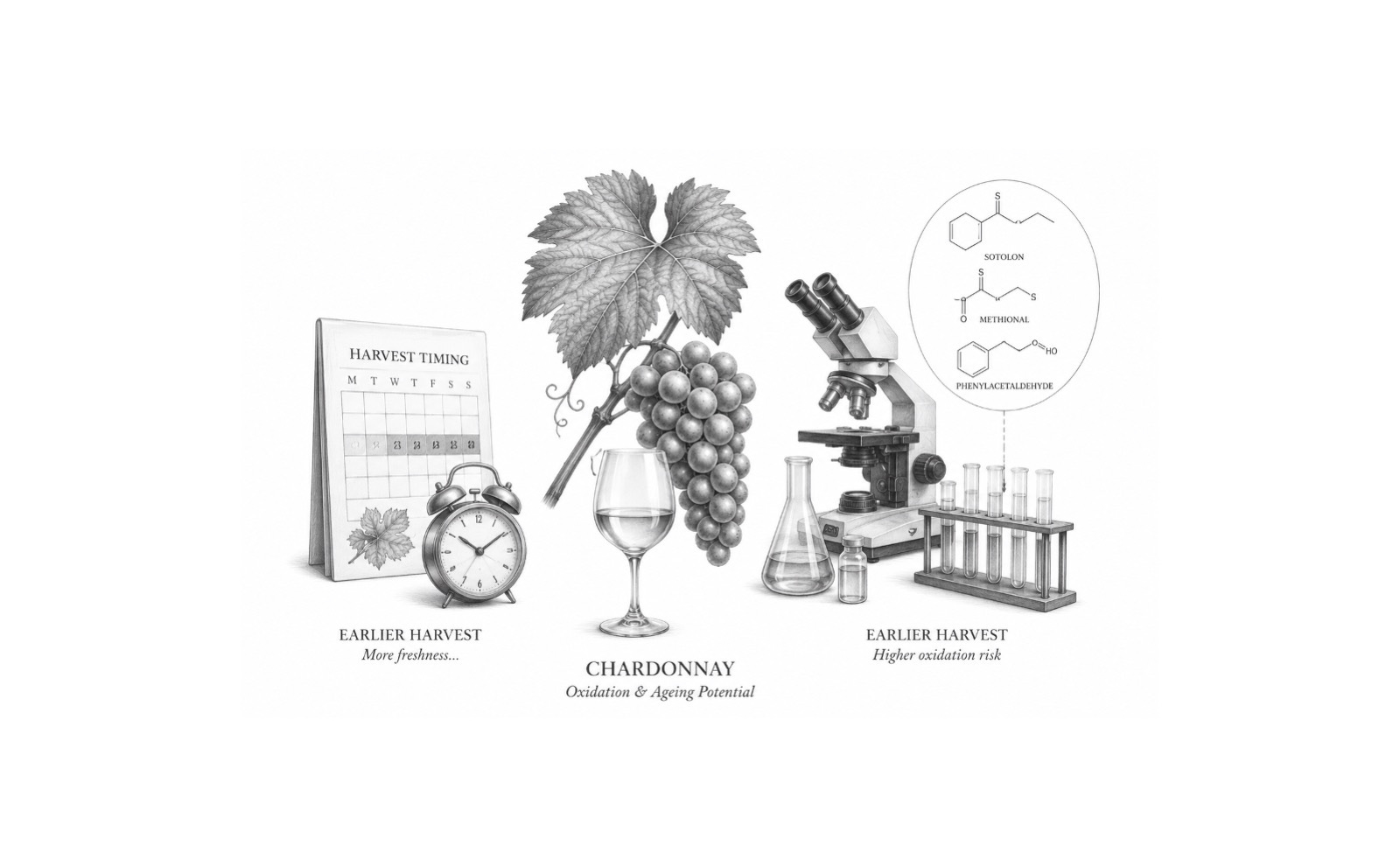
For growers hoping to make Chardonnay capable of developing gracefully in bottle, an early harvest can seem like a logical form of insurance. Pick sooner, preserve acidity and freshness, and surely the resulting wine should be better equipped for a long life.
New research from Bordeaux suggests that the relationship may be considerably more complicated.
Work carried out at the Institute of Vine and Wine Sciences (ISVV) has produced a rapid analytical method designed to assess a Chardonnay’s vulnerability to premature oxidation. When researchers used the technique to examine the effects of vineyard and cellar decisions, one result stood out: wines made from grapes harvested earlier were not necessarily better protected against oxidation. In the trials, the opposite tendency emerged.
It is a finding that could alter the way winemakers think about one of Chardonnay’s most important qualities: not simply how fresh the wine tastes at release, but how securely that freshness is built to last.
Chardonnay Oxidation and the Limits of Early Picking
Harvest timing is among the most consequential decisions of the growing season. A few days can affect sugar levels, acidity, aromatic development and the balance of the finished wine. In recent years, particularly as warmer conditions have pushed ripening forward in many regions, earlier picking has also become an important tool for retaining tension and avoiding excessive alcohol.
Yet chemical stability does not necessarily follow the same timetable as acidity or sugar accumulation.
The Bordeaux research was conducted by oenologist Pei Han at the ISVV. His doctoral work, which received the first thesis prize awarded by the Denis Dubourdieu Chair, focused on ways to identify a wine’s susceptibility to oxidative ageing before obvious deterioration appears.
The findings reported from that work indicate that bringing harvest forward by only four to seven days, compared with the timing considered optimal by the growers involved, could significantly reduce the resulting wine’s ageing potential.
That conclusion deserves some nuance. It does not mean that every early-picked Chardonnay will age poorly, nor that later harvesting is automatically preferable. Vintage conditions, site, vine balance, pressing, oxygen exposure, élevage and many other variables remain part of the equation. What the study questions is the simpler assumption that earlier harvest, by itself, provides protection against future oxidation.
A New Way to Assess Chardonnay Oxidation
One of the more intriguing aspects of the research is the test itself.
Rather than waiting years to discover whether a wine will develop oxidative aromas prematurely, Han developed an approach intended to reveal vulnerability much earlier. The method combines measurements of free radicals already present in wine, using electron paramagnetic resonance, with analysis of compounds associated with the later appearance of oxidative aromas.
Among the molecules being followed are sotolon, methional and phenylacetaldehyde. Each can contribute to the sensory changes associated with oxidation when present in relevant concentrations.
For wine lovers, the analytical detail matters less than the broader possibility it opens. Ageing potential has traditionally been judged through a mixture of experience, tasting, chemical analysis and time. A test capable of identifying oxidative risk earlier could give producers another way to understand how decisions made in the vineyard and cellar influence a wine’s future.
That is particularly relevant for Chardonnay, a variety capable of producing some of France’s longest-lived dry white wines but also one whose evolution under oxygen has been the subject of intense attention.
What Is Harvest Timing Really Changing?
Perhaps the most interesting question raised by the study is also the one that remains unresolved: why should slightly earlier picking increase sensitivity to oxidation?
The obvious explanations do not appear to be sufficient. According to the research team, differences in sugar concentration and acidity do not account for the effect they observed.
That points towards subtler changes taking place during the final stages of grape ripening. The biochemical systems influencing a wine’s oxidative stability are more complex than the familiar harvest figures of potential alcohol, total acidity or pH can express on their own.
For serious wine drinkers, this is a useful reminder that freshness and longevity are related but distinct ideas. A young wine can taste taut, acidic and energetic without necessarily possessing the chemical resilience required for prolonged ageing. Conversely, physiological ripeness need not be the enemy of freshness when it contributes to a more stable wine.
The practical lesson is therefore not that growers should simply wait longer. It is that the choice of picking date may need to account for dimensions of grape maturity that conventional measurements do not fully capture.
From Chardonnay to Sauvignon Blanc and Chenin Blanc
The project was supported by the Bourgogne Wine Board (BIVB) and the Oeneo group through the Apogée research programme, giving the Chardonnay work an obvious relevance to Burgundy. Its implications, however, may eventually extend well beyond a single variety.
Researchers hope that the knowledge gained from Chardonnay can be applied to other white grapes, including Sauvignon Blanc and Chenin Blanc. Both are central to French wine and both can produce bottles whose ability to age depends on a delicate balance between aromatic character, oxygen management and chemical stability.
Han has continued his work at the ISVV as a postdoctoral researcher, examining how ageing potential is established not only in the vineyard but also during maturation on the lees.
That wider perspective is important. A wine’s capacity to age is unlikely to be created at one single moment. It begins with the grapes, develops through pressing and fermentation, and continues to be shaped by decisions during élevage and bottling.
Rethinking What Makes Chardonnay Age
The Bordeaux research does not offer winemakers a new universal harvest rule. Its importance lies precisely in challenging the idea that such a simple rule exists.
Earlier picking may help achieve certain stylistic goals, especially where retaining acidity or moderating alcohol is a priority. But if the objective is to produce Chardonnay for extended bottle ageing, the date on the calendar cannot be judged by freshness alone.
The prospect of measuring oxidative vulnerability before it becomes visible in the glass could therefore become an important addition to the winemaker’s toolkit. It may also help clarify one of the enduring mysteries of fine white wine: why two bottles that appear equally vibrant in youth can follow very different paths with time.
For Chardonnay, longevity may depend less on picking early than on picking at the moment when the grape has acquired the right kind of maturity to endure.