
Champagne Ayala New CEO: Cédric Roblet to Lead the House from September 2026
Cédric Roblet will take the helm in September 2026, extending Ayala’s focus on Chardonnay, precision and long-term investment.
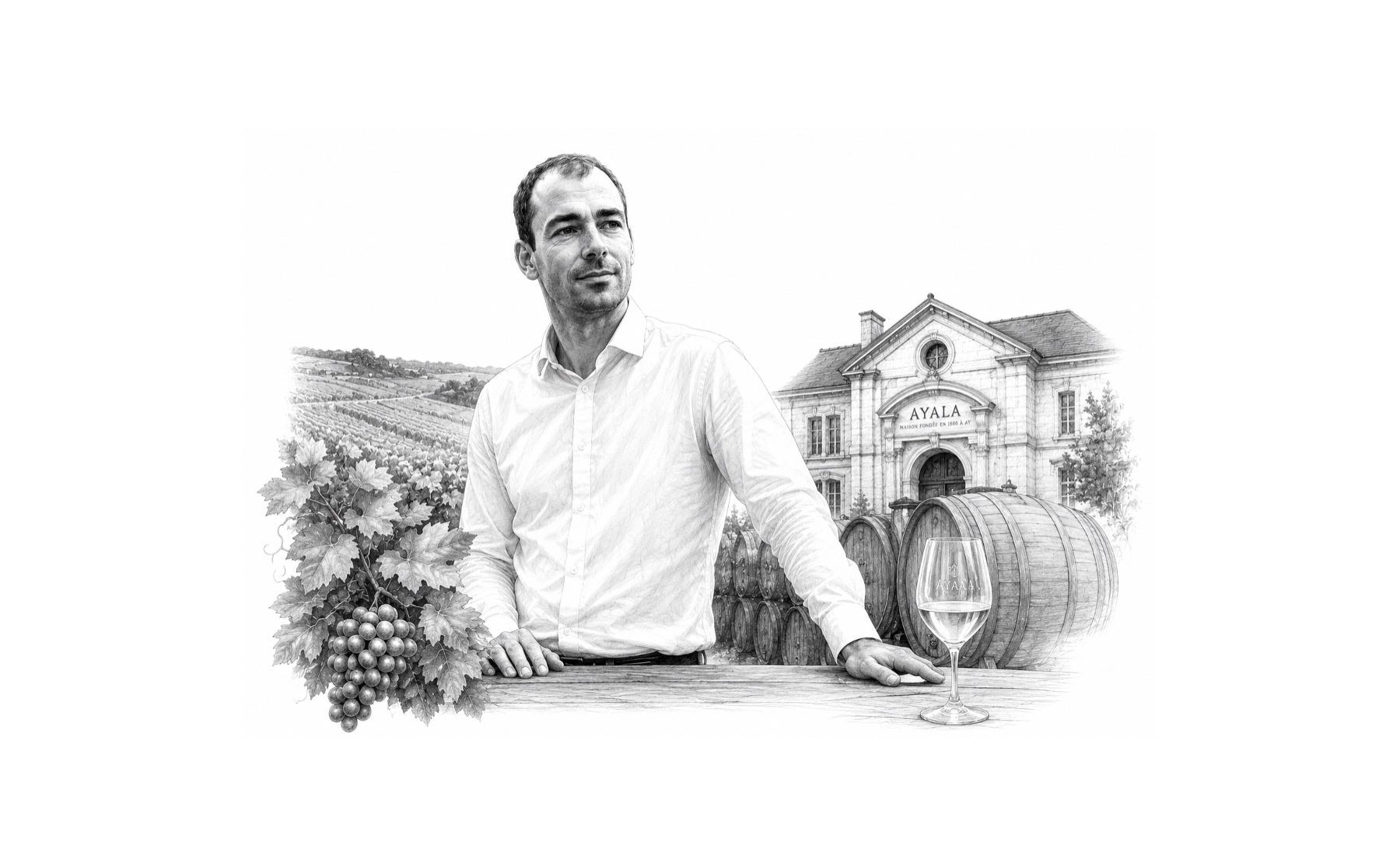
Cédric Roblet Named Champagne Ayala’s New CEO
Champagne Ayala has appointed Cédric Roblet as its new CEO, effective 14 September 2026. He will succeed Hadrien Mouflard, who has directed the historic Aÿ house since 2012.
The appointment represents continuity, but not simply in the conventional sense of promoting from within. Roblet has spent years working behind the scenes on some of the foundations that now define Ayala: its vineyard strategy, relationships with growers, winemaking facilities and long-term approach to production.
His elevation therefore places an executive with detailed knowledge of the house at the centre of its next phase.
An Appointment Rooted in the Bollinger Group
Roblet’s career within the Bollinger Group began in 2009, when he joined Champagne Bollinger in management control. He moved to Champagne Ayala in 2016 as administrative and financial director, later becoming the house’s secretary general.
That progression closely connects him to the operational development of Ayala over the past decade. Rather than arriving with an external programme or an abrupt change of direction, the Champagne Ayala new CEO steps into the role after contributing to many of the decisions that have shaped the house’s recent evolution.
Ayala itself has deep roots in Champagne. Founded in Aÿ in 1860 by Edmond de Ayala, the house belongs to a village whose name carries considerable historical weight in the region. Under Mouflard’s leadership, it has sought to clarify its identity while strengthening the practical infrastructure required to support it.
Roblet’s appointment suggests that this work will continue with a similar sense of purpose.
A Decade of Work in the Vineyard and Cellar
Much of Ayala’s recent development has taken place away from the public gaze. The house has worked to rebuild its vineyard holdings and organise its grape supply more deliberately, supported by partnerships with Champagne growers.
For a producer whose style depends on consistency as much as finesse, these questions are fundamental. Access to suitable fruit, dependable grower relationships and a clear understanding of vineyard resources all influence what can eventually be achieved in the blending room.
Roblet has also been involved in investments across Ayala’s production facilities. Several new vat rooms have been constructed, expanding the house’s capacity to separate and follow wines with greater precision.
The latest addition, designed for micro-vinification, is expected to enter service for the 2026 harvest. Such facilities allow smaller parcels or individual components to be vinified separately, giving the cellar team more possibilities when assessing vineyard character and composing future blends.
The significance lies not in novelty for its own sake, but in control. Champagne is built from numerous decisions made long before a bottle reaches the market, and more detailed vinification can offer a house a broader and more exact palette.
What the Champagne Ayala New CEO Inherits
Ayala has increasingly placed Chardonnay at the heart of its identity. The variety holds a dominant position in the house’s blends, contributing to a style associated with freshness, definition and measured elegance.
This Chardonnay-led approach gives Ayala a recognisable position within Champagne without reducing the house to a single formula. Blending remains central, but the emphasis provides a clear stylistic thread across the range.
The house has also expanded its international reach and is now distributed in more than 70 countries. Roblet will therefore lead a Champagne producer whose ambitions extend well beyond its historic base in Aÿ.
Maintaining that balance will be one of the central tasks of his tenure: preserving a coherent house style while serving an increasingly broad and varied international audience.
Continuity with Room to Develop
Roblet is expected to continue investing in Ayala’s production resources while giving greater prominence to the house’s historic site in Aÿ. The development of wine tourism is also among the priorities identified for the coming years.
For Ayala, opening the estate more fully to visitors could provide a direct way of explaining the relationship between its history, its Chardonnay-focused style and the technical work taking place in the cellar. The challenge will be to do so without turning heritage into spectacle or allowing hospitality to overshadow the wine itself.
Above all, the new leadership will be judged by the bottles. Ayala’s reputation rests on the quality and precision of its Champagnes, and the appointment of an executive already closely involved in its transformation signals an evolutionary rather than revolutionary course.
When Cédric Roblet assumes the role in September 2026, he will inherit both the results of a decade of investment and the responsibility of carrying them forward. For this historic Champagne house, the next chapter appears set to begin not with a break from the past, but with a deeper commitment to the direction already established.