
Canon-Fronsac 2025: The Return of Mineral Authority
Clos Toumalin reveals a chalk-driven Canon-Fronsac, where structure, austerity, and longevity redefine the vintage
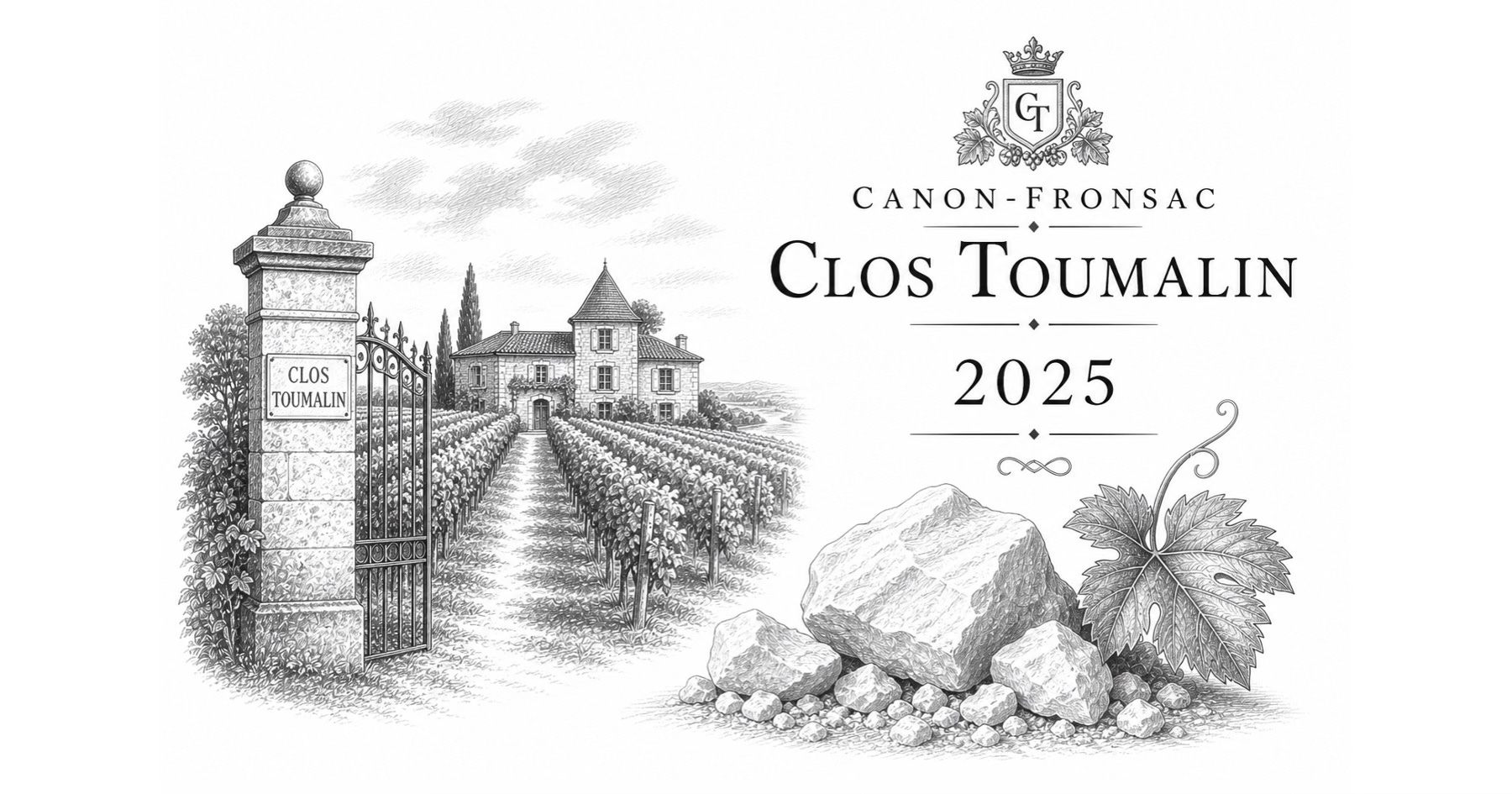
In the broader landscape of Bordeaux, Canon-Fronsac has often occupied a discreet position—respected, yet rarely central to contemporary discourse. The 2025 vintage, however, invites a reassessment. It does not do so through immediate charm, but through something more enduring: a reaffirmation of terroir in its most elemental form.
At the heart of this renewed attention stands Clos Toumalin, whose 2025 expression offers a particularly lucid interpretation of the appellation’s geological identity. Here, the wine is not constructed around fruit, but around structure—its architecture rooted firmly in the chalky substrata that define the finest sites of Canon-Fronsac.
The aromatic profile reflects this orientation. Rather than opening on overt fruit, the nose is initially marked by mineral tension. It suggests stone before flesh, a restraint that signals both precision and intent. This is not a wine designed for immediate accessibility; it requires a shift in expectation, away from primary expression and toward a more textural, almost tactile reading of terroir.
On the palate, this philosophy becomes even more pronounced. The structure is assertive, with a firmness that may at first appear austere. Yet this austerity is neither excessive nor unrefined. It is the direct consequence of a wine shaped by its mineral core—a kind of liquid geology, where the sensation evokes crushed rock and chalk rather than overt fruit sweetness.
Such a profile places Clos Toumalin firmly within a lineage of wines that privilege longevity over immediacy. The tannins, still in a formative stage, suggest a slow evolution. Their current angularity is not a limitation but a promise, indicating a trajectory that will unfold over decades rather than years. The expectation of extended ageing—two decades or more—aligns naturally with the wine’s structural composition.
This raises a broader question about Canon-Fronsac itself. In an era where many wines seek early approachability, what is the place of austerity? The 2025 vintage provides a compelling answer. It demonstrates that restraint, when anchored in terroir, can be as expressive as opulence. Indeed, it offers a different kind of clarity—one that emerges not from fruit intensity, but from the articulation of soil.
For the informed drinker, this represents an opportunity to engage with Bordeaux through a less conventional lens. Canon-Fronsac, in this context, is not an alternative to more celebrated appellations, but a complement to them. It offers a perspective grounded in minerality, structure, and time.
The 2025 Clos Toumalin stands as a concise yet powerful statement of this identity. It does not seek to persuade through immediacy. Instead, it invites patience, rewarding those willing to follow its evolution. In doing so, it reaffirms Canon-Fronsac as a source of wines defined not by fashion, but by their enduring relationship to place.