
Cahors: Malbec Across Terraces and Limestone Heights
From Lot river terraces to limestone plateaus, Cahors reveals Malbec through two geological origins shaping structure, depth, and identity
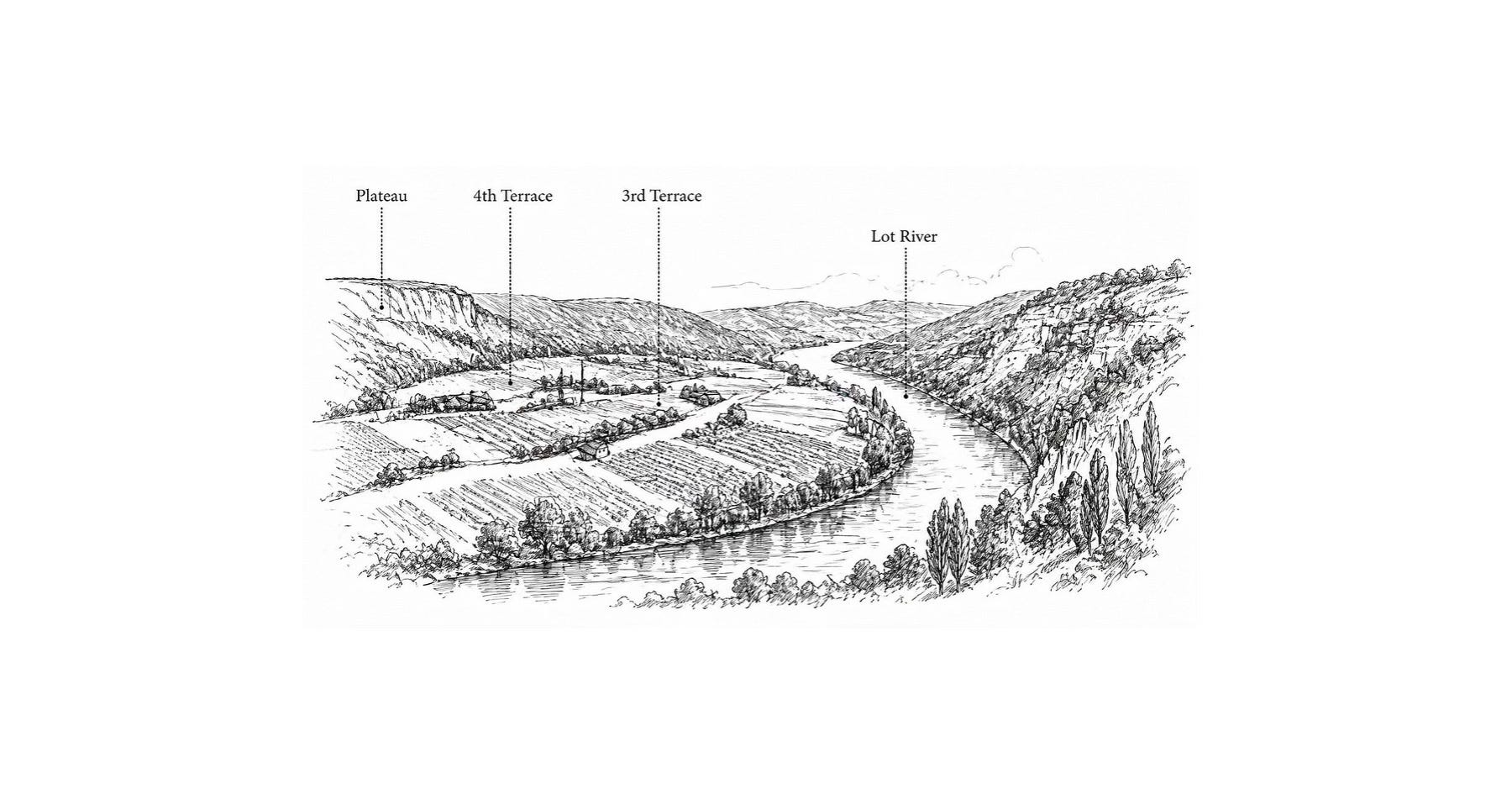
Cahors is often reduced to a single narrative: a dark, structured wine shaped by malbec. Yet the reality is more intricate. Beneath the surface lies a geological dialogue between river and plateau, between sediment and stone, that determines not only the architecture of the wines but also their capacity for nuance.
At the intersection of Atlantic, Mediterranean, and continental influences, the vineyard stretches along the Lot River and ascends toward the austere limestone plateaus of the Causses. Here, malbec finds a terrain that both challenges and refines it.
From River to Plateau: A Vertical Vineyard
The vineyard unfolds in a sequence of terraces carved over millennia by the Lot. These alluvial steps, rising from roughly 90 to 250 meters, form the historical backbone of Cahors. Their soils, composed of sands, gravels, and clays, vary in depth and drainage, creating a gradient of expression.
The lowest terrace, closest to the river, is composed of relatively recent deposits. Its soils, lighter and less structured, tend to produce wines of immediacy rather than depth. As elevation increases, the soils become older, richer in clay and stones, and more capable of regulating water. On these higher terraces, malbec achieves greater concentration and balance, its tannins more defined, its fruit more complete.
The third terrace, formed from ancient alluvium, often delivers the most consistent results. Here, drainage is optimal, and the vine’s access to water is moderated. The resulting wines combine breadth with clarity, offering a structural foundation that does not require excessive intervention in the cellar.
The Precision of Limestone Scree
Above these terraces lies a more discreet but highly distinctive formation: the limestone scree slopes. These fragmented, well-drained soils, formed by the gradual erosion of the plateau, are among the least extensive but most compelling terroirs of Cahors.
Here, malbec expresses a different register. The wines tend toward finesse rather than mass, with a more linear palate and a persistent, mineral-driven finish. The reduced soil depth limits vigor, concentrating the berries and refining tannic structure. When blended with fruit from the terraces, these wines contribute tension and length, tempering the broader, more powerful elements.
The Causses: Altitude and Restraint
Beyond 250 meters, the vineyard enters the domain of the Causses—limestone plateaus marked by shallow soils and a harsher growing environment. These areas, which account for a significant portion of the appellation’s potential, remain only partially cultivated due to their demanding conditions.
The soils here vary: hard Kimmeridgian limestone, marno-calcareous formations, and pockets of iron-rich red clays known as sidérolithique. Each contributes a distinct texture to the wines. On limestone slopes, where the rock is fractured, roots penetrate deeply, accessing scarce water reserves and producing wines of notable tension and verticality.
On the plateau itself, the combination of shallow soils and exposure can induce hydric stress, particularly in warmer vintages. Yet when managed carefully, these conditions yield small, concentrated berries. The resulting wines are structured, often requiring extended élevage to fully integrate their tannins.
Malbec: A Demanding Interpreter
Malbec in Cahors is neither forgiving nor uniform. It responds acutely to its environment, revealing both the strengths and limitations of each site. Its tannic framework demands full phenolic maturity; otherwise, it risks hardness and imbalance.
This sensitivity makes the management of water crucial. Excess vigor dilutes structure, while excessive stress arrests ripening. The equilibrium lies in soils capable of regulating water supply—deep enough to sustain the vine, but restrictive enough to limit excess.
Equally important is the selection of plant material. Over decades, local initiatives have sought to preserve and study a wide diversity of malbec clones, many originating from old vineyards. This genetic reservoir contributes to the complexity and resilience of the appellation.
Continuity and Reassessment
Cahors has never been static. Before phylloxera, it was one of France’s largest vineyards, occupying lands considered too poor for cereals. Today, only a fraction of its historical surface is planted, yet the potential remains considerable.
The contemporary challenge lies in redefining the relationship between terroir and identity. Climate variability, evolving viticultural practices, and shifting market expectations all play a role. Some plateau areas, once neglected, are being reconsidered for their qualitative potential. At the same time, questions of transmission and continuity remain, as not all estates have clear successors.
A Landscape of Distinctions
To speak of Cahors as a singular entity is to overlook its essential complexity. It is a vineyard structured vertically, geologically, and stylistically. From the riverbanks to the limestone heights, each level contributes a distinct voice to the expression of malbec.
The most compelling wines emerge not from uniformity but from the interplay of these elements—where depth meets precision, and structure is balanced by restraint. In this sense, Cahors is less a fixed style than a landscape of possibilities, defined by the subtle articulation of its soils.