
Cabernet Franc Precision in Montagne-Saint-Émilion
Domaine Simon Blanchard and the evolving finesse of Montagne-Saint-Émilion through a Cabernet Franc–led expression
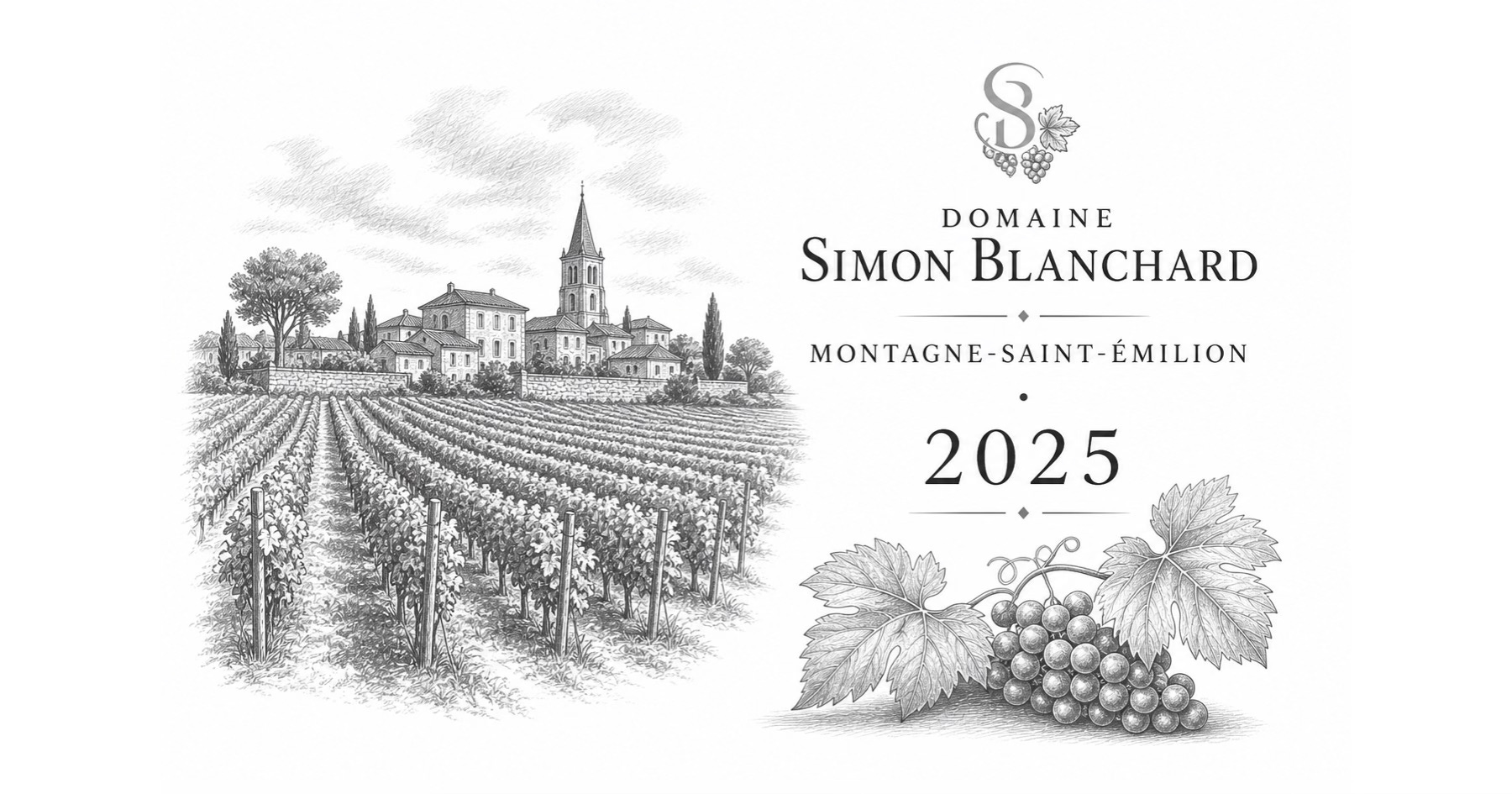
There are appellations in Bordeaux whose identity is not defined by scale, but by nuance. Montagne-Saint-Émilion belongs firmly to this category. Long perceived as a satellite of greater prestige, it has, in recent years, begun to articulate a more distinct voice—one shaped by varietal precision and a renewed focus on structural clarity.
Within this context, Domaine Simon Blanchard emerges as a compelling case study. The estate’s cuvée, driven predominantly by Cabernet Franc, reflects a deliberate stylistic choice that sets it apart within the appellation. At 89% Cabernet Franc, the composition is not merely technical; it defines the wine’s entire architecture.
Cabernet Franc, when handled with restraint, offers a particular kind of refinement—less immediate than Merlot, yet often more articulate in its expression. Here, it shapes a wine that privileges line over volume. The aromatic profile leans toward subtle spice, with a turmeric-like nuance that introduces both warmth and complexity without tipping into opulence.
The structure is equally considered. Tannins are finely delineated, neither austere nor overly softened. Their precision provides a framework through which the wine extends gracefully across the palate. This sense of length—what might be described as allonge—becomes central to the tasting experience. It is not a wine that asserts itself through density, but one that unfolds progressively, revealing detail through persistence.
Such an approach signals a broader evolution within Montagne-Saint-Émilion. Where once the emphasis may have leaned toward immediate accessibility, there is now a discernible shift toward wines that reward attention and time. The balance achieved here is not accidental; it reflects careful vineyard management and a measured approach in the cellar.
The implications for the appellation are noteworthy. As producers explore the full potential of Cabernet Franc—not merely as a supporting variety but as a structural backbone—Montagne-Saint-Émilion begins to differentiate itself more clearly from its neighbors. It moves away from imitation and toward definition.
In the context of the en primeur campaign, wines such as this, noted for their refinement and balance , suggest a trajectory that favors precision over power. For the informed drinker, this represents an opportunity to engage with Bordeaux from a different angle—one that values proportion, texture, and the quiet articulation of terroir.
Montagne-Saint-Émilion, in this light, is no longer simply adjacent to Saint-Émilion. It is increasingly a destination in its own right, defined by a measured elegance that continues to evolve.