
Burgundy Wine Labelling: Why the Word “Domaine” Is Under Scrutiny
Why the word “domaine” has become a test case for Burgundy’s merchants, growers and the promises made on a wine label.
Burgundy Wine Labelling and the Meaning of “Domaine”
Few words on a French wine label carry as much quiet authority as domaine. It suggests a direct line between vineyard, cellar and bottle: grapes grown by an estate, transformed into wine under its control and presented as the expression of a particular property.
In Burgundy, however, that apparently simple promise sits within an increasingly complex commercial landscape. Many leading producers combine the roles of vineyard owner, grower and négociant. Estates may belong to larger wine houses, while several legally distinct properties share technical teams, equipment or winemaking facilities.
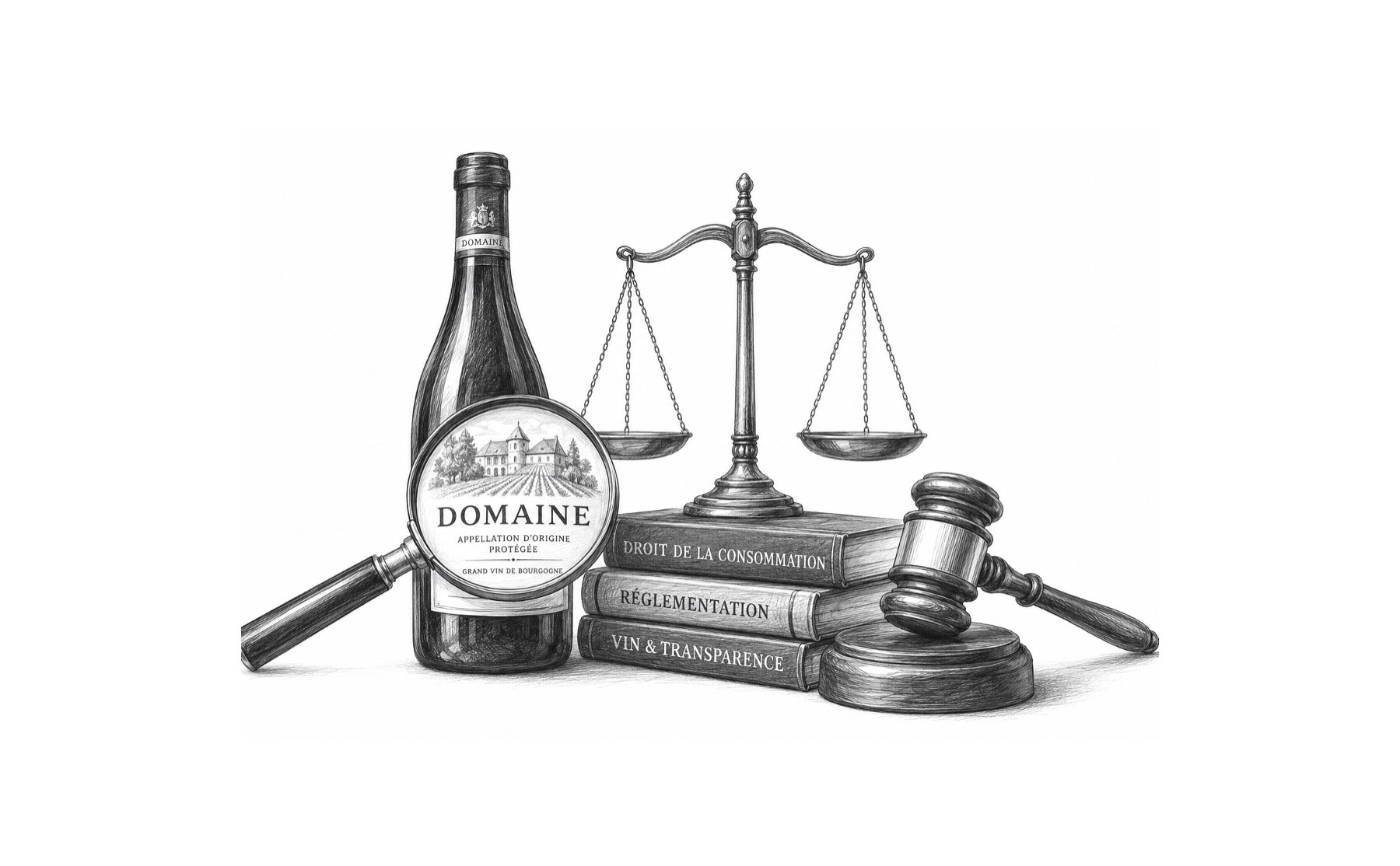
That tension between the legal identity of an estate and the practical organisation of winemaking has placed Burgundy wine labelling under unusual scrutiny. Recent action involving two of the region’s best-known houses, Louis Jadot and Albert Bichot, has turned a technical question of terminology into a wider debate about transparency, ownership and the modern meaning of estate wine.
A €140,000 Warning to Burgundy’s Wine Houses
Louis Jadot and Albert Bichot accepted financial settlements of €100,000 and €40,000 respectively following investigations by French consumer-protection authorities. The agreements were validated by the judicial court in Dijon.
At the centre of both cases was the use of the word domaine for wines connected to estates owned within the wider business groups but vinified in facilities belonging to the négociant house rather than to the specific legal entity named on the label.
The authorities considered those wines to be négociant wines for labelling purposes. The companies agreed to discontinue the disputed estate wording on the relevant bottles.
For consumers, the distinction may initially appear difficult to grasp. The grapes were not alleged to have come from undisclosed vineyards, nor was the identity of the wine itself necessarily in question. The dispute concerned where the wine was made, which company formally carried out the work and whether that structure satisfied the legal conditions attached to the domaine designation.
It is a reminder that French wine labels do more than describe geography or grape origin. Their vocabulary can also communicate a legally defined method of production.
Why “Domaine” Matters on French Wine Labels
French regulators regard domaine as one of the wine world’s most valuable terms. Its appeal rests on the sense of continuity it creates: one estate, one agricultural origin and one chain of responsibility.
Under the interpretation applied by the authorities, the term should be reserved for AOP or IGP wines made from grapes harvested on the land of the named agricultural holding and vinified within that same holding. When production takes place in another corporate or technical structure, even one closely connected to the estate, the designation may be challenged.
The purpose of such rules is understandable. Estate language can influence how a bottle is perceived and valued. A consumer choosing a domaine wine may believe that the producer named on the label controlled every stage from vineyard to cellar.
Strict domaine wine regulations are therefore intended to protect both buyers and growers whose wines fully meet that expectation. They also aim to prevent businesses with different production models from competing under language that implies an identical relationship with the land.
Yet Burgundy’s commercial reality does not always fit comfortably within these neat categories.
The Burgundy Négociant Is No Longer a Simple Middleman
The traditional distinction between domaine and négociant remains useful, but it no longer tells the whole story.
A domaine is generally associated with wine made from vineyards under the estate’s control. A négociant traditionally buys grapes, must or finished wine before vinifying, maturing, blending or bottling it under its own name.
Today, many Burgundy businesses operate on both sides of that divide. A house may own important vineyard estates while also maintaining a substantial négociant activity. A grower may supplement a small domaine production with purchased fruit. Winemakers, cellars and equipment may serve several properties within the same family or corporate group.
These arrangements do not necessarily weaken traceability. In some cases, the same technical team may oversee the vineyards, harvest, vinification and ageing of an estate’s wine, even though different companies own the vines and the winery.
The legal question is whether operational control is sufficient, or whether the entire production chain must remain inside the same formally defined agricultural entity.
For Burgundy wine labelling, that distinction is far from academic. It can decide whether a producer may place the commercially powerful word domaine on the bottle.
Louis Jadot’s Change from “Domaine” to “Vignoble”
Louis Jadot responded by maintaining that the grapes used for its estate wines came exclusively from its own vineyard holdings and that cultivation, harvesting, vinification and maturation remained fully traceable.
Its objection was directed at the administration’s interpretation of the business structure rather than at the underlying facts of production. Properties accumulated or organised through separate legal entities were considered distinct from the négociant facility in which the wines were made.
To comply with the ruling, Jadot indicated that the disputed domaine wording would be replaced by vignoble, or vineyard. The change affects the language on the label rather than the origin of the grapes or the methods used to produce the wine.
This is precisely what makes the affair so significant. To the regulator, wording is part of the product’s promise. To the producer, the new terminology may describe the same vineyards, people and wine less accurately in the eyes of the public.
Burgundy Wine Labelling Meets European Wine Law
The debate extends beyond Burgundy and touches on the relationship between French regulation and European case law.
Legal specialists cited in connection with the cases have questioned whether France’s narrow interpretation of an agricultural holding remains compatible with a 2023 judgment by the Court of Justice of the European Union concerning the German term Weingut, broadly comparable to domaine.
That decision considered circumstances in which some winemaking operations were carried out away from the estate. It has been interpreted as allowing estate terminology where the producer retains effective control and responsibility, even when every physical stage does not occur at the estate’s own premises.
The Burgundy cases are not identical, and the implications of the European judgment remain open to legal argument. Nevertheless, it raises an important question: should estate identity be defined principally by buildings and corporate boundaries, or by ownership, control, traceability and responsibility for the wine?
A fragmented approach across European wine regions would create its own problem. Similar production arrangements could be labelled differently depending on the member state in which the wine was made.
Why Cooperatives Are Treated Differently
French wine law already recognises that production may take place outside the estate without automatically losing the right to use an estate name.
A grower belonging to a cooperative may retain a domaine designation when the cooperative functions as an extension of the member’s agricultural holding. The estate’s grapes must be vinified and stored separately, preserving their identity throughout production.
That exception rests on traceability and continuity rather than on the physical location of the winery alone.
Burgundy négociants argue that a comparable principle might be relevant when an estate owned by a wine house is vinified in the house’s cellar under clearly separated conditions. Regulators, however, distinguish between the specific legal status of a cooperative and the corporate organisation of a négociant group.
The difference may be defensible in law, but it is not always intuitive to the person buying the bottle.
What the Debate Means for Wine Lovers
The controversy does not make the word domaine meaningless. On the contrary, the attention given to it shows how much the designation matters.
Still, wine lovers should resist treating any single label term as a complete guarantee of quality or authenticity. Domainedescribes a relationship between an agricultural holding and the production of its wine. It does not, by itself, tell the reader how carefully the vines were farmed, how sensitively the wine was made or how compelling it will be in the glass.
Nor should a wine be dismissed simply because it carries a négociant name. Burgundy’s great merchant houses have played a central role in the region’s wine culture, and many exercise detailed control over their sources and production.
The more useful approach is to read the complete label. The producer’s name, estate or merchant identity, appellation, bottling statement and cuvée all contribute to the story. Knowledge of the producer remains more valuable than reliance on one prestigious word.
A Vocabulary Struggling to Keep Pace
The deeper issue is that Burgundy has evolved more quickly than some of the categories used to describe it.
The region now contains growers who trade, merchants who farm, family estates held through several companies and sophisticated wineries serving multiple vineyard properties. These hybrid structures are not temporary exceptions. They are part of contemporary Burgundy.
Regulation must still protect consumers from suggestive or misleading language. A domaine designation should retain a clear connection to land, responsibility and traceable production. Without that discipline, one of the most trusted terms on French wine labels would gradually lose its force.
At the same time, rules that focus too narrowly on corporate form or cellar ownership risk obscuring genuine continuity between vineyard and wine. A label can be legally precise yet leave the drinker with a less accurate understanding of how the bottle came into being.
The dispute surrounding Burgundy wine labelling is therefore about more than a handful of names. It asks what an estate truly is: a parcel of land, a legal company, a physical winery or a continuous act of stewardship.
For a region built on exact distinctions, the answer will matter far beyond the fine print.