
Burgundy Vineyard Prices: What the Pierre Damoy Sale Reveals
The Pierre Damoy sale brings Burgundy’s soaring land values—and the future of family domaines—back into sharp focus.
Burgundy Vineyard Prices and the Changing Value of Terroir
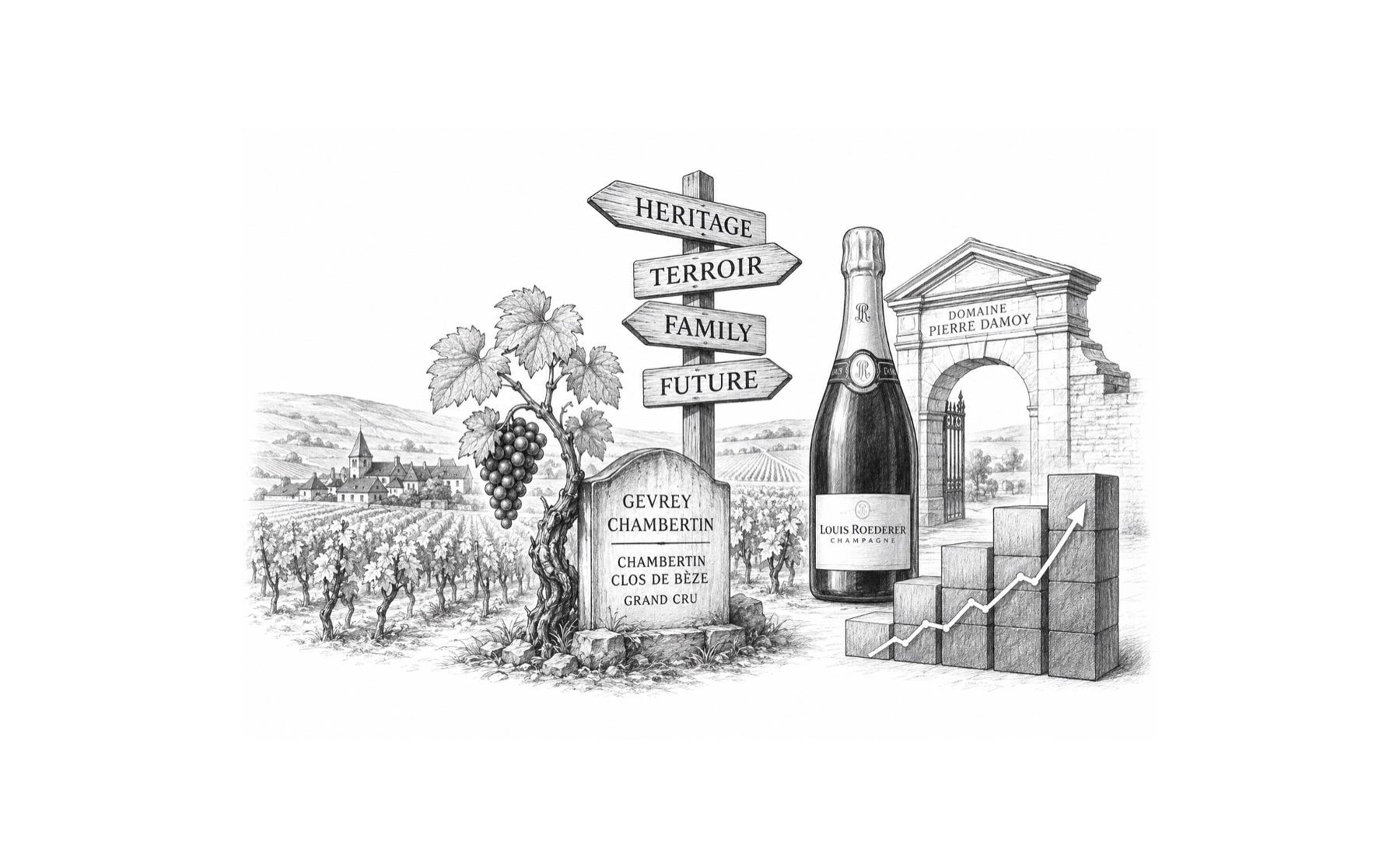
Few wine regions make the economics of land as visible—or as uncomfortable—as Burgundy. The acquisition of Domaine Pierre Damoy by Champagne house Louis Roederer is more than a transfer of ownership between two distinguished names. It has brought Burgundy vineyard prices back into the spotlight, along with a difficult question: what happens when the financial value of a vineyard moves beyond what winegrowing alone can reasonably support?
The issue is particularly acute in the Côte d’Or. Here, a small parcel can be at once a place of work, a family inheritance, a source of exceptional wine and an internationally coveted asset. Those identities have always coexisted. Today, however, the balance between them is becoming increasingly fragile.
A Significant Arrival in Gevrey-Chambertin
The purchase marks Louis Roederer’s first acquisition in Burgundy. Rather than beginning with a modest foothold, the family-owned Champagne producer has entered through one of the most important estates in Gevrey-Chambertin.
Domaine Pierre Damoy controls close to eight hectares of vines, with substantial holdings in the village’s celebrated grand cru vineyards. Its position in Chambertin-Clos de Bèze is especially notable, placing the estate among the most significant proprietors in one of the Côte de Nuits’ defining climats.
The price of the transaction has not been disclosed. Yet the precise figure is less important than the scale of value attached to such land. At Burgundy’s highest level, vineyard ownership is now judged by more than the income that can be generated from grapes and bottles. Rarity, reputation, strategic importance and the prospect of long-term capital appreciation all enter the calculation.
For Louis Roederer, the acquisition offers direct access to an exceptional viticultural heritage. For Burgundy, it provides another indication of how narrow the circle of potential buyers has become.
Why Burgundy Vineyard Prices Continue to Rise
Burgundy’s land market begins with an unavoidable fact: there is very little land available.
The boundaries of the region’s established appellations and climats are fixed. A grand cru cannot expand to satisfy demand, while centuries of inheritance have divided many vineyards into exceptionally small parcels. When an important holding reaches the market, buyers are competing for something that may not become available again for a generation.
Figures cited by the Côte-d’Or branch of Safer, the French rural land agency, suggest that only around 90 to 100 hectares are offered for sale each year across a Burgundy vineyard area of nearly 30,000 hectares. That total includes land at every level of the appellation hierarchy. The supply of prestigious premier cru and grand cru parcels is smaller still.
Scarcity, however, explains only part of the rise in Burgundy vineyard prices. A highly regarded vineyard can also provide a producer with prestige, market access and a permanent position within an appellation. For a well-capitalised buyer with established distribution and a long investment horizon, the value of the land may extend far beyond its annual yield.
This is where conventional agricultural economics begins to lose its authority. A grower purchasing a vineyard solely from the income expected from its wines may struggle to justify the price. A larger group can consider the same land as part of a wider portfolio, absorbing modest direct returns in exchange for strategic and reputational value.
When Vineyard Land Stops Behaving Like Farmland
A vineyard remains a working landscape. It requires pruning, soil management, treatments, harvesting, equipment and skilled labour. Its agricultural function does not disappear simply because its market value has risen.
The concern among Burgundy growers is that the price of certain vineyards no longer reflects that practical reality. Once land becomes almost impossible to finance through wine production, it begins to behave less like a farming resource and more like a rare financial asset.
This affects far more than the buyer and seller involved in a prominent transaction. Each major sale helps establish a new reference point for neighbouring vineyards. Families planning a succession may find that the theoretical value of their estate has increased dramatically, even though its productive capacity remains unchanged. Relatives wishing to continue farming can face greater difficulties keeping holdings together, while tenant growers may have little prospect of acquiring the vines they work.
The apparent enrichment of an estate on paper can therefore conceal a more complicated reality. Higher valuations may reward those ready to sell, but they can place an enormous burden on those determined to remain.
This is the deeper anxiety behind warnings about the loss of Burgundy’s agricultural character. It is not simply resistance to change, nor a romantic belief that vineyards should remain untouched by economics. It is a concern that ownership may gradually become separated from the daily work that gives the land its meaning.
Not Every Acquisition Is Pure Speculation
It would be misleading to treat every major buyer as a short-term investor. Louis Roederer is an independent, family-controlled wine producer with extensive experience of managing vineyards. Its arrival in Burgundy is materially different from the purchase of an estate by an anonymous financial vehicle with no history in wine.
That distinction matters, but it does not remove the broader structural problem. A responsible proprietor can farm conscientiously, invest for the long term and preserve the identity of an estate while still participating in a market whose prices are beyond the reach of most independent growers.
The intentions of an individual buyer and the consequences of the wider market are not always the same. Even patient, wine-focused ownership can reinforce valuations that make future transfers more difficult for smaller domaines.
Burgundy Vineyard Prices Do Not Describe All Burgundy
The grand cru land market attracts attention because its figures are extraordinary. It should not, however, be mistaken for the whole of Burgundy.
The region encompasses regional appellations, village wines, premier crus and grands crus, with enormous differences in reputation, production costs and land value. Much of Burgundy’s wine is made at a considerable distance—both geographically and economically—from the rarefied market surrounding Chambertin-Clos de Bèze.
This distinction matters for wine lovers. Burgundy should not be reduced to a collection of inaccessible labels or bottles intended for display rather than drinking. Its culture depends upon a broad community of growers, merchants and drinkers, not only the handful of domaines whose vineyards command exceptional valuations.
Nevertheless, the top of the market exerts an influence beyond its limited acreage. It shapes perceptions of the region, raises barriers to entry and contributes to the idea that Burgundy belongs increasingly to collectors and institutions rather than farmers and ordinary wine enthusiasts.
The danger is as much cultural as financial. When the conversation about Burgundy is dominated by asset values, the wine itself can begin to seem secondary.
Local Growers Are Also Competing for Land
The rise in Burgundy vineyard prices cannot be explained solely by the arrival of wealthy outside buyers. According to local land-market officials, many candidates for vineyard parcels are neighbouring growers, established domaines and regional farming companies seeking to consolidate their holdings.
This reflects the structure of Burgundy itself. With the average domaine covering only around six or seven hectares, acquiring even a small adjoining parcel can make an important operational difference. It may simplify vineyard work, strengthen production or help secure the future of an estate.
Local demand can therefore be intense. Individual parcels may attract dozens of candidates, particularly when they offer a rare opportunity to plant or expand within a sought-after area.
This makes the familiar contrast between family growers and external investors too simple. Burgundy’s land market is also driven by competition among producers who are already rooted in the region. Yet the result remains the same: those with limited access to capital find it increasingly difficult to participate.
What the Pierre Damoy Sale Changes—and What It Does Not
The change of ownership does not, by itself, alter the character of Gevrey-Chambertin or the qualities of its vineyards. Nor does it determine the future style of the wines. Those questions will depend on farming decisions, cellar work and the degree to which the identity of Domaine Pierre Damoy is maintained.
The acquisition is significant because of what it represents. It demonstrates how highly Burgundy’s finest land is now valued and how rarely an important estate can be acquired without resources extending well beyond those of a typical family domaine.
Louis Roederer’s stewardship will ultimately be judged over time: by its approach to the vineyards, its respect for the estate’s identity and its willingness to treat the land as more than a prestigious addition to a portfolio.
Burgundy faces a wider challenge. Estates will inevitably change hands, families will make different choices and new owners will enter the region. The objective cannot be to freeze the vineyard map in place. It must instead be to preserve meaningful opportunities for working growers, family succession and independent ownership.
The Value Beneath the Price
Burgundy’s finest vineyards are valuable because they are scarce, but scarcity alone does not produce great wine. Their importance also comes from continuity: the accumulated knowledge of particular soils, exposures, seasons and parcels, interpreted by people who work them year after year.
When the financial value of land overwhelms its agricultural purpose, the risk is not merely that Burgundy becomes more expensive. It is that the range of people able to participate in its wine culture becomes steadily narrower.
The sale of Domaine Pierre Damoy does not settle the debate over Burgundy vineyard prices. It sharpens it. The central question is no longer whether exceptional vineyards will command exceptional sums. They clearly will. The more urgent question is whether Burgundy can remain a living community of growers while its most celebrated land becomes one of the world’s rarest luxury assets.