
Burgundy Rethinks the Geometry of the Vine
Burgundy rethinks vine density as climate, water stress and tradition reshape the region’s viticultural future
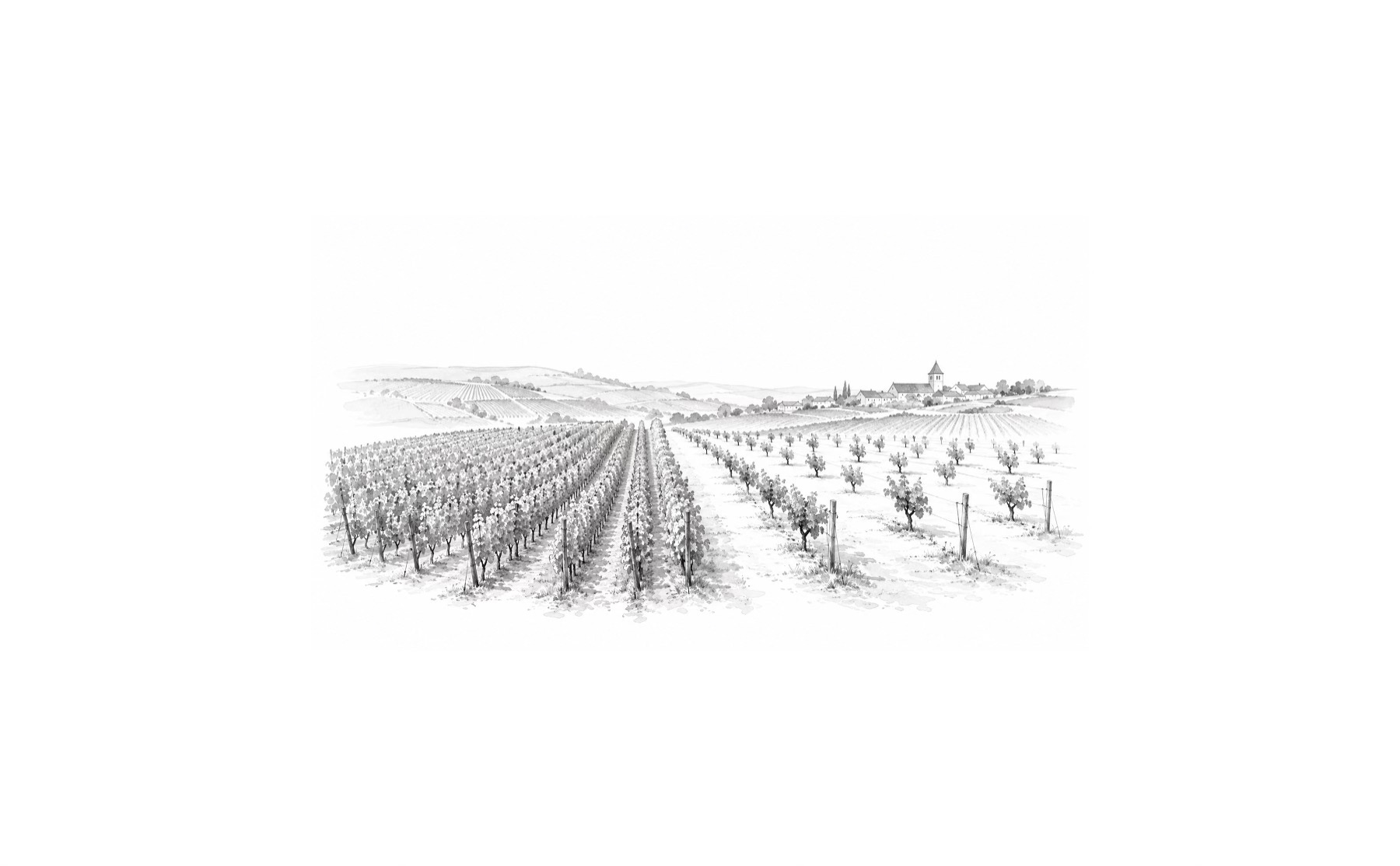
In Burgundy, few subjects are as deceptively technical, or as quietly emotional, as planting density. To the casual observer, the difference between 10,000 and 5,000 vines per hectare may seem agronomic. To Burgundy, it touches identity.
For generations, high density has been treated as one of the invisible foundations of Burgundian greatness. Narrow rows, vine competition, low vigour, small berries: the logic is familiar. In the Côte d’Or especially, the tightly planted vineyard has become part of the visual grammar of prestige.
Yet that grammar is changing.
Meursault Opens the Door
Since 1 January 2026, growers in Meursault have been allowed to plant at 5,000 vines per hectare on an experimental basis under the INAO’s Dispositif d’Évaluation des Innovations. For an appellation village so closely associated with high-density viticulture, the decision is significant. It does not overturn the old order. But it opens a door that would once have seemed almost unthinkable.
The timing is not accidental. The hot seasons of 2018, 2019 and 2020 intensified concerns about vine decline, hydric stress and the resilience of dense vineyards. In lower-density plantings, each vine has access to more water. In a warmer, drier climate, that may become a condition of survival.
Mâcon and the End of a Simple Hierarchy
Meursault is not alone. Mâcon is also expected to obtain authorisation to lower its planting floor from 7,000 to 5,000 vines per hectare, this time not as an experiment but as a formal right. The request is not new. Mâcon’s producers sought such flexibility in 2009, only to be refused when hierarchy still weighed heavily on regulatory thinking. Bourgogne had been granted the possibility of 5,000 vines per hectare; Mâcon, positioned slightly higher, was judged too elevated for such a concession.
That distinction now looks increasingly fragile. The old assumption that density and quality rise together in a straight line is being reconsidered across several Burgundian appellations. Not rejected wholesale, but examined with new urgency.
This is the crucial nuance. Burgundy is not abandoning high density. Nor is it embracing wide rows as a new doctrine. What is emerging is a pragmatic, localised viticulture, where density becomes a tool rather than a symbol.
The Bourgognes Identifiés Seek Flexibility
The debate is particularly active among the Bourgognes identifiés, the named geographical sectors within the Bourgogne appellation. Bourgogne Côte Chalonnaise and Bourgogne Épineuil are expected to seek the 5,000 vines-per-hectare threshold. Here, the case is both agronomic and economic. Some growers may never plant semi-wide rows. Others want the option when replanting under climatic and financial pressure.
This desire for optionality is central to the moment. Burgundy’s growers are not asking to flatten hierarchy. They are asking whether one inherited model can still serve all soils, exposures and estates.
The answer is complicated by Burgundy’s regulatory architecture: 84 specifications, each with its own rules and history. Harmonising them is essential if flexibility is to become useful. Bourgogne generic has allowed 5,000 vines per hectare since 2011, but the surface concerned remains very limited. Many estates farm parcels across several appellations; several vineyard geometries within one domaine complicate equipment, labour, cultivation and canopy management.
In other words, authorisation is not the same as adoption.
The Hautes-Côtes Exception
The Hautes-Côtes offer an instructive exception. The AOC Bourgogne Hautes-Côtes de Beaune and Bourgogne Hautes-Côtes de Nuits have long been permitted to plant at lower densities, with a historic threshold of 3,000 vines per hectare dating back to 1961. This is not a recent accommodation to climate change, but a structural feature. Machinery, working habits and vineyard architecture have adapted. Nearly half of their surface is now below 5,000 vines per hectare.
That exception matters because it shows that lower-density viticulture is not incompatible with Burgundian identity. It is already part of the region’s legal and viticultural reality. What is new is the possibility that this logic may move closer to more symbolically charged appellations.
What Is Really at Stake in Meursault
Meursault is therefore the emblematic case. The appellation’s wines are defined by a balance of amplitude and precision, richness and mineral tension. Its best vineyards have long been associated with painstaking work in tightly planted parcels. For some observers, the introduction of 5,000 vines per hectare may appear to threaten that equilibrium. Yet the experimental nature of the authorisation is important. It allows the appellation to test, measure and observe rather than legislate by ideology.
The essential question is not whether lower density is better. It is whether, under certain climatic conditions and on certain sites, it may produce healthier vines and wines of equal or greater balance.
High density has genuine virtues. It can moderate vigour, encourage deeper rooting where soils permit, increase competition and limit excessive production per vine. In Burgundy’s historic model, it also aligns with small-scale manual or semi-manual vineyard work and with a cultural preference for precision. The risk in simplifying the debate is to caricature high density as a relic. It is not. It remains one of the most powerful tools in the Burgundian viticultural repertoire.
But lower density also has arguments in its favour. It can reduce water competition, make certain forms of mechanisation easier, lower establishment costs and improve the economics of replanting. In a period of labour scarcity, rising costs and climatic uncertainty, these are not secondary considerations. They are central to the survival of domaines outside the most prestigious crus.
Constraint, Terroir and Adaptation
This is where the debate becomes philosophical. Burgundy has built much of its global authority on the idea that constraint produces greatness: restricted yields, narrow rows, demanding labour, rigorous appellation rules. Yet climate change is introducing a different kind of constraint, one that may not be solved by intensifying old methods. The question is whether fidelity to terroir requires preserving every inherited practice, or adapting those practices so that terroir can continue to express itself.
Planting density is only one part of that wider conversation. Rootstocks, pruning systems, canopy height, soil cover, organic matter, shade, harvest dates and clonal diversity all belong to the same field of inquiry. But density is unusually visible. A vineyard planted at 5,000 vines per hectare looks different. It changes the rhythm of the rows. It alters the mental image of what a serious Burgundian vineyard is supposed to be.
That visual dimension explains part of the resistance. Burgundy’s prestige is not based on wine alone, but on a landscape of accumulated signs: stone walls, combes, clos, lieux-dits, narrow parcels, old vines and dense rows. Any alteration to that landscape can feel like a breach in continuity.
Yet continuity in Burgundy has never meant immobility. The region has been shaped by centuries of adaptation: monastic development, ducal patronage, post-revolutionary fragmentation, phylloxera, replanting, mechanisation, domaine bottling, organic and biodynamic farming, and the globalisation of its market. The present debate belongs to that same history. It is not a departure from Burgundy’s seriousness, but an expression of it.
A Future That Will Not Be Uniform
What makes the current moment delicate is the hierarchy of appellations. In regions where classification is less intricate, technical flexibility may be easier to introduce. Burgundy’s system is acutely sensitive to perceived differences in rank. If lower density is allowed in one appellation and not another, the decision may be read not simply as agronomic but as symbolic. Does a lower planting floor imply lower ambition? Or does refusing it imply an inability to adapt?
The answer will likely differ from place to place. In the grands crus and many premiers crus, high density will probably remain deeply embedded, both practically and culturally. In village appellations and regional sectors, especially where economic pressure is sharper or water stress more acute, the case for flexibility may strengthen. The future will not be uniform.
That may be the point. Burgundy’s genius has always rested on difference: not only between villages and climats, but between exposures, soils, growers and interpretations. A more flexible approach to density need not dilute that genius. Properly managed, it may refine it.
Reading the Change in the Glass
For collectors, the implications will take time to read in the glass. New plantings require years before they can be judged with seriousness. The first wines from lower-density experimental parcels will not settle the matter. They will need to be followed across vintages, especially across hot, dry, wet and more classical years. The real test will not be whether they conform to an idea, but whether they offer balance, longevity and fidelity to place.
The most intelligent position, for now, is neither enthusiasm nor alarm. It is attention.
Burgundy is not renouncing its past. It is asking whether one of its most cherished assumptions still holds under new conditions. The move toward 5,000 vines per hectare in Meursault, Mâcon, and perhaps soon in the Côte Chalonnaise and Épineuil, is not a revolution in the theatrical sense. It is quieter, more technical, and more Burgundian than that.
A recalibration.
And in Burgundy, where centimetres of slope and subtle changes in soil have shaped centuries of meaning, even a change in spacing can mark the beginning of a new chapter.