
Bordeaux’s Bulk-Wine Crisis and the New Meaning of Prestige in French Wine
Falling bulk prices reveal a structural fracture beneath Bordeaux’s global image of hierarchy, heritage, and collectible value
Introduction: When Bordeaux’s Name Is No Longer Enough
Bordeaux has long traded on one of the most powerful names in wine. For collectors, it evokes First Growths, limestone plateaux, historic châteaux, blue-chip vintages, and cellars built for decades rather than seasons. For merchants and investors, it remains one of the central reference points of the fine-wine world: liquid, classified, recognizable, and global.
Yet behind that enduring prestige lies another Bordeaux, far larger and far more exposed: the Bordeaux of bulk wine, generic appellations, cooperative volumes, négociant contracts, declining demand, and growers whose economic reality bears little resemblance to the mythology of the grands crus.
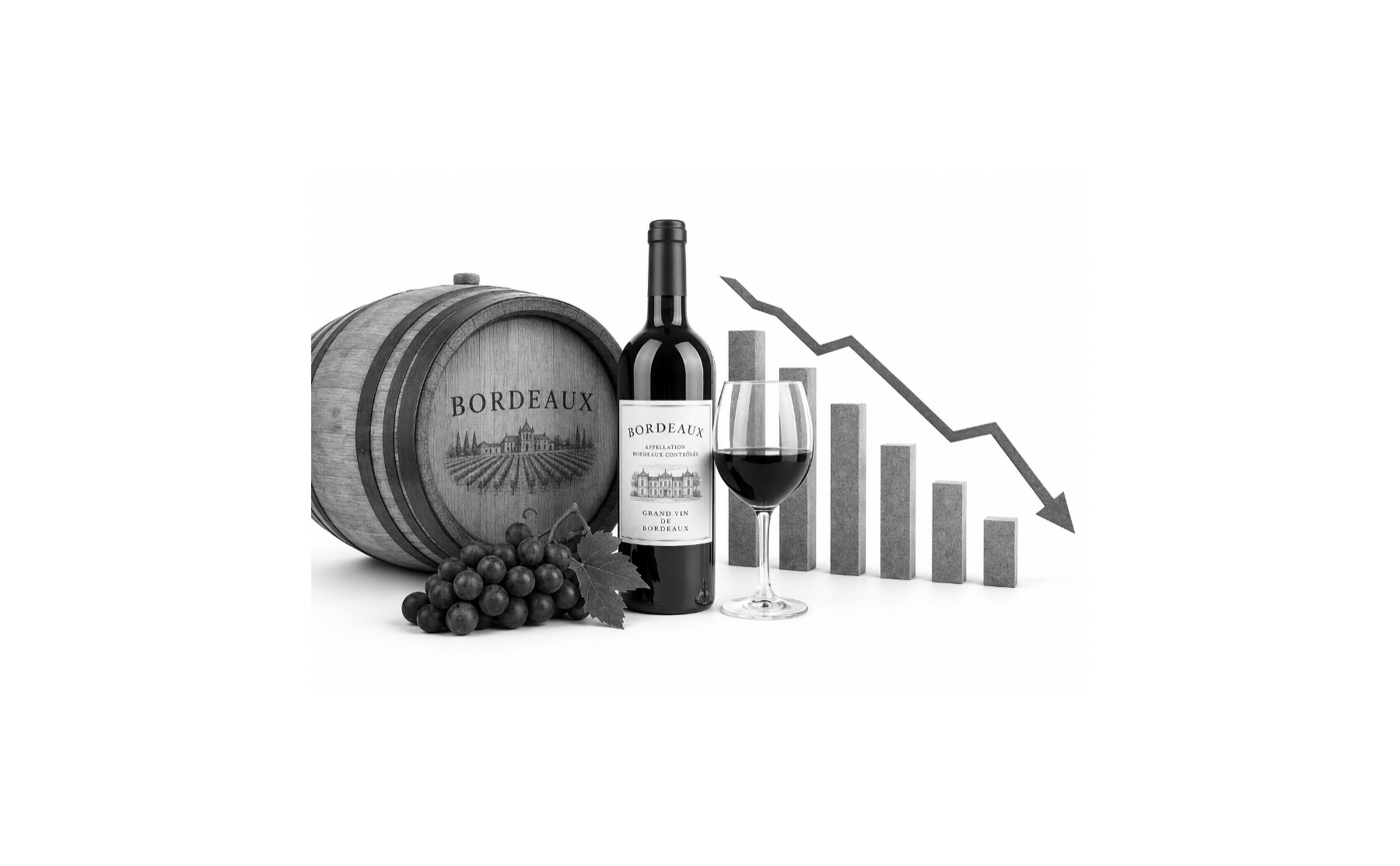
The latest figures from the bulk market are stark. Across the 2025/26 campaign, red Bordeaux in bulk has been trading at around €700 to €800 per tonneau. Bordeaux Supérieur is around €1,360. Côtes de Castillon, once a category capable of attracting more optimistic comparisons with the Right Bank’s better-known names, has seen tonneaux between €900 and €1,200. Generic Saint-Émilion has not exceeded €3,000, down from materially higher levels only eighteen months earlier. Meanwhile, bulk withdrawals have fallen across several appellation groups: Bordeaux red, the Côtes, Médoc and Graves, and the Saint-Émilion-Pomerol-Fronsac family.
This is not a marginal correction. It is a structural warning. Bordeaux’s crisis at the base of the pyramid does not directly undermine the rarity of Lafite, Margaux, Cheval Blanc, Ausone, Petrus, or the most sought-after domaines and châteaux of the region. But it does force a more serious question: what does the Bordeaux name mean when prestige and distress coexist so dramatically inside the same regional identity?
For collectors and investors, the answer matters. The future value of French wine is not built on reputation alone. It depends on demand, quality, scarcity, cultural relevance, and the credibility of the hierarchy beneath the label.
The Facts Behind the Fall
The bulk-wine market in Bordeaux is recording a severe decline across multiple appellations. According to the supplied figures, the average price for red Bordeaux bulk wine in the 2025/26 campaign sits between €700 and €800 per tonneau, compared with around €929 per tonneau for the period from 1 April 2025 to 31 March 2026. Bordeaux Supérieur is around €1,360 per tonneau, a figure that no longer represents significant upward movement compared with five years earlier. Côtes de Castillon ranges between €900 and €1,200, whereas five years ago it could command between €1,200 and €1,800. Generic Saint-Émilion has fallen below the symbolic comfort zone, not exceeding €3,000 compared with €3,500 to €4,000 a year and a half earlier.
Bulk withdrawals have also weakened. Red Bordeaux is down 5%. The Côtes are down 17%. Médoc and Graves are down 13%. Saint-Émilion, Pomerol, and Fronsac are down 10%. Only dry whites and crémants show a positive trajectory, with increases of 10% and 11% respectively.
The economic interpretation is even more alarming. If €1,200 per tonneau is treated as a threshold of profitability, then a large majority of red Bordeaux volumes are being sold below that level. The Chamber of Agriculture of the Gironde has estimated production costs at €1,400 per tonneau based on yields of 54 hectolitres per hectare. But with the previous year’s average yield reportedly closer to 36 hectolitres per hectare, the economics become still harsher. In that scenario, the argument that essentially all volumes are being sold at a loss is not rhetorical excess; it is a statement about the brutal arithmetic of viticulture.
The human reality is just as severe. The testimony of a long-standing broker, after more than half a century in the trade, describes distress among growers on a scale he has not seen before. Previous crises of overstock could, at times, be absorbed over time. This one appears different: lower prices, weaker demand, and pressure across all AOC categories.
Bordeaux’s Two Realities
The Collectible Bordeaux of Global Memory
For the international collector, Bordeaux often means classified growths, en primeur campaigns, vertical tastings, critic influence, château renovation, long-lived Cabernet Sauvignon, Merlot from privileged clay-limestone soils, and a secondary market shaped by decades of global demand.
This Bordeaux is not imaginary. It remains real. The best estates have built reputations over generations. They have distribution networks, brand equity, technical resources, strict selection, and the capacity to reduce volume rather than compromise image. Their wines are not valued simply as fermented grape juice but as cultural and financial objects: bottles with provenance, vintage identity, château narrative, and a place in the global architecture of luxury.
The Volume Bordeaux of Economic Exposure
But the broader Bordeaux vineyard cannot live on the aura of the classed growths. Much of the region depends on more everyday appellations: Bordeaux, Bordeaux Supérieur, the Côtes, generic Saint-Émilion, and other large-volume categories where price elasticity is harsher and brand differentiation weaker.
Here, the word “Bordeaux” is not always enough to sustain demand. Consumers who once bought inexpensive claret by habit have more choices than ever: southern French reds, Spanish and Italian alternatives, New World varietal wines, lighter styles, natural wines, and white or sparkling categories that better match current drinking patterns. The old promise of affordable Bordeaux—structure, tradition, and a recognizable name—has lost some of its commercial force.
This does not mean the wines lack merit. It means the market has become less forgiving of undifferentiated volume.
The Appellation Problem: When AOC Is Not a Market Strategy
The French AOC system is one of the great cultural achievements of wine. It protects origin, codifies production, and anchors wine in place rather than mere brand. In fine wine, appellation remains essential. It tells the collector why Pauillac is not Margaux, why Pomerol is not Saint-Émilion, why limestone, gravel, clay, exposure, and drainage matter.
But Bordeaux’s current crisis shows the limits of appellation as a commercial guarantee. An AOC can protect identity; it cannot manufacture demand. It can preserve rules; it cannot automatically create desirability. It can certify origin; it cannot replace a compelling reason to buy.
This distinction is vital. For high-end collectors, appellation is only one part of the value equation. The market also rewards producer reputation, vineyard specificity, scarcity, age-worthiness, critical confidence, and historical continuity. A bottle of great Bordeaux is not collectible because it says Bordeaux. It is collectible because it comes from a precise estate, from a particular vintage, with a track record of quality and desirability.
At the bulk level, the hierarchy is less protective. If wine is sold without a strongly differentiated estate identity, the appellation must carry a burden it may no longer be able to bear.
Scarcity, Surplus, and the Psychology of Value
Fine-wine value depends on scarcity, but not all scarcity is equal. The scarcity that matters to collectors is wanted scarcity: a small production of a wine people actively desire. The problem in Bordeaux’s broader market is the opposite condition: excess supply relative to demand.
Measures such as vine-pulling and distillation may reduce pressure, but the supplied source rightly presents a more complicated question. Reducing supply can offer an individual exit route. It does not automatically rebuild the commercial appeal of a category. If demand is weak because consumer preference has shifted, because distribution lacks energy, or because too many wines appear interchangeable, then reducing hectares may stabilize the system without renewing its prestige.
This is an uncomfortable lesson for Bordeaux. In the fine-wine market, scarcity is powerful only when joined to reputation. In the volume market, scarcity created by crisis can simply reveal a loss of relevance.
Why Dry Whites and Crémants Matter
The figures show that dry whites and crémants are moving against the downward trend, with bulk withdrawals up 10% and 11%. This detail deserves attention because it points to a broader evolution in wine consumption.
Bordeaux is still culturally associated with red wine. Its greatest historical symbols are red. Its classification mythology is red. Its cellar-building reputation is red. Yet current demand in many markets has been moving toward freshness, lower tannic weight, white wines, sparkling wines, and more immediate drinkability.
The relative resilience of dry whites and crémants does not solve Bordeaux’s red-wine crisis. But it does suggest that the region’s future cannot rely solely on inherited assumptions. Bordeaux has terroirs, grape varieties, and technical skill beyond red blends. The question is whether the region can translate those assets into a modern identity without diluting its historic authority.
For collectors, this does not mean that Bordeaux crémant is about to become the next great investment category. That would be an unsupported leap. It does mean that Bordeaux’s commercial vitality may increasingly depend on segments that were once secondary to its grand red narrative.
Collector and Investment Relevance
Blue-Chip Bordeaux Remains Distinct
Serious collectors should not confuse the collapse of bulk prices with an immediate collapse in the value of the region’s most collectible wines. Classified growths, elite Right Bank estates, and highly regarded château bottlings operate in a different economy from bulk AOC wine. Their prices are shaped by rarity, global distribution, vintage reputation, critic history, château prestige, and long-term cellar demand.
However, prestige does not exist in a vacuum. A great region’s reputation is partly sustained by the coherence of the whole. If the base of Bordeaux becomes associated with distress, discounting, and lack of demand, the region’s broader cultural energy may weaken. The top estates can remain exceptional, but the regional story becomes harder to tell with confidence.
Opportunity for Discerning Buyers
A falling market can also create opportunity. In less fashionable appellations and overlooked corners of Bordeaux, serious producers may be making wines of genuine quality while suffering from the general weakness of category perception. For connoisseurs rather than speculators, this is important. Distress in the bulk market does not mean all non-classified Bordeaux is poor value. Quite the opposite: it may mean that thoughtful buyers can find wines whose intrinsic quality exceeds their market recognition.
But selectivity is crucial. The opportunity lies not in buying Bordeaux generically, but in identifying producers with estate identity, disciplined viticulture, clear style, and a route to consumer relevance. In a pressured market, the gap between anonymous production and serious domaine work becomes more visible.
Risk for Speculative Buyers
For investors, the crisis is a warning against lazy assumptions. The Bordeaux name alone is not a sufficient investment thesis. Nor is appellation status. Long-term value requires demand that can survive changing fashion. Wines bought purely because they belong to a famous region may disappoint if they lack producer distinction, scarcity, and a credible secondary-market audience.
The most resilient French wines are rarely those with the broadest names. They are those with the strongest identities.
Comparative Perspective: Bordeaux and the Wider French Hierarchy
Bordeaux’s predicament contrasts with the logic of Burgundy, where small-scale production, vineyard fragmentation, and global demand have created intense scarcity at the top and, increasingly, across many lesser-known appellations. Burgundy’s challenge is often affordability and allocation. Bordeaux’s challenge, outside the elite, is demand absorption.
Champagne offers another comparison. It has succeeded in giving a regional category luxury coherence, even while encompassing both grandes marques and growers. Its collective identity remains commercially powerful. Bordeaux, by contrast, is more hierarchical and fragmented in perception: the consumer understands the top but may struggle to understand why ordinary Bordeaux should matter.
The Rhône, Loire, and Languedoc have also complicated Bordeaux’s position by offering distinctive alternatives: Syrah from the northern Rhône, Cabernet Franc from the Loire, Mediterranean blends from the south, and increasingly precise single-site wines from regions once regarded as peripheral. Bordeaux must now compete not only with New World Cabernet and Merlot but with a more confident French landscape.
This is not the end of Bordeaux’s authority. It is the end of automatic deference.
Cultural and Historical Significance
The crisis matters beyond price. Bordeaux is not merely a commercial region; it is one of the great cultural structures of French wine. Its châteaux, brokers, merchants, river trade, classifications, and appellations have shaped how the world thinks about wine as hierarchy, patrimony, and investment.
If growers at the base of that structure are selling at a loss, the issue is not only financial. It is cultural. Vineyard landscapes are human landscapes. Appellations survive through families, labor, seasonal risk, and intergenerational knowledge. When prices fall below sustainable production costs, what is threatened is not just margin but continuity.
The danger is a hollowing out of the middle and lower tiers: fewer growers, less diversity, more abandonment, and a widening symbolic gap between trophy estates and struggling viticulture. A region can retain its icons while losing part of its social and agricultural fabric. For French wine, that would be a serious loss.
The Need for a Collective Economic Vision
One of the most striking elements in the supplied material is the criticism that Bordeaux lacks a sufficiently collective economic vision for the sector. This is not a minor complaint. Bordeaux’s historic strength came partly from structure: brokers, négociants, classifications, export networks, and a shared regional identity. If that structure no longer responds effectively to modern demand, the region must rethink more than price.
The issue is not simply how to remove surplus. It is how to rebuild desirability. That requires sharper segmentation, clearer communication, stronger producer identities, more credible quality signals, and perhaps a less complacent relationship with the Bordeaux name itself.
For too long, broad regional recognition may have disguised weak differentiation. In today’s market, consumers and collectors reward precision. They want to know not only where a wine comes from, but why it exists, who made it, what distinguishes it, and why it deserves a place at the table or in the cellar.
Conclusion: Bordeaux Must Defend More Than Its Icons
The fall in Bordeaux bulk prices is not merely a story of agricultural distress. It is a test of the region’s meaning in the twenty-first century. The most prestigious châteaux will continue to command attention, allocations, and cellar space. But the broader Bordeaux ecosystem faces a more difficult question: can it convert inherited fame into renewed relevance?
For collectors, the lesson is clear. Bordeaux remains indispensable, but it must be read with greater discrimination. The label alone is not the value. The value lies in the convergence of place, producer, vintage, scarcity, demand, and cultural authority.
The current crisis exposes the fragility beneath one of wine’s most famous names. It also clarifies the stakes. If Bordeaux can use this moment to sharpen identity, restore economic coherence, and distinguish quality from volume, it may emerge with a more honest and durable hierarchy. If not, the gap between collectible Bordeaux and unsold Bordeaux will widen further.
And in fine wine, reputation is strongest when the whole region still believes in the promise written on the label.