
Bordeaux Wines and the Quiet Collapse of Price Reference
Deep promotions on established labels expose a structural crisis in Bordeaux’s value perception.
Early-year promotions in French supermarkets are nothing new. They traditionally serve to reactivate consumer interest after the holiday season and clear inventories accumulated in December. What is new, however, is the way certain promotions are now staged—and the signal they send to the market.
By highlighting second-bottle discounts reaching up to 68 percent, French retailer Auchan has crossed a symbolic threshold in the presentation of Bordeaux wines. The issue is not the existence of promotions, but the choice to communicate almost exclusively through the lowest possible unit price, even when that price has little connection to economic reality in the vineyard.
From Anonymous Labels to Established Names
For years, aggressive discounting primarily affected little-known brands or entry-level private labels. That boundary no longer holds. Well-established names are now drawn into the same downward spiral.
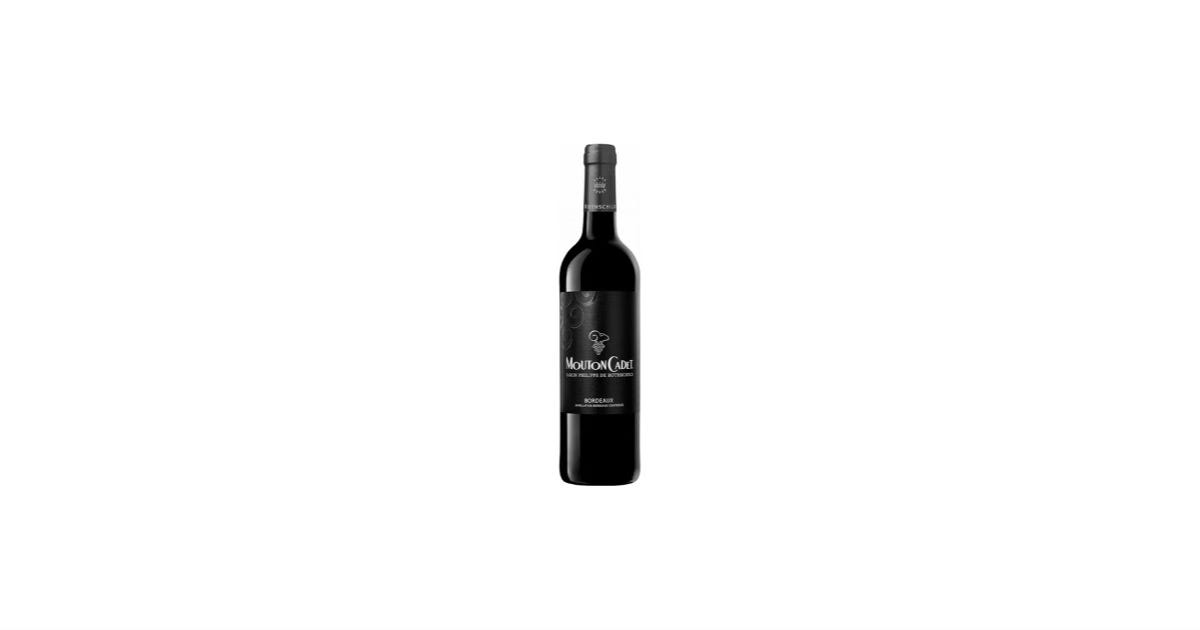
A second bottle of Mouton Cadet, Bordeaux Rouge 2023, was displayed at €2.87—an implied reduction of 68 percent compared with the first bottle priced at €8.99. The arithmetic may be legally correct, yet the visual impact is striking. The promoted price sits far below commonly understood production costs for Bordeaux, and even further from the brand narrative carefully constructed over decades.
The contradiction is particularly stark given the producer’s public commitments. The label emphasizes fair-trade certification and environmental standards, positioning the wine as ethically produced and socially responsible. Such messages struggle to coexist with a shelf price that suggests disposability rather than value.
A Broader Pattern of Devaluation
The phenomenon extends beyond a single brand. Wines associated with prominent figures are no longer insulated from extreme discounting. A Bordeaux Rouge 2021 from a property owned by Bernard Magrez was promoted with a second-bottle price of €2.36, reflecting a 60 percent reduction. An AOC Médoc 2021, awarded a gold medal at a recognized competition, appeared at €1.80 under a similar mechanism.
These figures mark a sharp contrast with retail benchmarks from only a few years ago, when comparable wines rarely dipped below €9.99, even during promotional periods. The shift is not marginal; it is structural.
The Mechanics of the Lowest Possible Price
Retailers point out, correctly, that these prices apply only within multi-bottle offers. The actual transaction price per bottle is higher when averaged across the purchase. Yet this clarification rarely features in the visual language of in-store communication.
What remains in the consumer’s mind is the lowest number displayed, amplified by the highest permissible discount rate. The regulatory cap on promotions limits the percentage reduction on the reference price, but it does not prevent communication strategies that emphasize the most extreme-looking figure.
This approach recalls earlier controversies involving discount retailers, where promotional triggers rather than overall purchase value shaped consumer perception. The difference today lies in the scope: Bordeaux’s established appellations and brands are now directly implicated.
A Blurred Price Signal for the Consumer
For the Bordeaux trade, the concern goes beyond immediate sales. Repeated exposure to fragmented and fluctuating reference prices erodes the consumer’s ability to understand what a bottle of Bordeaux is “worth.” When the same wine oscillates between €9 and under €3 depending on promotional framing, price ceases to function as a meaningful indicator of quality, origin, or production effort.
This confusion arrives at a time when producers and négociants are actively seeking to rebuild demand and restore confidence. Yet without coherent price signaling, these efforts risk being undermined at the point of sale.
An Unanswered Question for the Trade
Notably, the producers and négociants behind the wines concerned have, so far, remained silent. Their absence from the conversation reinforces a growing unease within the sector: pricing decisions that shape public perception are increasingly made downstream, with limited input from those who bear the economic and cultural weight of production.
What is at stake is not simply margin, but meaning. Bordeaux has long relied on a delicate balance between accessibility and prestige. When that balance collapses into a race for the lowest visible price, the damage may extend far beyond a single promotional cycle.
The question now facing the region is whether it can reassert a coherent value narrative—or whether price erosion has become the dominant language through which Bordeaux is spoken to consumers.