
Bordeaux at a Crossroads: Reinventing a Great Wine Region
How Bordeaux is confronting structural decline, changing consumers, and the search for a new wine economy
For more than three centuries, Bordeaux has stood at the center of the global wine trade. Its châteaux, merchants, classifications, and export networks helped define the modern fine-wine economy. Yet beneath the enduring prestige of the region lies a reality that is becoming increasingly difficult to ignore: Bordeaux is navigating one of the most profound transformations in its history.
The challenge extends far beyond a temporary market slowdown. What is unfolding today is a structural redefinition of how wine is produced, sold, and consumed. The consequences are visible throughout the Gironde, where thousands of hectares of vineyards have disappeared, family estates face uncertain futures, and producers are searching for new business models in a rapidly changing world.
The End of an Era
The global wine market has entered a period of contraction unprecedented in recent decades. Worldwide wine consumption has fallen steadily, reflecting shifting lifestyles, changing demographics, health-conscious consumer behavior, and growing competition from other beverages.
For Bordeaux, a region that expanded significantly during the era of globalization, these changes have been particularly painful.
The traditional growth model that fueled Bordeaux’s success throughout the late twentieth and early twenty-first centuries depended on expanding international demand. New consumers emerged in North America, Japan, and later China. Exports flourished. Vineyard values increased. Investment poured into the region.
That model is now under pressure.
Geopolitical uncertainty, slower economic growth, inflation, changing consumption habits, and evolving consumer expectations have combined to create a challenging environment for producers at every level of the market.
A Vineyard Under Pressure
The scale of the adjustment is remarkable.
Thousands of hectares of vines have been removed across Bordeaux in recent years. Areas once planted with vineyards now stand abandoned, converted, or awaiting new uses. While vineyard restructuring has always been part of Bordeaux’s history, the current wave reflects a deeper imbalance between supply and demand.
The consequences are not merely economic.
Behind every vineyard are families, generations of accumulated knowledge, and communities whose identity has long been tied to wine production. Across the region, succession has become increasingly complicated. Younger generations are often reluctant to assume responsibility for estates facing uncertain profitability and growing regulatory complexity.
The challenge is particularly acute among small and medium-sized family properties, where owners are expected to manage every aspect of the business: viticulture, winemaking, administration, marketing, sales, hospitality, and export development.
Modern winegrowers must be entrepreneurs as much as farmers.
Bordeaux’s Hidden Strength: Knowledge
Despite the difficulties, Bordeaux retains one of the world’s most valuable assets: intellectual capital.
Few wine regions possess such a concentration of expertise. Researchers, viticulturists, oenologists, economists, climate specialists, consultants, and educators form an ecosystem that continues to drive innovation.
Institutions dedicated to vine and wine science have helped Bordeaux remain at the forefront of research into climate adaptation, disease resistance, vineyard management, precision viticulture, and wine quality.
This knowledge base may prove as important to Bordeaux’s future as its famous terroirs.
The region’s ability to adapt has always depended on innovation. The fight against phylloxera, advances in vineyard management, and the globalization of fine wine all emerged from periods of disruption. Today’s challenges may ultimately produce another wave of reinvention.
The Rise of Direct-to-Consumer Wine
One of the most notable developments is the growing importance of direct relationships between producers and consumers.
For generations, Bordeaux relied heavily on intermediaries. Merchants, brokers, importers, distributors, and retailers formed a sophisticated commercial system that became a model for the wine world.
Today, many producers are discovering the strategic value of direct sales.
Private wine fairs, cellar-door purchases, mailing lists, wine clubs, and digital communication platforms allow estates to engage consumers more personally. While these channels require significant time and effort, they offer something increasingly valuable: customer loyalty.
The direct-to-consumer model is not a complete solution to Bordeaux’s challenges. It demands substantial investment in travel, communication, hospitality, and relationship-building. Nevertheless, it represents a growing source of resilience in an uncertain market.
Wine Tourism as Economic Diversification
Wine tourism has evolved from a supplementary activity into a strategic pillar for many estates.
Over the past decade, significant investments have transformed visitor experiences throughout Bordeaux. Modern tasting rooms, architectural wineries, hospitality facilities, and cultural programs have expanded the region’s appeal beyond traditional wine buyers.
This evolution reflects a broader shift in consumer behavior.
Wine enthusiasts increasingly seek experiences rather than transactions. They want to understand landscapes, meet producers, explore vineyards, and connect wine to culture, gastronomy, and history.
For Bordeaux, wine tourism offers multiple benefits. It creates additional revenue streams, strengthens brand identity, increases direct sales opportunities, and reinforces emotional connections between estates and consumers.
Most importantly, it repositions wine as part of a broader cultural experience.
Sustainability and the Search for Value
Environmental practices have become central to the conversation about Bordeaux’s future.
Organic viticulture, biodiversity initiatives, agroforestry, regenerative farming, and reduced chemical inputs are no longer niche topics. They are increasingly viewed as essential components of long-term competitiveness.
Yet a significant challenge remains: translating environmental investment into economic value.
Many producers argue that consumers and markets have not fully rewarded the additional costs associated with sustainable production. This disconnect raises important questions about how the wine industry communicates environmental efforts and how consumers evaluate value.
As climate change continues to reshape viticulture worldwide, sustainability is likely to become an even more important differentiator.
The Return of Local Markets
Perhaps the most intriguing vision for Bordeaux’s future lies in the concept of proximity.
For decades, success was measured by global reach. Export growth represented progress. International distribution became the primary objective.
A growing number of economists and industry observers now suggest that the next chapter may look different.
Rising transportation costs, environmental concerns, geopolitical tensions, and changing consumer priorities could encourage a renewed focus on regional and neighboring markets. Rather than depending exclusively on distant consumers, producers may increasingly cultivate relationships closer to home.
This does not imply a retreat from international trade. Rather, it suggests a more balanced model in which local engagement complements global presence.
For Bordeaux, a region historically defined by commerce, such a shift would represent a significant cultural transformation.
Beyond Crisis
The narrative surrounding Bordeaux often focuses on decline. Falling consumption, vineyard removals, oversupply, and financial pressure dominate headlines.
Yet crises can also reveal hidden strengths.
Bordeaux remains one of the world’s most recognized wine regions. It possesses extraordinary terroirs, world-class expertise, unmatched cultural heritage, and an international reputation built over centuries.
The question is no longer whether Bordeaux will change.
The question is how it will change.
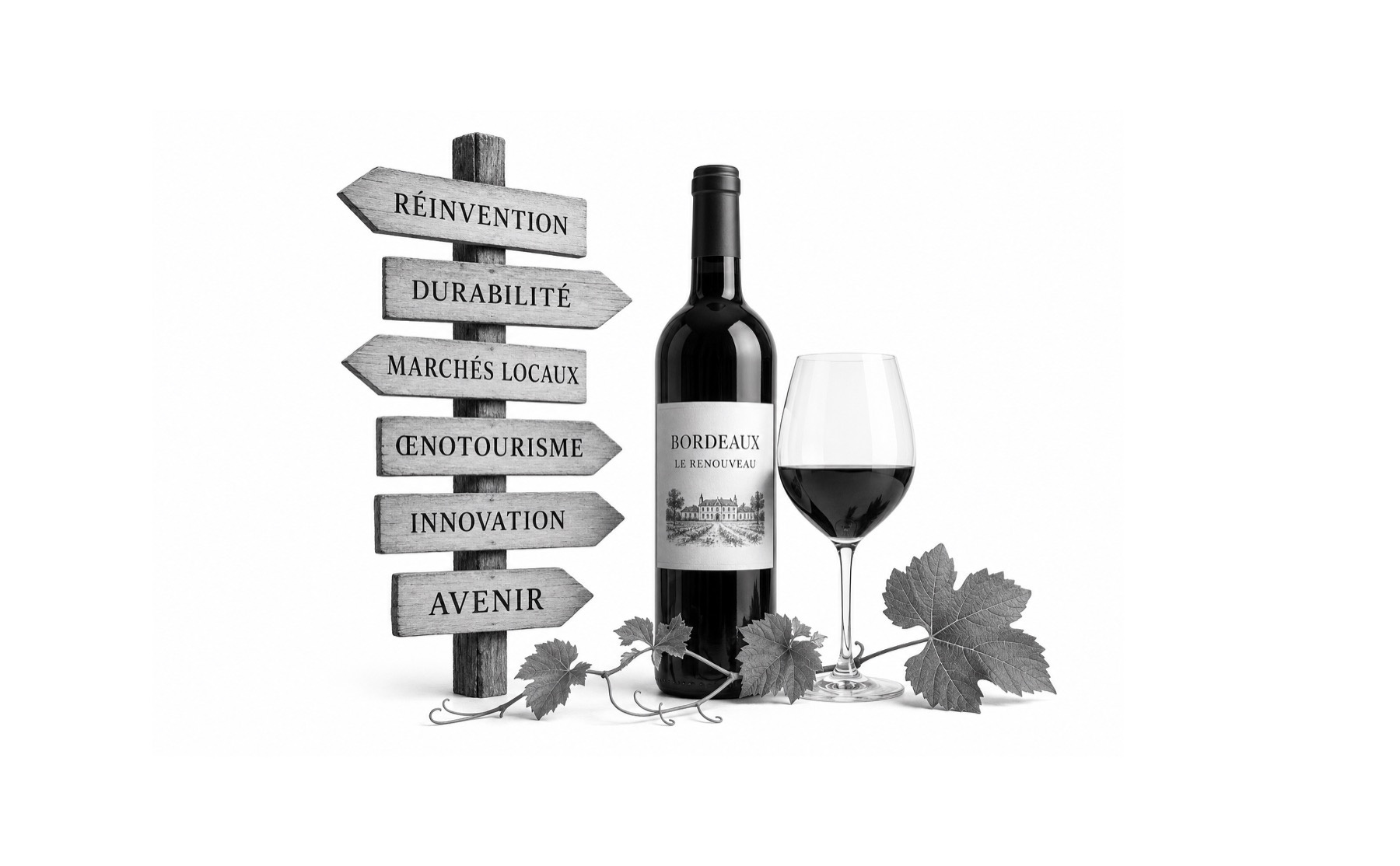
The emerging answers point toward a wine economy built on closer consumer relationships, experiential tourism, environmental responsibility, scientific innovation, and renewed regional engagement.
For a region that has repeatedly reinvented itself throughout history, the current moment may ultimately be remembered not as the end of an era, but as the beginning of a new one.