
Bonnes-Mares Grand Cru: A Burgundy Wine of Depth, Tension and Quiet Grandeur
A guide to the Côte de Nuits grand cru shaped by Chambolle elegance and Morey firmness.
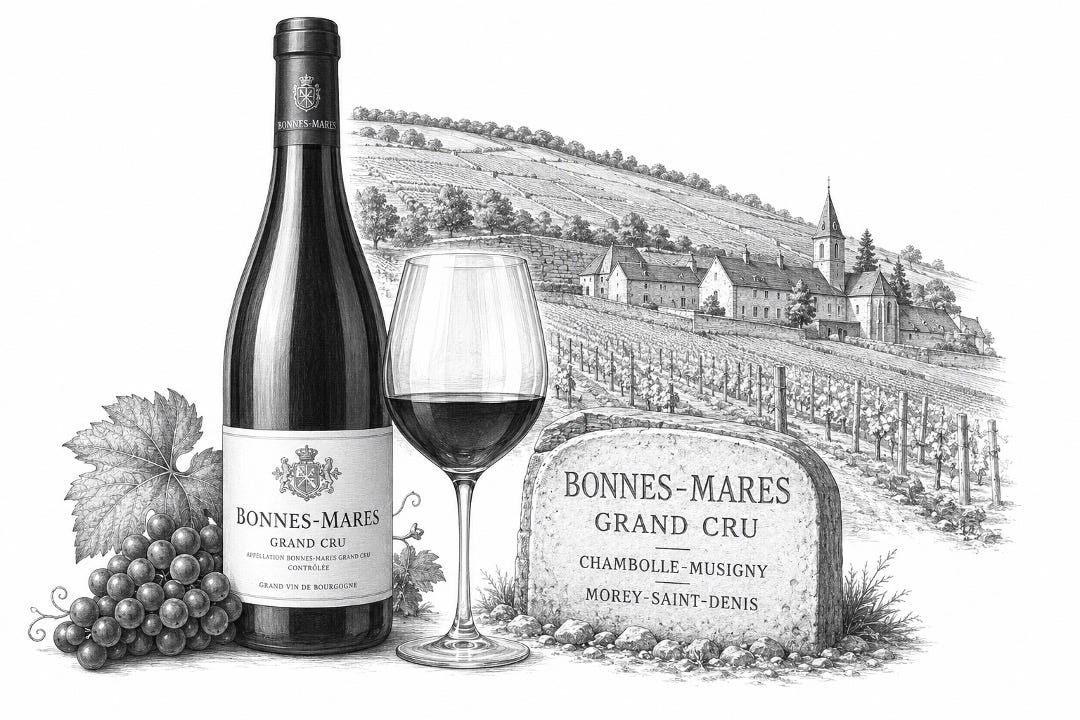
Bonnes-Mares Grand Cru occupies one of Burgundy’s most fascinating positions: geographically, geologically and stylistically. This celebrated Côte de Nuits vineyard sits between Chambolle-Musigny and Morey-Saint-Denis, two villages whose temperaments are often described in contrasting language. Chambolle suggests fragrance, poise and delicacy; Morey brings depth, savour, and a firmer frame. Bonnes-Mares does not choose between them. Its greatness lies in the way it holds both.
For lovers of French wine, Bonnes-Mares Grand Cru is not simply another famous name on a Burgundy label. It is a vineyard that rewards close attention: to producer, parcel, vintage, farming, cellar history and the patience required to let serious Pinot Noir unfold. At its best, Bonnes-Mares offers one of the Côte de Nuits’ most compelling combinations of aromatic lift and structural authority.
A Grand Cru Between Chambolle-Musigny and Morey-Saint-Denis
Bonnes-Mares was officially recognised as a Grand Cru AOC in 1936, placing it among the highest-ranked vineyards in Burgundy’s legal hierarchy. The appellation covers only a small surface area, roughly fifteen hectares, making it scarce even before one considers the fragmentation of ownership and the tiny quantities bottled by leading domaines.
Its position is part of its intrigue. The vineyard lies on an east-facing slope, receiving morning light and benefitting from the classical Burgundian marriage of exposure, drainage and limestone-influenced soils. Yet Bonnes-Mares is not uniform. It is shared between two communes and shaped by internal variations that can be felt in the glass. This is one reason why the name alone is never enough. A bottle of Bonnes-Mares is always a dialogue between vineyard and grower.
The Terroir of Bonnes-Mares Grand Cru
The personality of Bonnes-Mares Grand Cru is often explained through its soils. The vineyard includes both redder, clay-influenced sectors and paler, marl-rich areas. In broad terms, the former tend to give wines of greater density, tannin and breadth; the latter can emphasise perfume, energy and finesse. These distinctions should not be reduced to a simple formula, but they help explain why Bonnes-Mares can seem both powerful and highly aromatic.
This internal contrast separates it from some neighbouring grands crus. Musigny is often associated with extraordinary refinement; Clos de Tart, as a monopole, has a more singular estate identity; Clos de la Roche can show the deeper, more sombre side of Morey-Saint-Denis. Bonnes-Mares sits among them with its own voice: broad-shouldered yet scented, serious yet not severe, capable of grandeur without abandoning nuance.
Pinot Noir is the essential grape here, and in practice Bonnes-Mares is understood as a red-wine appellation. The best wines are not built on immediate charm alone. They have matter, grip and length, and their beauty often comes from the slow resolution of elements that can feel tightly coiled in youth.
What Does Bonnes-Mares Grand Cru Taste Like?
Young Bonnes-Mares can be impressive, but not always easy. The fruit profile often leans toward dark cherry, blackberry, mulberry and plum, with floral notes that may suggest violet or peony. Depending on producer and vintage, one may also find spice, smoke, earth, game, tea leaf or a faintly wild savour.
With age, the wine tends to move away from simple fruit and toward greater aromatic complexity. Forest floor, truffle, leather, dried flowers and sous-bois may emerge, while the tannins become more integrated. Mature Bonnes-Mares is rarely merely soft. Its pleasure lies in texture, depth and the way savoury elements gather around the remaining fruit.
This is one of the reasons Bonnes-Mares is so admired by Burgundy collectors. It can be magnificent, but it asks for time. The finest bottles are often at their most eloquent only after many years in a proper cellar. Strong vintages from top domaines can reward two decades or more; exceptional bottles may travel still further.
Bonnes-Mares Grand Cru Producers to Know
Because ownership is divided among many growers, producer choice is central. Bonnes-Mares Grand Cru is not a vineyard where one should buy blindly by appellation. The finest domaines bring out different aspects of the site, and the market recognises those differences.
Domaine Comte Georges de Vogüé remains one of the historic names attached to Bonnes-Mares. Its wines are often sought by collectors who value classical Burgundy pedigree, longevity and a firmly established reputation.
Domaine Georges Roumier stands at the highest level of demand, with Bonnes-Mares often considered one of the benchmark interpretations of the climat. Its bottles are rare, intensely followed and among the most internationally legible names for serious Burgundy buyers.
Domaine Jacques-Frédéric Mugnier offers another kind of fascination. Its Bonnes-Mares is often prized for elegance, precision and aromatic grace rather than sheer mass. For drinkers who love the more refined register of Chambolle-Musigny, Mugnier can be especially compelling.
Domaine Dujac brings a distinctive signature, frequently associated with whole-cluster complexity, spice and a savoury framework. Its approach can give Bonnes-Mares a particularly expressive architecture, marrying fruit depth with aromatic detail.
Robert Groffier and Domaine Arlaud also deserve close attention. Groffier can deliver a darker, generously fruited style with real grand cru presence, while Arlaud appeals to those drawn to biodynamic farming, small production and a more artisanal reading of place.
These names do not exhaust the appellation, but they illustrate the central principle: Bonnes-Mares is a producer-led grand cru. The vineyard gives the material; the domaine determines how clearly it speaks.
Collecting Bonnes-Mares Grand Cru
For collectors, Bonnes-Mares Grand Cru has obvious attractions: rarity, prestige, ageing capacity and a secure place in the Burgundy canon. Yet it is not a wine to approach casually. The most desirable bottles tend to come from a narrow group of domaines, and the gap between a good Bonnes-Mares and a great one can be substantial.
Vintage selection matters. Warm, concentrated years may produce wines of impressive depth, but balance and definition are essential. Cooler or lighter vintages can be charming and transparent, though not always built for the same long horizon. As ever in Burgundy, the best buying decisions combine vintage reputation with knowledge of the individual producer.
Provenance is equally important. For mature Bonnes-Mares, the condition of the bottle, storage history, fill level, capsule, label and source of sale can matter as much as the vintage itself. Magnums are especially attractive for long cellaring, both for their slower evolution and their appeal among collectors. Original cases and well-documented ownership add confidence.
Bonnes-Mares may have investment appeal, but it should not be treated as a speculative shortcut. Burgundy’s most famous wines have become global luxury objects, yet the wisest buyers remain disciplined. They favour trusted merchants, reputable auctions, transparent provenance and producers with established demand. Scarcity alone does not guarantee value; quality and authenticity must come first.
How to Serve and Cellar Bonnes-Mares Grand Cru
Most serious Bonnes-Mares should not be opened too young unless one is prepared for structure. In youth, decanting can help, though delicate handling is advisable. Mature bottles deserve more caution: standing the bottle in advance and decanting only when necessary may preserve fragile aromatics.
Serving temperature should be cool rather than warm, allowing the wine’s perfume to rise without letting alcohol or oak dominate. Large Burgundy stems are appropriate, giving the wine space to expand. Food pairings should respect both power and nuance: game birds, roast duck, veal, mushrooms, truffle, aged cheeses and refined dishes with earthy undertones can work beautifully.
For cellaring, consistency matters more than ambition. A stable, cool, dark cellar with controlled humidity is essential. Bonnes-Mares is a wine of patience, but patience only rewards those who store it properly.
Why Bonnes-Mares Grand Cru Is One of Burgundy's Most Coveted Vineyards
Bonnes-Mares Grand Cru matters because it expresses one of Burgundy’s great themes: the drama of small differences. A change in soil, slope, village boundary or grower philosophy can alter the final wine profoundly. In lesser hands, this complexity can become inconsistency. In the best hands, it becomes fascination.
It is not the most delicate grand cru in Burgundy, nor the most monolithic. Its beauty lies in contrast: perfume against tannin, elegance against force, Chambolle grace against Morey depth. That tension gives Bonnes-Mares its intellectual and sensual appeal.
For the serious lover of French wine, Bonnes-Mares is worth studying not as a trophy but as a lesson in Burgundy itself. It shows how a vineyard can be both legally defined and endlessly variable, historically revered and still dependent on the living choices of growers. When producer, vintage and provenance align, Bonnes-Mares Grand Cru can offer red Burgundy at its most commanding: fragrant, structured, long-lived and quietly unforgettable.