

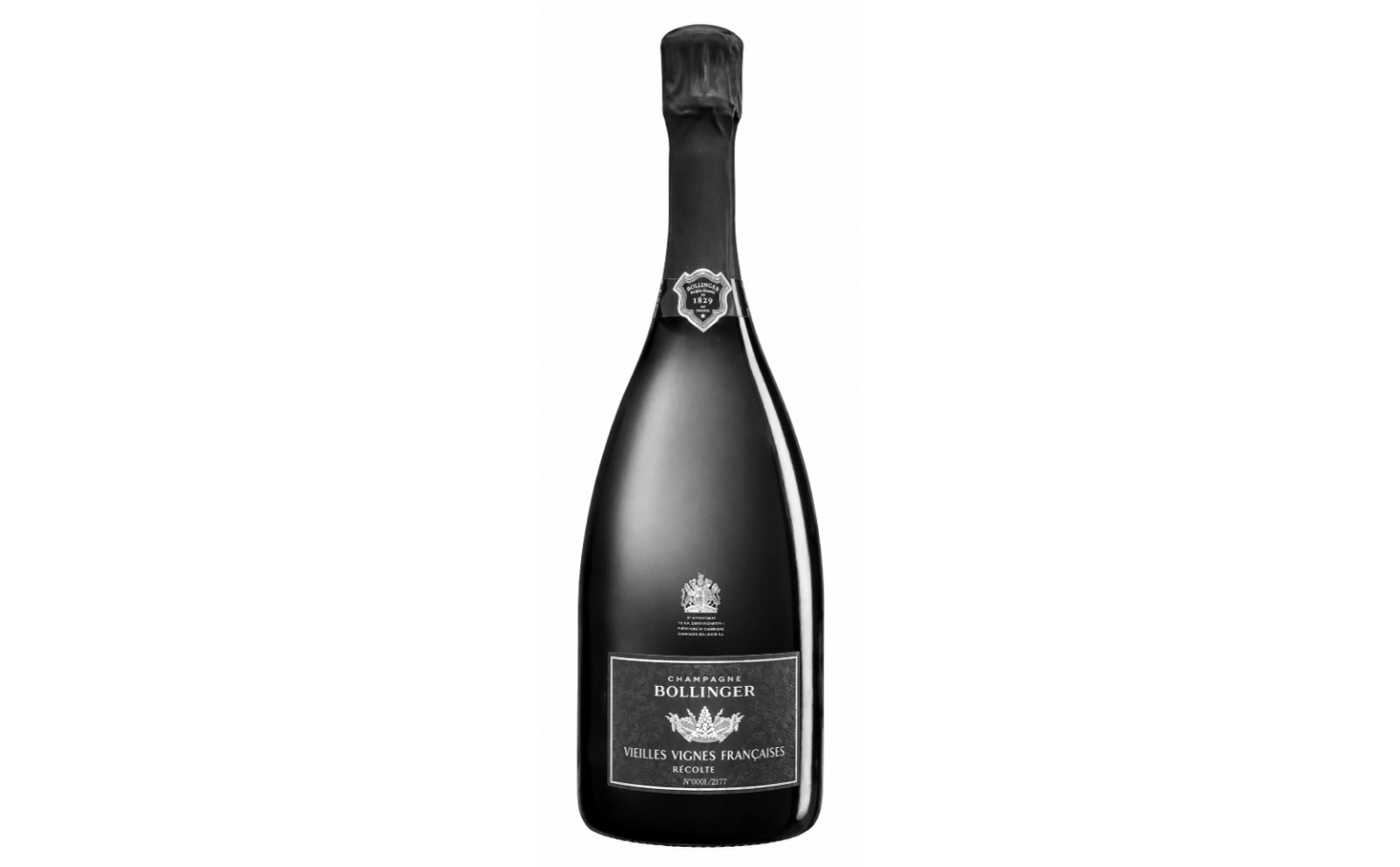
Bollinger’s rarest Champagne sits at the intersection of historic vineyard continuity, ungrafted cultivation and a modern dispute over the age of the present vines.
Few Champagne wines come with a more persuasive origin story than Bollinger’s Vieilles Vignes Françaises.
The wine is made from Pinot Noir grown in two tiny clos in Aÿ, Clos Saint-Jacques and Les Chaudes Terres. Together they cover just 31 ares, or 0.31 hectare. The vines are ungrafted, planted en foule rather than in conventional rows, and maintained through provignage, the old practice of replacing vines by layering shoots from existing plants. Bollinger says the vineyards are worked entirely by hand and records the use of a draught horse. Production is correspondingly minute: the 2016 vintage yielded 1,736 numbered bottles.
It is exactly the kind of wine around which Champagne mythology accumulates easily.
The vineyards are routinely presented as remnants of pre-phylloxera Champagne. Bollinger itself describes Clos Saint-Jacques and Les Chaudes Terres as sites that never succumbed to the insect that transformed European viticulture in the late nineteenth and early twentieth centuries. Read quickly, that language invites a simple conclusion: these are nineteenth-century vines that somehow survived.
The available evidence does not support making that statement without qualification.
A detailed 2026 report by William Kelley states that the present vines were replanted during the 1970s using massal selections from Aÿ, while remaining ungrafted. Bollinger’s account and Kelley’s reporting therefore appear to describe different kinds of continuity. One concerns the historic vineyards, the persistence of ungrafted cultivation and the survival of a viticultural system. The other concerns the literal age of the individual plants standing there today.
That distinction does not make Vieilles Vignes Françaises less interesting.
It makes it more interesting.
Because to understand what survived phylloxera at Bollinger, it is necessary to separate five ideas that are often collapsed into one: an old vineyard site, an ungrafted vine, a pre-phylloxera cultivation system, a massal lineage and a literal nineteenth-century surviving plant.
They are not the same thing.
A wine built on 31 ares
Vieilles Vignes Françaises is one of Bollinger’s smallest and rarest wines.
The current cuvée comes from two estate-owned plots in Aÿ: Clos Saint-Jacques and Les Chaudes Terres. Their combined published surface is 31 ares. Bollinger does not currently publish the individual surface of each parcel. An older visit report gave Clos Saint-Jacques as 21 ares, but that figure should be treated as historical secondary evidence rather than present cadastral proof.
Both parcels are planted to Pinot Noir.
That fact alone does not make them unusual in Aÿ. Their cultivation does.
Modern Champagne vineyards are generally planted in orderly rows. Clos Saint-Jacques and Les Chaudes Terres are planted en foule: vines stand in a dense, irregular arrangement associated with older vineyard systems rather than contemporary mechanised viticulture.
They are also ungrafted.
That matters because the dominant response to phylloxera in Europe was the grafting of Vitis vinifera varieties onto resistant American rootstocks. The solution allowed European grape varieties to survive in soils where phylloxera would otherwise damage their roots. An ungrafted Pinot Noir vine remains on its own roots.
At Bollinger’s two clos, replacement is also carried out through provignage. A shoot from an existing vine is bent into the soil and allowed to establish new roots while remaining connected to the parent plant before eventually becoming independent.
Taken together—ungrafted vines, en foule planting and provignage—these practices preserve a form of viticulture that bears little resemblance to the standard visual language of a modern Champagne vineyard.
That is real continuity.
It is also different from saying that every vine currently growing there was already alive before phylloxera reached Champagne.
The problem with the word “survivor”
Bollinger’s current presentation says that Clos Saint-Jacques and Les Chaudes Terres never succumbed to phylloxera and describes them as surviving remnants of pre-phylloxera Champagne.
That statement can be understood in several ways.
A vineyard site can survive even when its vines are periodically replanted.
A cultivation method can survive even when individual plants do not.
A population of vines can preserve local genetic material through massal selection even if successive generations replace one another.
An ungrafted tradition can persist across replantings.
And, in the narrowest possible meaning, an individual vine can itself survive for more than a century.
Wine writing often allows those different forms of continuity to merge because the resulting story is easier to tell. A pre-phylloxera site planted with ungrafted vines becomes, almost imperceptibly, “a vineyard of pre-phylloxera vines”.
But the phrases are not interchangeable.
William Kelley’s 2026 reporting introduces an important complication: he states that the present vines were replanted during the 1970s from Aÿ massal selections while remaining ungrafted.
If that account is correct, the current plants themselves should not be described as literal nineteenth-century survivors.
The historic clos remain exceptional. Their ungrafted cultivation remains exceptional. Their preservation of local Pinot Noir material may remain viticulturally significant. Their association with an older vineyard system is undiminished.
But vine age and historical continuity become two different questions.
That difference is precisely where the real story begins.
Site continuity is not vine continuity
Vineyards are unusually prone to confusion between place and plant.
Names persist for centuries. Parcels retain cadastral identities. Walls, exposures, soil profiles and local reputations survive successive generations of vines. A vineyard can be very old even when its vines are relatively young.
Burgundy offers the most obvious examples: no serious observer would argue that a climat ceases to be historic because its vines have been replanted. The identity of the place exists independently from the biological age of every plant within it.
The same distinction applies here.
Clos Saint-Jacques lies beside Bollinger’s house in Aÿ. The producer describes it as favourably exposed, although it does not give a precise compass bearing. An older specialist visit described approximately 40 centimetres of soil over chalk. For Les Chaudes Terres, Bollinger does not publicly provide an equally detailed parcel-specific soil profile or exact exposure.
The absence of such information matters because the strongest case for the wine’s importance does not need to rely solely on vine age.
Its importance can instead be understood through the persistence of the site, the unusual cultivation system, the use of ungrafted Pinot Noir and the preservation of a highly localised vine population.
That is a more complicated story than “these vines survived phylloxera”.
It is also a more defensible one.
What ungrafted actually tells us
An ungrafted vine is not automatically an ancient vine.
That point deserves emphasis because the two ideas are often psychologically linked.
In most European vineyards today, the visible grape-producing part of the plant—Pinot Noir, Chardonnay, Cabernet Sauvignon and so on—is grafted onto a rootstock selected partly for resistance to phylloxera. An ungrafted vine, by contrast, grows on its own roots.
The distinction concerns root system and propagation, not necessarily age.
An ungrafted vine planted in 1975 is still ungrafted. It can preserve characteristics of a local vine population, and if propagated through massal selection rather than through a single commercial clone it may retain meaningful genetic diversity. But none of that turns it into a plant from 1875.
The Bollinger case therefore asks a more useful question than simply “how old are the vines?”
It asks what exactly has been transmitted from one generation of vines to the next.
If the present plants were indeed established in the 1970s from Aÿ massal material, the historical continuity may reside partly in that lineage.
Massal selection works very differently from the idea of preserving one immortal vine. Growers select propagation material from a population of vines judged worth reproducing. Over successive generations, the vineyard can retain a local biological inheritance without each plant itself being ancient.
This is lineage rather than immortality.
For a wine such as Vieilles Vignes Françaises, that distinction should be central to the conversation.
The significance of provignage
The role of provignage makes the question even more interesting.
Rather than pulling out a failing vine and replacing it with a standard nursery plant, layering allows an existing vine to produce a new rooted plant from one of its own shoots.
The result complicates the idea of a vineyard having a single planting date.
In a vineyard maintained in this way, generations overlap. The biological population is renewed progressively rather than created all at once. It can become difficult to describe the vineyard accurately with the modern shorthand of “planted in year X”.
Bollinger explicitly says that Clos Saint-Jacques and Les Chaudes Terres are maintained through provignage. The vines are cultivated en foule, worked manually, and a draught horse is used.
That combination matters more than picturesque vineyard imagery might suggest.
It describes an operating system.
The vineyard is not important merely because it looks old or because it permits the house to invoke a pre-phylloxera past. Its physical structure determines how vines can be cultivated, replaced and worked. A modern tractor-based row system cannot simply be imposed upon it.
Here, historical viticulture persists through practice.
That may ultimately be the most convincing sense in which something pre-phylloxera has survived.