

Beaujolais Wines Refocus on Pleasure as the Region Faces Leaner Harvests
Beaujolais is sharpening its message around pleasure and accessibility as lower harvests force the region to spend with greater focus.
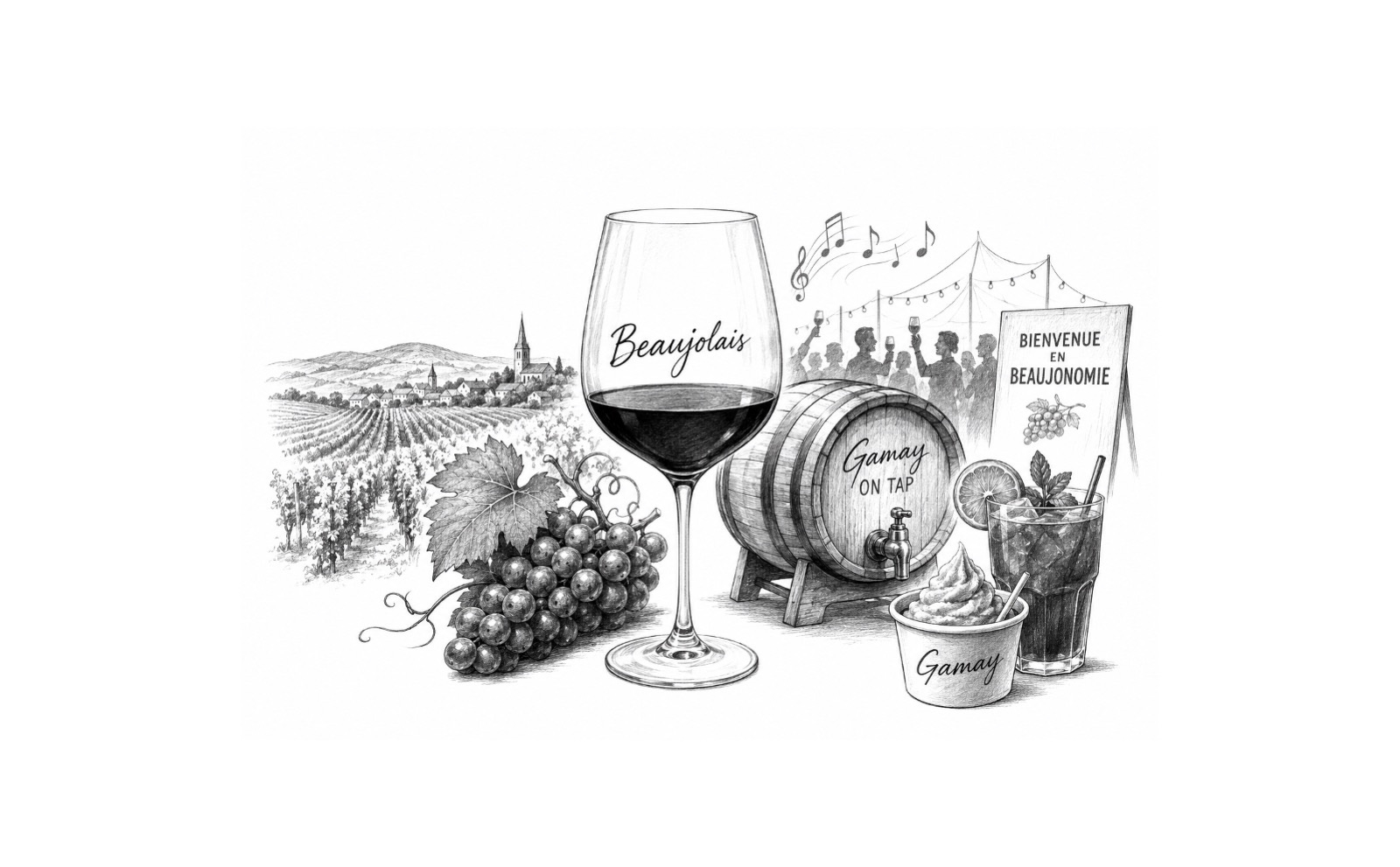
Beaujolais has spent much of the past decade asking wine lovers to look again. Beyond the familiar image of youthful, fruit-driven bottles lies a region of distinctive villages, serious crus and increasingly confident winemakers. That work has changed perceptions. Yet the next chapter may depend less on proving that Beaujolais wines can be profound than on reminding people why they are enjoyable in the first place.
This shift comes at a difficult moment. Small harvests have reduced the amount of wine available to sell, weakening producers’ finances and limiting the resources of InterBeaujolais, the regional wine body responsible for promotion and collective strategy. At the same time, successful public events suggest that Beaujolais still possesses something many wine regions struggle to manufacture: an open, sociable identity capable of attracting people who do not consider themselves wine experts.
The challenge is therefore twofold. Beaujolais must manage a period of economic and climatic pressure while presenting its wines in ways that feel inviting, contemporary and true to the region.
Beaujolais Wines Meet a Difficult Vineyard Reality
The violent hailstorm of 18 July 2026 arrived when growers were already carrying the effects of two disappointing harvests. Before the storm, the new crop had appeared encouraging, with promising quality and a potentially larger yield than the previous year despite periods of extreme heat.
For some estates, that optimism disappeared in minutes.
The wider context is equally sobering. Beaujolais produced only 361,000 hectolitres in 2025, described by the regional organisation as its lowest harvest on record. Such limited volumes affect far more than the number of bottles reaching the market. When there is less wine to sell, estates struggle to rebuild margins, invest in their vineyards or absorb another difficult season.
Several long-term pressures are converging. A changing climate is making weather patterns less predictable, while growers also face an ageing vineyard and a narrowing range of permitted crop-protection tools. Yield alone cannot define the health of a wine region, but repeated shortfalls make economic recovery considerably harder.
This is particularly frustrating because Beaujolais had begun to regain commercial confidence. Better recognition of the crus, growing interest in site-specific wines and greater attention to farming and vinification had strengthened the region’s reputation. Smaller harvests have interrupted that progress without diminishing the quality or ambition behind it.
Tighter Budgets, Clearer Priorities
Lower production also means lower income for InterBeaujolais, whose funding is linked partly to the volume of wine marketed. The organisation had already begun a two-year effort in 2025 to restore financial balance following four consecutive deficit years. Harvest volumes below expectations have made that task more demanding.
Costs have been reduced through a move to less expensive premises and savings in staffing. Promotional activity is also becoming more selective. Rather than distributing limited resources across numerous small initiatives, the organisation is concentrating on projects considered most likely to deliver meaningful results.
Some media programmes have been suspended, while export promotion is being focused on five markets: the United States, Canada, the United Kingdom, Japan and Sweden. The approach reflects financial necessity, but it may also encourage greater discipline. In a crowded international wine market, a clear presence in a smaller number of countries can be more effective than a faint presence almost everywhere.
Beaujolais is not abandoning its ambitions. It is choosing where those ambitions can realistically be pursued.
Events Reveal the Social Strength of Beaujolais Wines
The most encouraging signs are coming from experiences that place wine in a convivial setting rather than behind a wall of technical language.
The seventh edition of Bienvenue en Beaujonomie brought 2,452 guests to the region in June 2026. Attendance rose by 19 per cent in one year and by 67 per cent over two years. The event also appears to be building loyalty: 39 per cent of participants had attended previously, while 80 per cent said they intended to order wine afterwards.
Those figures matter because they show how effectively personal contact can turn curiosity into engagement. Beaujolais is especially well suited to this kind of encounter. Its wines are closely connected to food, village life and the pleasure of gathering around a table. When visitors meet growers and taste wines in context, the region becomes easier to understand without being simplified.
A similar lesson emerged from the first Gamay Days event in Lyon. Nearly 3,000 people attended over a single weekend, with young urban visitors forming much of the audience. Their presence challenges the assumption that younger consumers are simply uninterested in wine.
Many may instead be uninterested in the formality surrounding it.
Well-designed events can remove that barrier. Music, food, informal service and a strong sense of occasion allow wine to become part of a broader cultural experience. The liquid remains important, but it is no longer presented as an examination the visitor must pass.
Gamay Beyond the Conventional Wine Glass
Gamay’s adaptability offers another route towards new drinkers. In recent events and promotional settings, the grape has appeared chilled and served on tap, incorporated into cocktails, transformed into frozen drinks and made in sparkling styles.
Traditionalists may regard some of these formats with caution. They should not, however, be confused with the region’s more established wines or presented as replacements for cru Beaujolais. Their value lies elsewhere: they provide accessible points of entry and demonstrate that Gamay does not have to be confined to a single style or occasion.
Wine regions often speak about attracting new consumers while continuing to communicate almost exclusively through appellations, vintages and tasting vocabulary. Beaujolais has an opportunity to take a more imaginative route. Someone who first encounters Gamay in a lively bar or summer event may later become curious about a bottle from Morgon, Fleurie or Moulin-à-Vent.
Not every informal experience will lead to deeper exploration. It does not need to. Wine can sometimes be enjoyed without becoming a subject of study. Recognising that simple truth may help Beaujolais speak to a broader public.
A Broader Invitation from Beaujolais
Sébastien Kargul, the new president of InterBeaujolais and its former vice-president, inherits a strategy built around quality, diversity and technical progress. The region intends to continue highlighting the range of its wines, supporting research through Sicarex Beaujolais and the experimental estate, and strengthening connections with other local organisations.
The change is primarily one of emphasis.
Beaujolais has worked hard to establish that its wines merit serious attention. The finest examples now appear on respected restaurant lists and in the cellars of knowledgeable drinkers. The region need not retreat from that progress. Nor should it reduce its identity to uncomplicated fruitiness or seasonal celebration.
But seriousness and pleasure are not opposing ideas. A wine may express granite, schist or limestone soils while remaining generous at the table. It can reward contemplation without demanding ceremony. Indeed, one of the enduring strengths of Beaujolais wines is their ability to move comfortably between those worlds.
That quality may be especially valuable at a time when many consumers feel distanced from wine by expense, complexity or cultural codes. Beaujolais can offer substance without stiffness and character without intimidation.
Pleasure as a Form of Resilience
The region’s immediate problems cannot be solved by communication alone. Growers need viable harvests, sustainable returns and vineyards capable of adapting to increasingly unstable conditions. Promotional success cannot compensate for grapes destroyed by hail or for cellars left short of wine.
Yet the public response to recent events offers a reason for confidence. People will gather around Beaujolais when the invitation feels genuine. Younger drinkers will explore Gamay when it is presented without condescension. Existing enthusiasts will return when encounters with the region feel personal and memorable.
With less money available, Beaujolais must communicate more precisely. That may ultimately bring its message closer to the essence of the wines themselves: vivid, welcoming and grounded in shared enjoyment.