

France’s register of vine varieties is rarely the place one expects to find surprises. Yet the latest additions bring together two grapes with almost nothing in common except their ability to challenge familiar ideas about what may have a place in the French vineyard.
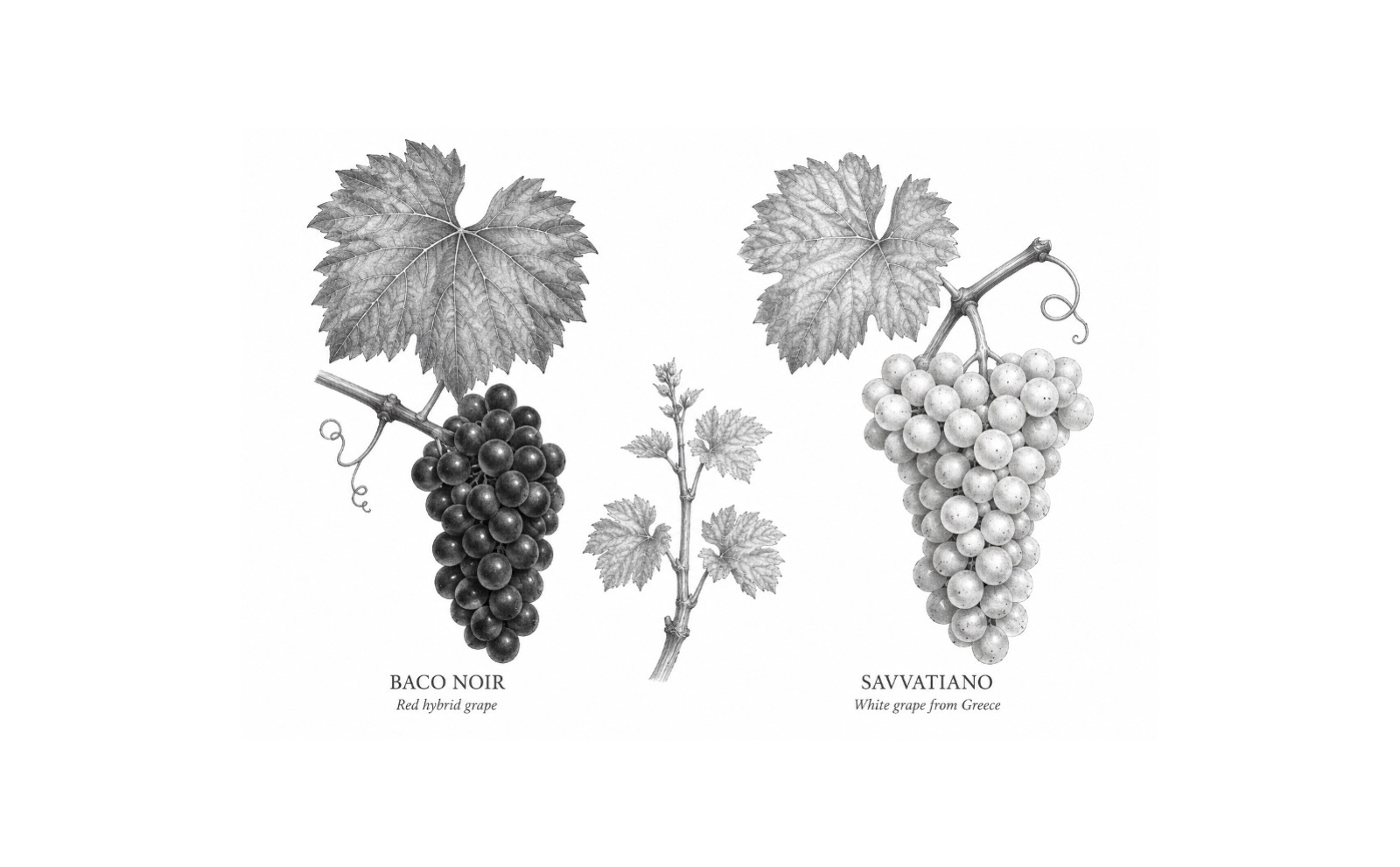
Baco Noir and Savvatiano can now be propagated and marketed as vine plants in France. One is a historic French-American hybrid that has almost vanished from the country where it was created. The other is a Greek white variety with centuries of Mediterranean experience behind it. Both, however, arrive with characteristics that feel unusually relevant to contemporary winegrowing: freshness in the glass and, in different ways, resilience in the vineyard.
Their inclusion does not predict a wave of new plantings. It does, however, make them available for consideration at a moment when growers are looking more closely at varieties capable of responding to changing climatic and viticultural conditions.
Baco Noir and Savvatiano Take Different Roads to France
Of the two, Baco Noir has the more paradoxical story.
The variety was once a substantial presence in France. Around 12,000 hectares were planted in 1958; today, only about four hectares remain. Like many interspecific hybrids, Baco Noir gradually disappeared from mainstream French viticulture during the second half of the twentieth century.
Its return to the official catalogue therefore feels less like an introduction than a rediscovery.
Baco Noir was created from Folle Blanche, the historic white grape still closely associated with western France, and a vine belonging to the North American species Vitis riparia. That parentage places it within a generation of hybrids developed partly to combine European wine quality with useful characteristics from American vines.
For decades, hybrid varieties carried considerable stylistic baggage. Some became associated with the distinctive aromas often described as “foxy”, a profile that helped limit their reputation among European winegrowers and drinkers.
Baco Noir is more interesting than that stereotype suggests.
Baco Noir: An Old Hybrid Seen Through New Eyes
According to the work behind its French registration, Baco Noir can produce deeply coloured but relatively supple wines, with clear fruit and enough acidity to retain freshness. Crucially, its berries are not associated with the pronounced “foxy” character that has historically complicated perceptions of some hybrids.
That combination gives the grape an unexpectedly contemporary profile. There is increasing interest in red wines built around fruit, freshness and moderate weight rather than sheer concentration, and Baco Noir appears capable of fitting comfortably within that stylistic territory.
France is not the only country where the variety has attracted attention. Baco Noir remains cultivated in Canada, with around 700 hectares reported there, and it is among the grapes permitted for varietally labelled VQA wines in Ontario and British Columbia.
Its viticultural behaviour may prove at least as interesting as its wine style.
Baco Noir shows strong tolerance to downy mildew and powdery mildew, two diseases that can demand considerable intervention in susceptible European varieties. Its relationship with other fungal pressures is less straightforward: bunches can be more vulnerable to botrytis, while growers in North America have also reported sensitivity to black rot.
The vine itself is vigorous—sometimes markedly so. It produces long, semi-erect shoots and has historically been recommended for relatively generous vineyard spacing. A short growing cycle and good fertility helped make it useful in colder North American wine regions.
Whether those characteristics will translate equally well to warmer or drier French conditions remains less certain. Its response to prolonged heat and water stress is not yet well documented, making Baco Noir a variety of interest rather than a ready-made answer to climate change.
That distinction matters. Resilience is rarely a single characteristic.
Savvatiano Brings Mediterranean Experience
Where Baco Noir looks back towards a forgotten chapter of French viticulture, Savvatiano arrives from an entirely different wine culture.
The white grape is the most widely planted variety in Greece, accounting for close to 15% of the country’s vineyard area. In France it remains unfamiliar, but in its homeland Savvatiano has long demonstrated its ability to perform under conditions that increasingly command attention farther north.
Its wines can range from moderately to more vividly acidic depending on altitude and harvest timing. Aromatically, the variety is associated with citrus, lemon, apple and white flowers, sometimes accompanied by herbal or stony nuances.
The overall profile can be fresh and expressive without depending on extreme acidity or overt aromatic intensity. That alone may make Savvatiano interesting to growers and winemakers exploring white varieties suited to warmer environments.
Its vineyard credentials strengthen the case.
Why Savvatiano May Interest French Growers
Savvatiano has a reputation in the viticultural literature for coping well with drought. It is also capable of growing successfully on limestone and relatively poor soils—conditions hardly alien to French wine country.
That does not mean a Greek variety can simply be transferred into France with predictable results. Grape varieties express themselves through the interaction of climate, soil, farming and local choices, and a vine accustomed to one landscape does not automatically behave identically in another.
Nevertheless, Savvatiano enters the French catalogue at an intriguing moment.
Periods of drought and intense heat are becoming increasingly important considerations in vineyard planning. At the same time, growers must continue to think about freshness, balance and the identity of the wines they produce. Varieties that have already demonstrated an ability to function in dry Mediterranean environments inevitably attract attention.
Savvatiano therefore represents something broader than the arrival of an unfamiliar Greek grape. It illustrates the increasingly international search for genetic and viticultural resources that may help vineyards adapt without abandoning the qualities drinkers value in wine.
Baco Noir and Savvatiano Expand the Conversation
The most compelling aspect of these two additions is the contrast between them.
Baco Noir asks whether a nearly forgotten hybrid deserves to be reconsidered in light of modern vineyard pressures and changing tastes. Savvatiano asks what France might learn from an established Mediterranean variety shaped by generations of cultivation under dry conditions.
Neither should be regarded as a solution in search of a problem. Nor does entry into the official catalogue mean either grape is destined to become a significant feature of French wine.
What changes is the possibility of working with them.
French growers and nurseries can now explore two varieties whose relevance rests on rather different foundations: disease tolerance and cool-climate adaptability in the case of Baco Noir; drought tolerance and Mediterranean experience in the case of Savvatiano.
They also share a quality that may be just as significant. Both are capable of producing wines defined by fruit and freshness rather than heaviness.
For a French wine landscape confronting climatic uncertainty while drinkers increasingly prize energy and drinkability, that makes Baco Noir and Savvatiano worth watching—not as replacements for the grapes France already knows, but as additions to a much larger conversation about what its vineyards may need next.