
Alcohol-Free Wine Labelling: New EU Rules Raise Questions for French Producers
New EU terms promise consistency, yet French producers face stricter 0.0% thresholds and more crowded labels.
Alcohol-Free Wine Labelling Enters a New European Era
For French producers working in the no- and low-alcohol category, the European Union’s latest wine reform brings welcome consistency—and a fresh layer of complexity.
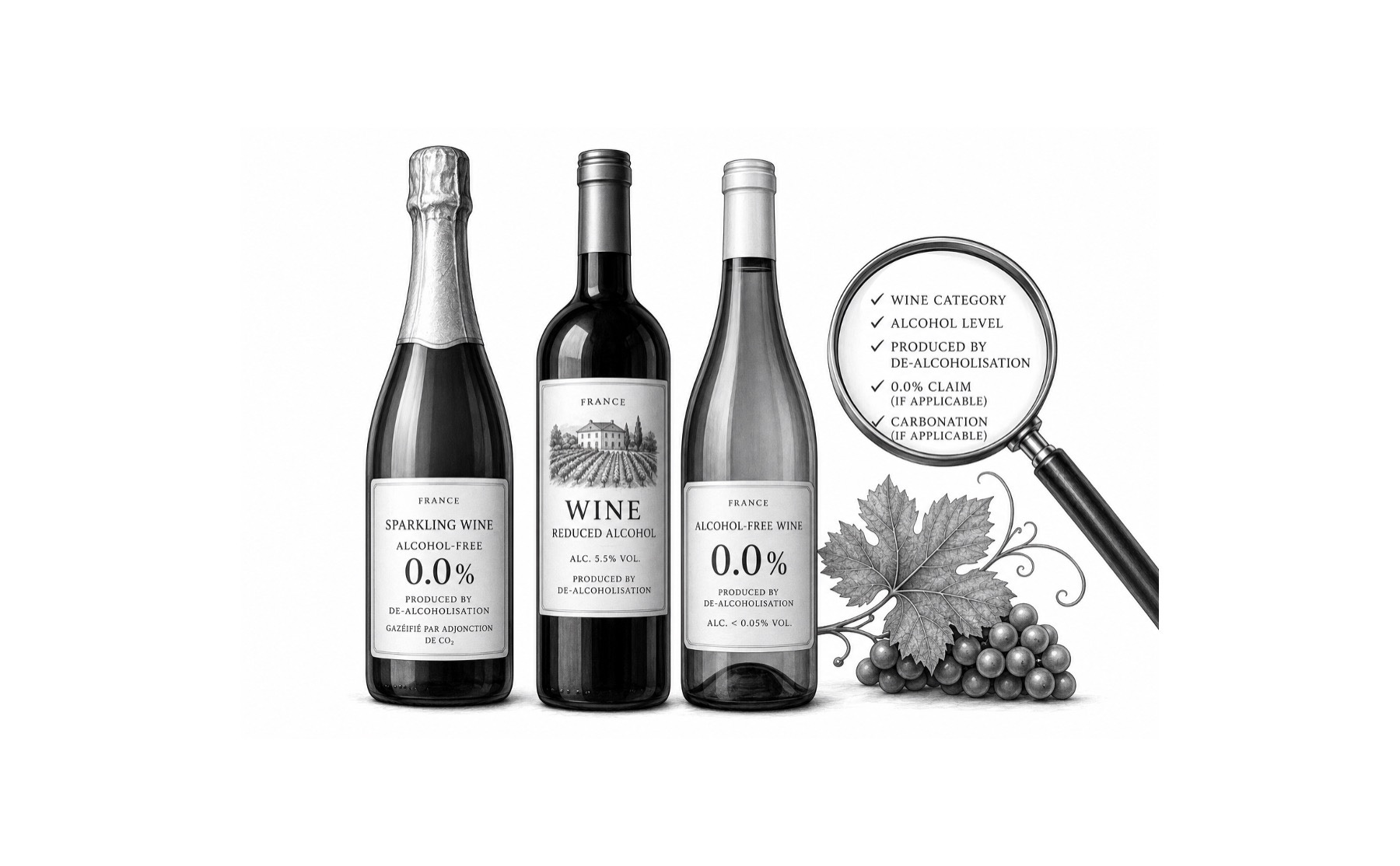
Regulation (EU) 2026/471 establishes a common vocabulary for wines from which alcohol has been wholly or partly removed. From September 2027, familiar expressions such as “alcohol-free,” “0.0%” and “reduced alcohol” will be governed by the same thresholds throughout the European Union. The method of production must also remain visible: affected products will have to carry the words “produced by de-alcoholisation.”
The intention is straightforward. Consumers should encounter the same terminology whether they buy a bottle in Bordeaux, Brussels or Berlin. Yet alcohol-free wine labelling is rarely as simple as placing a prominent “0.0” on the front label. Product category, actual alcoholic strength, production method and, in some cases, carbonation must all be described correctly.
The result may be greater legal harmony without necessarily producing a cleaner or more elegant bottle.
What Qualifies as Alcohol-Free Wine?
Under the new framework, a wine may use the term “alcohol-free” when its actual alcoholic strength does not exceed 0.5% alcohol by volume.
The more striking “0.0%” expression is reserved for products containing no more than 0.05% alcohol by volume. It does not replace “alcohol-free”; rather, it accompanies it. In practical terms, a qualifying product will combine the regulated wine category with the alcohol-free designation and, where appropriate, the 0.0% statement.
This represents a significant change for France. The DGCCRF guidance published in July 2025 permitted a voluntary “0.0% vol.” claim when alcohol was analytically undetectable, defined at that time as below 0.1% vol. The European threshold is therefore twice as strict.
For producers, that difference is not merely typographical. A bottle intended to display 0.0% must meet a demanding analytical limit with sufficient consistency across production, testing and shelf life. A wine at 0.08% may remain alcohol-free under the new rules, but it will no longer qualify for the additional 0.0% expression.
Alcohol-Free Wine Labelling Must Explain the Process
The reform does more than establish alcohol thresholds. It also requires transparency about how the product was made.
Where alcohol has been removed from all or part of a wine, the label must include the wording “produced by de-alcoholisation.” This applies whether the final product is alcohol-free or falls into the reduced-alcohol category.
The distinction matters because not every grape-based drink without alcohol has passed through fermentation and subsequent de-alcoholisation. Some alternatives are made from grape juice, infusions, flavourings or other ingredients and cannot automatically use the regulated terminology reserved for wine.
French guidance already distinguishes wine that has undergone authorised de-alcoholisation from drinks that merely borrow the appearance or flavour profile of wine. Products made with unauthorised additions, such as external flavourings or water, may require a descriptive sales name rather than the legal designation for de-alcoholised wine.
For serious wine producers, this offers an important point of differentiation. An alcohol-free wine is not simply grape juice presented in a bottle shaped like a Bordeaux. It begins as wine and undergoes an additional technical process intended to reduce its alcoholic strength while retaining as much balance and vinous identity as possible.
The New Rules for Reduced-Alcohol Wine
Products above 0.5% vol. may use the term “reduced alcohol”, but only when their alcoholic strength is at least 30% below the minimum required for the original wine category before de-alcoholisation.
This formulation is more restrictive than it first appears. For a wine category with a minimum strength of 8.5% vol., a reduction of at least 30% produces an upper limit of 5.95% vol. A de-alcoholised product at 5% could therefore qualify as reduced alcohol, while one at 6.5% might not.
That leaves an awkward interval between the ceiling for the new designation and the ordinary minimum strength of wine. Products in this range may have undergone genuine de-alcoholisation yet fail to satisfy the conditions for either “alcohol-free” or “reduced alcohol.”
For the French no/low sector, this is one of the reform’s least resolved features. Wines in the middle ground—particularly those between roughly 6% and 8.5% vol., depending on the category—risk being described less precisely than products at either end of the scale. Further regulatory guidance will be important before producers redesign labels or develop new ranges around these intermediate strengths.
Why Sparkling Labels Could Become Particularly Dense
The challenge is even more visible for sparkling products.
A producer may need to communicate the wine category, its alcohol-free status, a possible 0.0% claim, the fact that it was produced through de-alcoholisation and, where carbon dioxide has been added, the appropriate statement concerning carbonation.
Each element serves a legitimate purpose. Taken together, however, they can turn a front or back label into a small paragraph of regulatory language.
This is not simply a matter of aesthetics. Good wine labelling creates a hierarchy: the producer and cuvée establish identity, the appellation or origin gives context, and the technical information confirms what is inside. When legal terminology occupies too much visual space, the message most useful to the consumer can become harder to find.
The EU reform recognises growing demand for sparkling wines with little or no alcohol and permits their production from de-alcoholised still wine through a second fermentation or the addition of carbon dioxide, as appropriate. That opens useful possibilities for producers, but it also makes precise category wording increasingly important.
Does France Need to Introduce Its Own Law?
Regulation 2026/471 is directly applicable in every EU member state. It is not a directive that must first be transposed into French legislation.
Nevertheless, updated national guidance will matter. The DGCCRF’s currently available detailed guidance dates from July 2025 and reflects the earlier terminology of “vin désalcoolisé” and “vin partiellement désalcoolisé,” together with France’s former 0.1% approach to the 0.0% claim.
French authorities will therefore need to explain how the new European expressions should appear in French, how they interact with existing mandatory particulars and how operators should treat products falling between the recognised alcohol categories.
There is also a linguistic question. The established French terms describe what has happened to the wine: it has been de-alcoholised, wholly or partly. The new vocabulary places greater emphasis on the final alcohol level, while the separate statement about production explains the process. That may be logically accurate, but it is not necessarily more concise.
When Do the New Alcohol-Free Wine Labelling Rules Apply?
The revised requirements will apply from 19 September 2027. A transitional provision allows wines labelled under the previous rules before that date to remain on sale until existing stocks have been exhausted.
The transition gives producers time, but label development is rarely a last-minute exercise. Decisions about packaging, export markets, laboratory specifications and brand architecture often need to be made well before bottling.
French wineries developing alcohol-free or reduced-alcohol ranges should therefore review more than the headline alcohol claim. They will need to consider the full legal name of the product, the placement of the production statement, the declared alcoholic strength, ingredients and nutritional information, minimum durability requirements and any additional wording required for sparkling wines.
Harmonisation Without True Simplicity
The reform confirms that alcohol-free and reduced-alcohol wines are no longer peripheral curiosities. They are recognised parts of the European wine market, deserving of shared rules and language.
That recognition is valuable. Common terminology should make cross-border trade easier and give consumers a more consistent understanding of alcohol levels. The Council of the European Union has presented the measures as a simplification of wine labelling and a response to changing consumer preferences.
On the bottle itself, however, the effect may feel less streamlined. Producers must combine accessible consumer language with formal category descriptions and technical production information. Some alcohol levels appear to sit uneasily between the newly defined terms, while the 0.05% threshold places a stricter burden on wines wishing to claim 0.0%.
The central achievement is therefore harmonisation rather than simplicity. Europe is giving alcohol-free wine a common regulatory language. The next task—particularly for the French authorities—will be ensuring that this language remains intelligible when it reaches the label.