
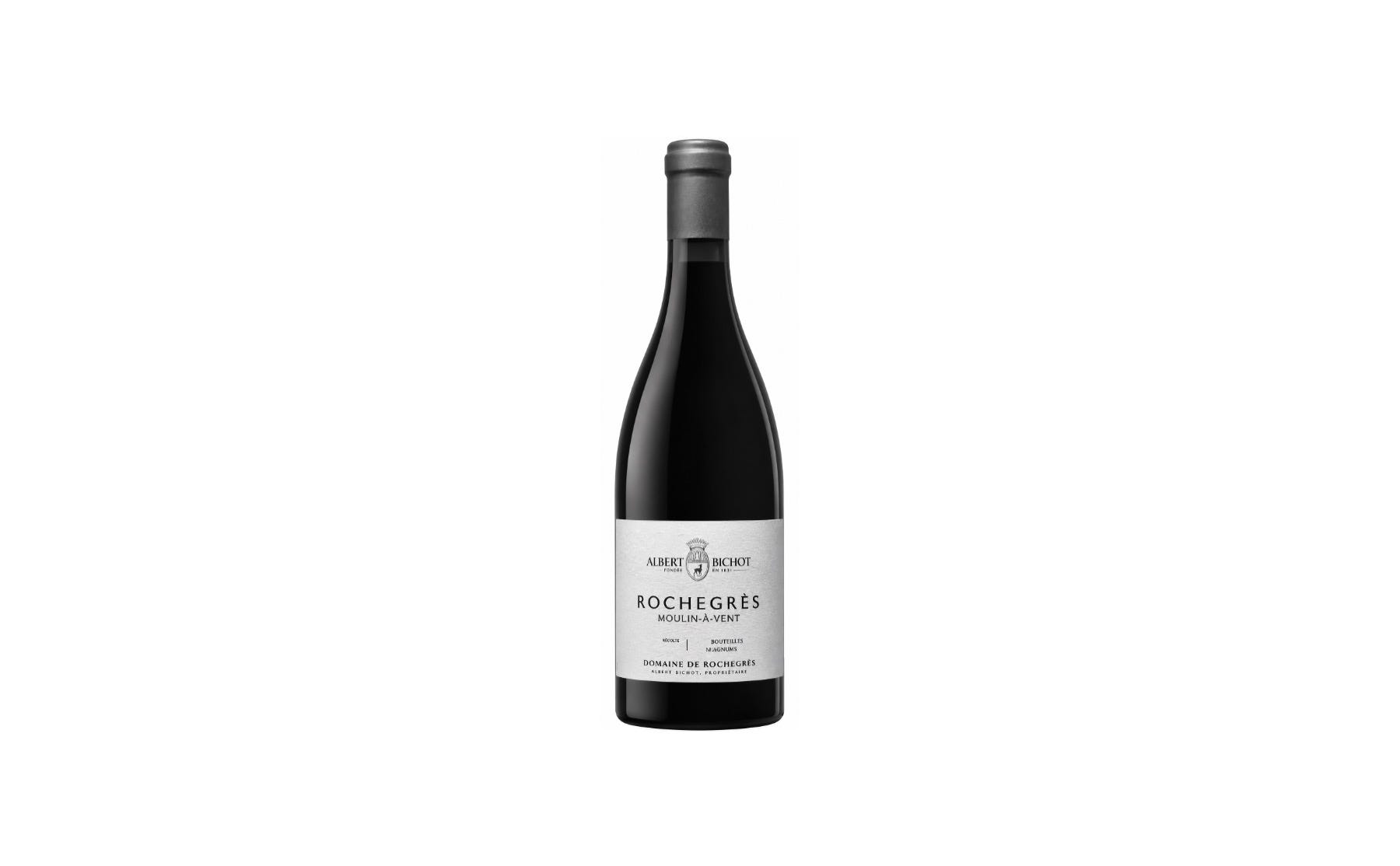
At the northern edge of Beaujolais, Domaine de Rochegrès produces one of Albert Bichot’s most distinctive expressions of Gamay. Drawn from exceptionally old vines rooted in poor pink-granite soils, Rochegrès combines aromatic elegance with the concentration, structure and ageing potential associated with serious Moulin-à-Vent. Its vineyard identity and critical reputation make it particularly attractive to enthusiasts and collectors. Its financial-investment credentials, however, are considerably less established than its qualities in the glass.
A Beaujolais cru with a Burgundian connection
Moulin-à-Vent has long occupied a distinctive position among the ten crus of Beaujolais. Where the region is frequently associated with youthful, fruit-driven wines, Moulin-à-Vent has established a reputation for greater structure, concentration and an ability to develop considerable complexity in bottle.
The appellation lies in northern Beaujolais, principally across the communes of Romanèche-Thorins and Chénas. Historically associated with wines sold as vins des Thorins, it received official appellation recognition in 1936.
Its reputation rests substantially on Gamay’s capacity to produce wines of remarkable depth when cultivated on the appellation’s granitic slopes. The finest examples combine the variety’s characteristic fragrance and acidity with sufficient tannic structure to reward extended cellaring.
Within this landscape, Rochegrès is a particularly distinguished named climat.
The name refers to the rocky character of the vineyard, where granitic bedrock can emerge through the relatively thin covering of soil. Its combination of exposure, poor fertility and old vines makes it an especially compelling source of structured Gamay.
Rochegrès should not, however, be confused with a separate appellation or a legally classified Premier Cru. Nor is it a monopole. Other producers, notably Château des Jacques with its Clos de Rochegrès, cultivate and bottle wines from the broader named site.
Albert Bichot’s Rochegrès is therefore best understood as an estate-grown, single-climat selection from particularly old vines within one of Moulin-à-Vent’s recognised vineyard sectors.
Its individuality comes from the vineyard and the selection of fruit, rather than from any formal classification above AOC Moulin-à-Vent.
Albert Bichot and the evolution of Domaine de Rochegrès
Maison Albert Bichot was established in Burgundy in 1831 and remains an independent, family-controlled wine house based in Beaune.
Known particularly for its Burgundy domaines and its extensive involvement in the region’s fine-wine culture, the house expanded its direct vineyard interests into Beaujolais with the acquisition of Domaine de Rochegrès in 2014.
Contemporary reporting placed the original acquisition at approximately 3.5 hectares. The estate subsequently expanded, and current producer information describes a property of approximately 4.9 hectares within Moulin-à-Vent.
The acquisition added a significant new dimension to Bichot’s estate portfolio.
Unlike a regional Beaujolais bottling assembled from multiple growers, Domaine de Rochegrès offered a clearly identified vineyard property with mature vines, established local viticultural traditions and the potential to express an individual terroir.
An important part of that continuity is the involvement of local growers.
Alain and Marie-Christine Margerand are associated with the estate’s cultivation. The Moulin-à-Vent growers’ organisation identifies Domaine Alain Margerand as farming approximately 4.9 hectares of Domaine de Rochegrès vines under métayage, a traditional sharecropping arrangement.
This distinction matters because the estate’s identity reflects both the ownership and commercial resources of Albert Bichot and a longstanding relationship with local viticulture.
The precise division of present-day winemaking responsibilities is not publicly detailed, but the continuity of vineyard stewardship is an important part of the property’s history.
Within the estate’s portfolio, the distinction between its two principal Moulin-à-Vent wines is particularly revealing.
The broader cuvée, Le Roc, incorporates fruit from younger vines in Rochegrès alongside the La Rochelle and Au Mont sectors. The named Rochegrès bottling, by contrast, is reserved for the estate’s oldest vines within the Rochegrès climat itself.
The result is a more narrowly defined interpretation of the site, with greater emphasis on vine age, concentration and ageing potential.
Rochegrès: Pink granite at the heart of Moulin-à-Vent
The defining geological feature of Rochegrès is its poor, predominantly pink-granite soil.
Across Moulin-à-Vent, granitic parent rock has weathered into sandy, friable material. In Rochegrès, the bedrock can approach or break through the surface, creating particularly lean growing conditions.
Albert Bichot’s vines occupy a predominantly south-eastern exposure, receiving useful morning sunlight and benefiting from the generally open aspect of the slope.
The wider appellation extends across elevations of approximately 250–400 metres, with vineyard orientation, slope and soil depth creating meaningful differences between its named climats.
Rochegrès belongs to the more visibly rocky expressions of this landscape.
Such soils generally drain readily and offer relatively limited reserves of water and nutrients. Their influence becomes especially significant during warm or dry growing seasons, when vine water availability can affect berry development, concentration and ripening.
Bichot associates the vineyard’s low fertility with deeper rooting and greater complexity in the resulting wine. That is a plausible viticultural interpretation, although depth of rooting alone cannot scientifically establish a direct relationship with wine quality.
The sensory character often described as mineral should likewise be understood as a tasting impression, not evidence that granite minerals are literally transferred into the wine’s flavour.
The more convincing relationship lies in the site’s influence on vine vigour, water balance, ripening conditions and the eventual balance between fruit, acidity and tannin.
This combination gives Rochegrès a strong and recognisable terroir identity without reducing its character to geology alone.
Old vines and deliberately limited production
The age of the vines is one of Rochegrès’ most compelling distinguishing features.
Albert Bichot currently describes the vines used for the named cuvée as approximately 80–100 years old.
These are remarkably mature Gamay plantings, with established root systems and decades of adaptation to their immediate growing conditions.
Old vines do not automatically produce superior wine. Their significance depends on vine health, available water, crop balance and the quality of vineyard management.
Nevertheless, mature vines can moderate vegetative growth and contribute to more consistent fruit development, particularly when growing on naturally demanding soils.
For Rochegrès, vine age reinforces an already distinctive vineyard environment.
The producer’s current specifications identify approximately 1.8 hectares devoted to the cuvée. Earlier estate information referred to 2.2 hectares, so the present figure is best treated as the current published specification rather than an unchanged historical measurement.
Average annual production is approximately 12,000 bottles, equivalent to around 1,000 twelve-bottle cases.
This is small by commercial wine-production standards, although it is not the extreme scarcity associated with France’s rarest trophy wines.
Production is fundamentally constrained by the modest vineyard area and the selection of its oldest vines, while annual yields can naturally vary according to vintage conditions.
Harvesting is carried out manually, allowing grapes to be collected with attention to maturity and vineyard condition.
Environmental credentials require some distinction. Albert Bichot follows organic or sustainable approaches across its estate portfolio, but specific organic certification for Domaine de Rochegrès has not been established. The International Wine & Spirit Competition identified the 2020 wine as sustainably produced rather than organic.
Rochegrès should consequently not be marketed as certified organic without further confirmation.
Its clearest viticultural credentials remain the age of the vines, the specificity of the vineyard and the relatively modest scale of production.
Winemaking: Structure without excessive oak
Rochegrès is made from Gamay, with a winemaking approach intended to develop structure while preserving the fruit and aromatic character of its vineyard.
Following manual harvesting, fermentative maceration takes place in temperature-controlled open vats for approximately 16–18 days.
This is a substantial period of skin contact, allowing the extraction of colour, flavour compounds and tannins that contribute to the wine’s depth and architecture.
The technical information does not establish the precise proportions of whole bunches or destemmed fruit, nor does it identify the yeast regime. It would therefore be misleading to assume a particular form of carbonic maceration simply because the wine originates in Beaujolais.
The subsequent maturation is particularly instructive.
For the first eight to nine months, approximately half the wine is aged in 350-litre oak barrels and half in stainless-steel tanks.
Around 20% of the barrel component is new oak, meaning that only a relatively small proportion of the total wine is exposed directly to new barrels.
The entire wine then spends a further three to four months in stainless steel before bottling.
This combination offers several potential advantages.
The barrel component contributes texture, controlled oxygen exposure and subtle spice, while stainless steel provides a more neutral environment in which the fruit and floral character can remain prominent.
The final period in tank also allows the different components to integrate without further significant oak influence.
The resulting style is neither an entirely unoaked, immediate-drinking Gamay nor an overtly barrel-dominated interpretation of Moulin-à-Vent.
Instead, Rochegrès seeks a balance between concentration and freshness, with enough tannic substance for ageing but sufficient aromatic clarity to remain recognisably Beaujolais.
A Gamay of dark fruit, floral perfume and mineral tension
Rochegrès is generally more substantial than the popular stereotype of Beaujolais might suggest.
Its youthful aromatic profile centres on ripe red cherry, black cherry and darker berry fruit, frequently accompanied by floral notes recalling rose.
Depending on vintage and bottle development, the bouquet can acquire impressions of raspberry, plum, liquorice, pepper and subtle wood-derived spice.
The wine’s floral dimension is particularly important.
Even in warmer vintages, where darker fruit and greater concentration can dominate, the presence of delicate perfume helps distinguish Rochegrès from heavier interpretations of Gamay.
On the palate, the wine is typically rounded and generously textured, with an underlying framework of meaningful tannin.
Acidity provides freshness and definition, while the impression of stony or mineral tension can contribute to a more focused finish.
The balance between these elements is central to its personality.
Rochegrès is not simply powerful. Its better expressions combine a fleshy mid-palate with aromatic lift, structural precision and an ability to remain composed as the fruit develops.
Bottle maturation introduces another dimension.
The immediate cherry and berry aromas can gradually move toward dried rose, woodland floor, savoury spice and more complex earthy notes.
The tannins become more integrated, while well-preserved acidity helps sustain freshness.
In favourable vintages, a mature Rochegrès can offer an appealing combination of developed aromatic complexity and the energy that makes Gamay such a distinctive variety.
The wine’s defining achievement is therefore not concentration alone, but the relationship between fruit, structure and finesse.
The vintages that define modern Rochegrès
Albert Bichot’s acquisition in 2014 provides a useful starting point for examining the modern evolution of Rochegrès.
The 2014 vintage is the earliest documented Bichot-era reference. It remains particularly interesting as a historical marker, although the available evidence does not establish whether it was the first commercial Rochegrès bottling ever produced.
The warm, dry conditions of 2015 created a favourable broader vintage context for ripe, concentrated Beaujolais.
The 2016 is one of the more useful early reference points for maturity. Vinous awarded it 92 points, highlighting its dark-fruit, floral and spicy character and giving a drinking window of 2021–2027. Well-stored examples now offer an opportunity to assess how the cuvée develops around a decade after harvest.
The 2018 established a particularly strong critical profile.
Wine Enthusiast awarded 93 points, emphasising the wine’s firm tannins, dark fruit, spice and structural richness. The review recommended beginning to drink the wine in 2022, reflecting the expectation that additional bottle age would improve integration.
The 2019 received another 93 points from Wine Enthusiast.
Its appeal was described in terms of perfume, structure and balance, with sufficient concentration to develop beyond the immediate fruit-driven stage. The recommended drinking period began in 2023.
Together, these vintages demonstrate that Rochegrès is capable of expressing substantial structure without losing the fragrance associated with Gamay.
The 2020 represents one of the strongest recent critical benchmarks.
Awarded 94 points by Wine Enthusiast, it was recognised for ripe tannins, abundant black-cherry fruit, acidity and spice. Its generous structure makes it especially relevant for collectors seeking a richer, ageworthy expression of the vineyard.
The 2022 offers a somewhat different perspective.
Despite the unusually hot and dry growing season across much of France, the broader Bichot vintage assessment emphasised the surprising elegance of the resulting wines.
Wine Spectator awarded Rochegrès 2022 a score of 92 points and suggested drinking through 2032, citing its combination of generous cherry fruit, mineral firmness and composure.
It is a useful modern benchmark for evaluating the relationship between ripeness and balance.
The 2023 illustrates why critical consensus should not be taken for granted.
Tim Atkin awarded the vintage 93 points, while Tamlyn Currin’s assessment for JancisRobinson.com was a more reserved 15.5+/20, reflecting a leaner and more angular interpretation.
Such differences are valuable rather than inconvenient. They underline the influence of vintage conditions and individual critical priorities on the perception of a wine whose structure can be as prominent as its fruit.
Across these vintages, 2018 and 2020 have particularly persuasive credentials for collectors who favour concentration and structure. The 2019 is attractive for its balance, while the 2022 deserves attention for its poise despite the heat of the year.
The 2016, meanwhile, offers a useful opportunity to explore the transition from youthful fruit to mature complexity.
How long can Rochegrès age?
Moulin-à-Vent has a longstanding reputation among Beaujolais crus for its ability to reward cellaring, but individual wines should still be judged according to their own documented performance.
Albert Bichot’s general guidance for Rochegrès is relatively conservative: it may be enjoyed young or kept for three to five years and longer.
Independent assessments suggest that strong vintages can develop successfully beyond that baseline.
The 2016 Vinous window extending to 2027 and Wine Spectator’s recommendation for the 2022 through 2032 both support an ageing horizon approaching or exceeding a decade from harvest.
For carefully stored bottles from successful vintages, approximately eight to twelve years is therefore a reasonable editorial expectation, rather than a rigid drinking rule.
Some bottles may remain compelling for longer, particularly in strong vintages and larger formats.
Nevertheless, the Bichot-era cuvée has only a little more than a decade of documented history. There is insufficient retrospective evidence to present Rochegrès as a consistently proven twenty- or thirty-year wine.
That distinction matters.
The general capacity of Moulin-à-Vent to age does not automatically establish the maximum longevity of every individual bottling.
For collectors interested in maturity, bottles from 2014 and 2016 are particularly relevant today, provided their storage history is sound.
The 2018–2020 sequence offers a useful combination of current drinking potential and further development, while the 2022 is well suited to a longer comparative cellar study.
The principal reward of ageing is expected to be aromatic evolution rather than simply the survival of fruit.
As cherry and berry notes recede, the wine can gain dried-flower, spice and forest-floor complexity, with its tannic framework becoming increasingly integrated.
The best moment to open a bottle will ultimately depend on whether the drinker prefers youthful fruit and energy or the more savoury expression of mature Gamay.
Rochegrès in the fine-wine market
Rochegrès occupies an appealing but unusual position within the market for collectible French wine.
Its credentials are substantial: a clearly identified climat, 80–100-year-old vines, relatively modest production, a respected family-owned producer and repeated critical recognition.
Yet these characteristics have not translated into the kind of secondary-market visibility normally associated with established investment-grade Burgundy or Bordeaux.
The contrast is especially striking when viewed alongside the wine’s primary-market price.
In early November 2026, Albert Bichot’s own boutique listed the 2022 Rochegrès at €28 per 750 ml bottle, including tax but excluding any applicable delivery charges.
For a wine combining old vines, site specificity and repeated 90-plus-point reviews, this represents an attractive entry point.
It also helps explain why Rochegrès is more interesting as a wine to cellar and enjoy than as an object of immediate speculation.
The available auction evidence is limited.
One documented iDealwine sale of a 2014 magnum realised €19 before commission, or €23.90 including commission.
This demonstrates that mature-format bottles can enter the secondary market, but the result does not indicate significant appreciation or establish a representative market price.
It is a single transaction, influenced by the particular vintage, format, bottle condition and circumstances of the sale.
Other observed market offerings included a 2016 standard bottle at €14.50, a 2014 magnum at €25 and a 4.5-litre 2014 jeroboam at €120.
These were asking prices rather than completed transactions and cannot be used as evidence of realised market value.
More importantly, there is no sufficiently transparent public trading history to construct a dependable long-term price index for this specific cuvée.
Rochegrès may be recognised and enjoyed by knowledgeable collectors, but it does not presently possess the readily observable international liquidity of established fine-wine investment benchmarks.
For investors, this is a fundamental limitation.
A wine can be rare, critically respected and excellent to drink without offering a reliable route to financial returns.
At relatively modest bottle values, transaction costs become particularly significant.
Auction commissions, storage, shipping, insurance and taxes can absorb a disproportionate share of any appreciation. Even a substantial percentage increase in the nominal value of a €28 bottle may produce little net financial gain.
Growing recognition of serious cru Beaujolais could support future demand for distinguished vineyard bottlings such as Rochegrès.
However, that possibility should be understood as a market scenario, not an established investment trend.
Its strongest current value proposition remains qualitative rather than speculative.
What collectors should look for
The most persuasive collecting strategy for Rochegrès is to assemble a carefully selected vertical rather than to accumulate bottles solely in anticipation of resale.
The 2014 vintage marks the beginning of the documented Bichot era and provides a natural historical reference.
The 2016 offers an early opportunity to explore maturity, while 2018, 2019 and 2020 provide a particularly useful comparison of recent vintages with strong critical recognition.
The 2022 is attractive for collectors building a cellar around wines with clearly documented future drinking potential.
A vertical spanning these years could reveal how the same vineyard responds to vintage variation and how its structural characteristics develop with age.
There is also a useful distinction between standard bottles and larger formats.
Magnums and jeroboams from the early Bichot era have appeared on the secondary market.
Larger bottles generally mature more slowly than standard formats under comparable conditions, although no controlled Rochegrès-specific comparison establishes how much additional longevity they may provide.
For collectors intending to drink mature bottles, a well-stored magnum could be particularly appealing.
Provenance should nevertheless take precedence over format.
As with any ageing wine, storage temperature, transport history, closure condition and bottle integrity can determine whether its original potential has been preserved.
For older vintages, buyers should examine fill levels, capsules, labels and any evidence of seepage or heat exposure.
A traceable history from a reputable merchant or carefully managed private cellar is more valuable than a nominally rare format with uncertain storage conditions.
Rochegrès does not appear to be a prominent target for sophisticated wine counterfeiting, but that does not eliminate the need for careful authentication when provenance or bottle condition is unclear.
For this wine, the greater practical danger is arguably not paying for a counterfeit prestige bottle, but acquiring a genuine bottle whose condition has deteriorated.
The most rewarding collection will be one assembled with the intention of opening and comparing bottles over time.
Serving and food pairing
Rochegrès benefits from attentive service, particularly when opening bottles that have begun to develop mature aromatic complexity.
Albert Bichot recommends a serving temperature of 15–16°C.
This is warm enough to allow the wine’s floral and fruit aromas to emerge while remaining cool enough to preserve freshness and structural definition.
Excessively warm service can emphasise alcohol and diminish the impression of precision. Serving too cold, meanwhile, may make the tannins appear firmer and suppress aromatic complexity.
Young vintages can benefit from a brief period of aeration, particularly if the wine initially appears closed.
A cautious decant of approximately 30–60 minutes may be useful, although prolonged aeration should not be automatic.
Mature bottles require a gentler approach.
Older examples should ideally be stood upright before opening if sediment is expected. The wine should then be tasted before any decision to decant, with air exposure kept proportionate to its condition and aromatic delicacy.
At the table, Rochegrès has an unusually versatile combination of Gamay freshness and Moulin-à-Vent structure.
Roast Bresse chicken with morels is an especially appealing pairing. The delicacy of the poultry allows the wine’s floral character to remain visible, while the mushrooms complement its developing savoury complexity.
Duck breast with cherries offers another natural match. The fruit echoes the wine’s cherry profile, while the acidity helps balance the richness of the meat.
Veal with mushrooms, roast lamb with herbs and pigeon are also excellent candidates.
As Rochegrès matures, dishes incorporating woodland mushrooms or black truffle become increasingly appropriate, drawing on the wine’s evolving earthy and spicy notes.
Medium-strength cheeses provide a simpler alternative, particularly when the wine retains a generous proportion of youthful fruit.
The guiding principle is to match its concentration without obscuring its fragrance.
Rochegrès has enough substance for serious cuisine, but its distinctive appeal depends on allowing the relationship between fruit, freshness and savoury complexity to remain perceptible.
How Rochegrès compares with other Moulin-à-Vent wines
The most revealing comparison is with another wine from the same estate.
Moulin-à-Vent Le Roc, also produced by Domaine de Rochegrès, incorporates younger vines from Rochegrès together with fruit from La Rochelle and Au Mont.
Its vines average approximately 30–40 years of age, compared with the 80–100-year-old material selected for the named Rochegrès cuvée.
Average production is also greater, at approximately 20,000 bottles annually.
The broadly similar approach to maturation makes this a useful comparison for examining the influence of vineyard selection and vine age.
Le Roc offers a wider interpretation of the estate’s Moulin-à-Vent holdings, while Rochegrès concentrates on a more narrowly defined old-vine source.
Beyond the estate, Château des Jacques Clos de Rochegrès is the most direct terroir comparison.
Both wines originate from the Rochegrès sector, but they represent different parcels and winemaking choices.
Château des Jacques reports a longer maceration period of approximately three to four weeks and around ten months of oak maturation.
Bichot’s shorter fermentative maceration and mixed barrel-and-stainless-steel élevage provide a contrasting approach.
Tasting the two alongside one another offers a particularly instructive opportunity to distinguish characteristics associated with the wider Rochegrès terroir from those shaped by producer selection and cellar practice.
Other serious Moulin-à-Vent producers provide useful context.
Château du Moulin-à-Vent, Domaine Labruyère and Thibault Liger-Belair all demonstrate the appellation’s ability to produce structured, ageworthy Gamay.
Thibault Liger-Belair’s Moulin-à-Vent Les Vieilles Vignes is a particularly relevant old-vine comparison, drawing on multiple parcels with vines approximately 65–105 years old.
It is not a single-climat equivalent of Rochegrès, but it illustrates the broader relationship between old vines, vineyard selection and the ambition to produce fine Gamay capable of development in bottle.
Among these peers, Rochegrès’ distinction rests on its particularly clear combination of named-climat identity, mature vines, measured oak influence and accessible pricing.
It offers a compelling introduction to the more serious side of Moulin-à-Vent without requiring the financial commitment associated with France’s most established collectible red wines.
Gallico Vinum Verdict
Albert Bichot’s Rochegrès is a persuasive demonstration of the quality and individuality that old-vine Gamay can achieve in Moulin-à-Vent.
Its strongest credentials are tangible: a distinctive pink-granite site, vines approaching a century of age, a carefully defined vineyard selection and winemaking that develops structure without overwhelming the wine’s natural fragrance.
The result is a red wine whose combination of cherry fruit, floral elegance, tannic depth and ageing potential places it comfortably beyond the stereotype of simple, youthful Beaujolais.
For French wine enthusiasts, its attraction lies in terroir expression and the opportunity to explore one of the country’s most characterful grape varieties through a distinguished named vineyard.
For collectors, Rochegrès offers a particularly appealing combination of relative scarcity, documented critical quality, approachable pricing and a growing sequence of Bichot-era vintages suitable for comparative cellaring.
Its capacity to develop over approximately a decade in successful vintages makes it a credible addition to a cellar organised around drinking pleasure and the study of mature French wines.
For investors, the proposition is considerably more cautious.
The vineyard’s qualitative credentials are stronger than its observable secondary-market performance. Auction activity is sparse, prices remain relatively modest and trading costs can easily outweigh any nominal appreciation.
There is insufficient evidence to regard Rochegrès as an established, liquid investment-grade wine.
That limitation does not diminish its appeal to collectors who value quality above speculation.
Indeed, it is central to the opportunity.
At a price still accessible to many serious wine enthusiasts, Rochegrès offers an unusually direct encounter with old vines, distinguished Beaujolais terroir and the capacity of Gamay to develop complexity with age.
Gallico Vinum considers Rochegrès most compelling as a wine to buy intelligently, cellar selectively and eventually drink. Its enduring value is more convincingly measured in the evolution of a mature bottle than in the movement of a secondary-market price.