
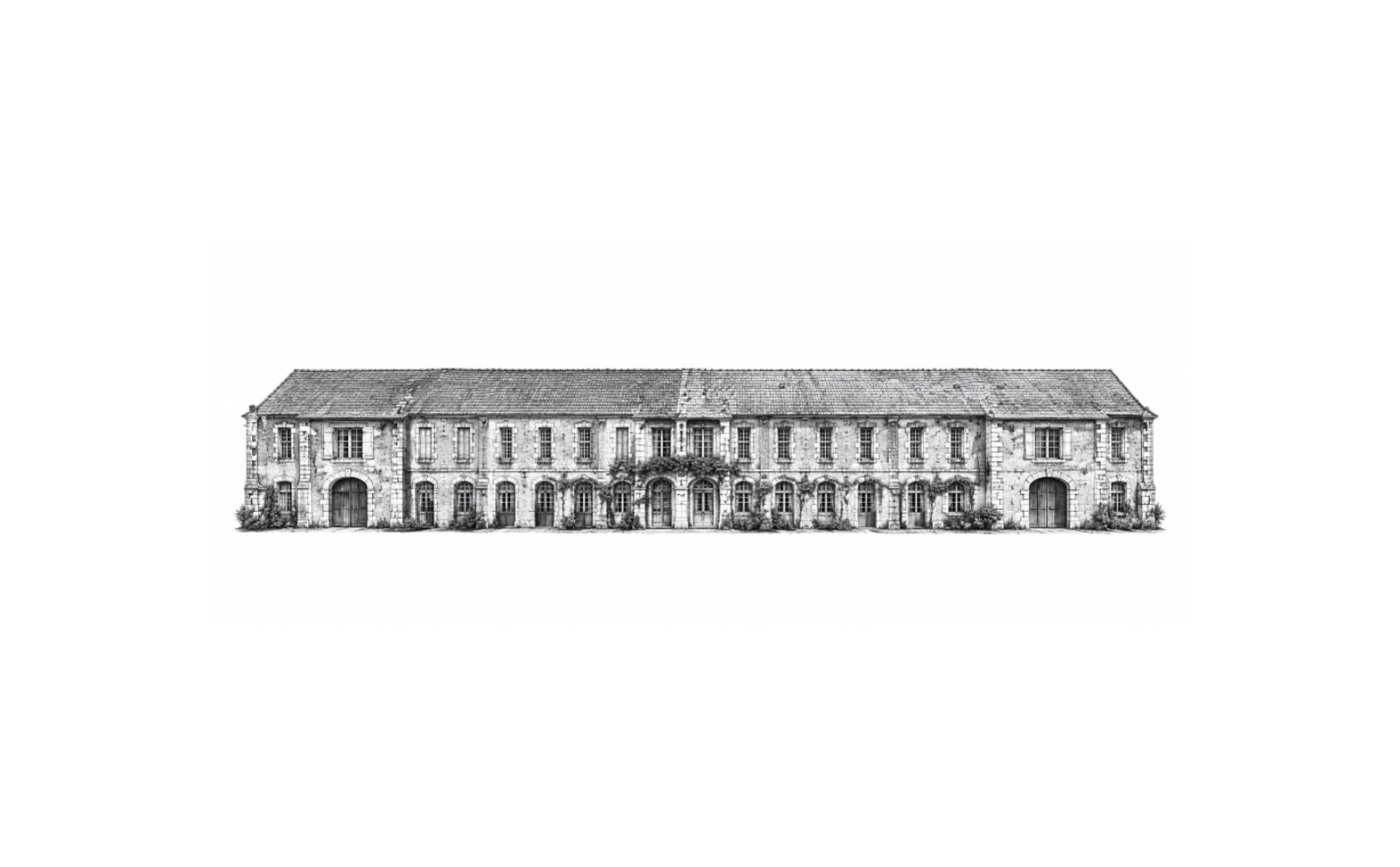
Burgundy often speaks of inheritance through vineyards, cellars and bottles passed from one generation to the next. In September 2026, that idea of transmission took a different form. Winegrowers, collectors and institutions came together to raise nearly €800,000 for the restoration of the Définitoire at the Abbey of Cîteaux, linking the region’s contemporary wine culture with one of the historic places at the heart of its identity.
The second edition of the fundraising initiative was organised by the Château du Clos de Vougeot and the Fondation du patrimoine, in partnership with Christie’s. It combined an international online wine auction with a charity dinner and further auction at Clos de Vougeot on 19 September.
The result comfortably exceeded the €650,000 raised by the previous edition in 2022. Yet the significance of the event went beyond the final figure. Producers from across Burgundy donated bottles directly from their domaines, turning the auction into an unusually broad portrait of the region: grands crus and premiers crus alongside village wines, mature vintages beside recent releases, and individual bottles alongside magnums, jeroboams and carefully assembled verticals.
Why the Abbey of Cîteaux still matters to Burgundy wine
For Burgundy, heritage is rarely separate from wine. Vineyards, architecture, gastronomy and the customs surrounding the table form parts of the same cultural landscape. The Abbey of Cîteaux occupies a particularly resonant place within that story, making its restoration a cause capable of bringing together producers from across the World Heritage-listed Climats of Burgundy.
That breadth of support was one of the most striking aspects of the 2026 campaign. Contributions came from estates spanning the region, from the Maranges to Gevrey-Chambertin. Rather than concentrating solely on trophy bottles from a small circle of famous appellations, the sale drew on Burgundy’s hierarchy at several levels.
This mattered. The auction was not simply a display of scarcity. It showed how Burgundy’s sense of place can be expressed through a wide range of wines, even if the fiercest bidding inevitably gathered around celebrated producers, rare formats and exceptional vineyards.
A Burgundy wine auction built on provenance
The online Christie’s sale ran from 4 to 19 September and comprised 153 lots from 61 Burgundy appellations, including 24 grands crus, 19 premiers crus and 17 village appellations.
Every wine came directly from its producer. For collectors, that provenance added an important dimension to an already unusual catalogue, while some lots also included private tastings, domaine visits or stays.
Demand was substantial. Nearly 300 participants took part, with an average of more than eight bidders competing for each lot. Every lot sold, and 99% finished above its high estimate.
Those figures underline how strongly collectors responded to the combination of direct provenance, unusual formats and charitable purpose. They also offer an intriguing snapshot of the present appetite for Burgundy at auction: not merely for the best-known labels, but for bottles that are difficult to encounter through normal commercial channels.
The Burgundy bottles that drew the strongest bidding
At the upper end of the sale, several results illustrated just how far competition could move beyond pre-sale expectations.
A vertical of three magnums of Pierre-Yves Colin-Morey Montrachet, covering the 2020, 2022 and 2023 vintages, sold for €47,500. A 2005 jeroboam of Jacques-Frédéric Mugnier Musigny reached €43,750, against a pre-sale estimate of €11,000 to €16,000.
Another striking result came from the Hospices de Beaune. Three magnums of Mazis-Chambertin Cuvée Madeleine Collignon, from 2014, 2015 and 2016, sold together for €17,500, with a domaine visit included.
The sale also demonstrated that intense bidding was not confined to grand cru Burgundy. A magnum of Bernard-Bonin Meursault La Rencontre 2022, originally estimated at €450 to €600, reached €4,375. A bottle of Benjamin Leroux Meursault La Pièce Sous le Bois 2022 achieved the same price from an estimate of €190 to €240.
Meanwhile, a magnum of Thibault Liger-Belair Vosne-Romanée Les Petits Monts 2015 sold for €5,250, while a jeroboam of Vignoble des Cabottes Chevalier-Montrachet Grand Cru 2023, accompanied by a private tasting for six, realised €6,875.
Taken individually, such prices reflect the peculiar dynamics of a charity auction and should not be read as straightforward market valuations. Collectors were bidding not only for wine but also for rarity, direct provenance, distinctive experiences and the knowledge that the proceeds supported the restoration project.
Clos de Vougeot brings the Abbey of Cîteaux appeal to the table
The online sale formed only one part of the campaign. On 19 September, around 320 guests gathered in the Cistercian cellar of the Château du Clos de Vougeot for a charity dinner attended by figures from Burgundy’s wine community and international collectors.
The setting gave the evening particular resonance. Clos de Vougeot is deeply associated with the cultural life of Burgundy wine, and the dinner brought together the themes running through the wider campaign: wine, gastronomy, architecture and the preservation of heritage.
Chef Alexandra Bouvret prepared the menu, which included Burgundy’s emblematic œuf en meurette. A further live auction added ten wine lots to the fundraising effort. Among them was a magnum of Domaine de la Romanée-Conti La Tâche Grand Cru 2015.
The auction was conducted by Christie’s Adrien Meyer, who travelled from New York for the occasion. The evening was held under the patronage of Dom Pierre-André Burton, Abbot of Cîteaux, with Aubert de Villaine and Guillaume Poitrinal among those presiding over the event.
The Abbey of Cîteaux and Burgundy’s culture of transmission
There is an obvious temptation to view a charity wine auction through its headline bottles and spectacular hammer prices. In this case, however, the larger story lies in the breadth of the response.
Almost €800,000 was raised because Burgundy’s producers supplied wines that collectors genuinely wanted to pursue, while bidders from around the world were prepared to attach additional value to the purpose behind the bottles. Participants came from 33 countries, including France, the United States, the United Kingdom and China.
For the Abbey of Cîteaux, the practical result is funding for the restoration of the Définitoire. For Burgundy, the event offered something less tangible but equally characteristic: an expression of the region’s belief that wine belongs to a cultural inheritance larger than the contents of any single cellar.
The finest bottles in Burgundy are often discussed in terms of rarity. This initiative suggested another way of looking at rarity: not simply as something to possess, but as something capable of helping preserve the places and traditions from which Burgundy’s wine culture has grown.